Extension leads, power strips and cable reels
Extension leads, power strips and cable reels extend reach or provide more connection points. They do not increase the power available from the circuit. The loading limits of the complete arrangement and its location remain decisive.
This guide covers selection and use. The existing power-strip assembly photographs stay in the plugs and connectors guide, avoiding duplicate assembly instructions.
Different forms, common questions
An extension lead reaches a distant load. A power strip divides one connection into several outlets. A cable reel stores cable compactly but adds important thermal considerations.
The cable, contacts, strain relief and enclosure form an assembly. Cable cross-section alone does not establish the capacity of the whole strip. Switches, contacts, surroundings and manufacturer limits also matter.
A switch on a strip does not automatically provide safe isolation for work on connected equipment. Switching arrangements vary. Follow the appliance's required isolation procedure before maintenance or cleaning.
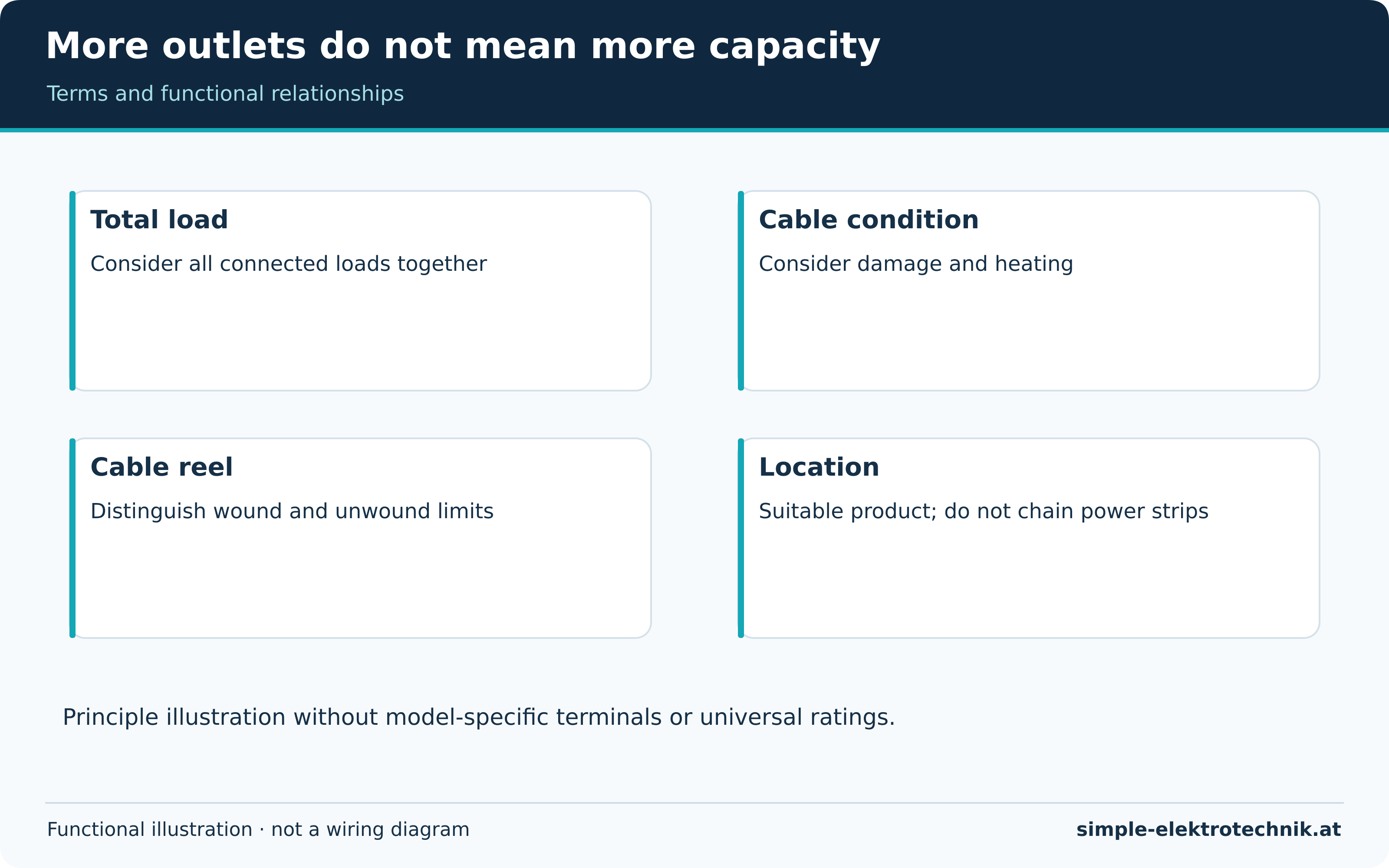
Total loading matters
The stated load limit applies to the complete strip or defined assembly, not separately to each outlet. Several heating appliances can quickly use that capacity. Some lower-power electronic loads also impose particular inrush demands.
For an explicitly assumed single-phase example of 230 V, 10 A and a resistive load, P = U × I gives 2300 W. This is an arithmetic example, not a universal power-strip rating. Actual markings, supply and use conditions decide. Other load types need more than this simplified calculation.
Upstream protection does not automatically make every thinner extension suitable in every situation. Assess the complete arrangement. A damaged or hot connection is not safe merely because the breaker has not tripped.
Cable reels and heat
Current produces heat in the conductors. A wound cable dissipates that heat less effectively. Manufacturers may therefore specify different limits for fully wound and fully unwound operation.
Unwind the cable fully for higher loads as instructed. Thermal cut-out operation is a protective response, not a normal operating strategy. Investigate the cause and reset only as directed after the appropriate conditions are restored.
Calling the problem solely a coil effect is misleading. Conductor losses and restricted heat dissipation are central. Even completely unwound, the reel remains subject to its stated total limits.
Location and routing
| Situation | Consideration |
|---|---|
| Outdoors | Use cable, connectors and enclosures specified for the conditions. |
| Moisture or dirt | Protect contact points and meet the actual IP conditions. |
| Long runs | Assess voltage drop and protective conditions. |
| Mechanical loading | Avoid crushing, sharp edges, vehicle damage and tension. |
| Repeated long-term demand | Plan suitable fixed outlets rather than chains of temporary products. |
Do not connect power strips in series; follow the product warnings. Chaining makes total loading harder to assess and adds contact points. Do not cover products with materials that impair necessary heat dissipation.
Surge protection and USB outlets do not raise the permitted loading of the mains outlets. A portable residual-current device has a defined protective function and does not replace suitable wiring or required installation verification.
Checks before use
Look for cuts, crushing, discolouration and loose parts. Remove damaged products from use. Disconnect by holding the plug rather than pulling the cable. Unusual heat, smell or noise calls for stopping use and investigation.
Route unwound cable to avoid trip hazards. Permanent routing, penetrations and special work areas need appropriate solutions. A domestic indoor strip is not automatically suitable for a construction site or commercial environment.
Common questions
Can each outlet deliver the full marked power?
No. The total rating and any separate outlet limits apply together.
Is a thick cable automatically suitable outdoors?
No. Cross-section, insulation and sheath material, temperature range and connector design are separate properties.
Will the breaker always prevent hot contacts?
No. A poor contact can overheat at a current below the protective device's operating level.
Sources and documentation
More equipment guides: Equipment overview