Surge protective devices: types and coordination
A surge protective device, or SPD, limits transient overvoltages and diverts surge current through intended paths. It complements the installation's protective design. It does not replace overcurrent protection, residual-current protection or a required external lightning protection system.
Coordination matters. One protected socket adapter is not automatically a complete solution for a building and all connected data circuits.
Where do surges come from?
Lightning can affect a building through incoming services, electromagnetic coupling and potential differences. Switching operations can also produce transient overvoltages. A transient is a brief event, distinct from a sustained incorrect supply voltage.
Depending on its design, an SPD responds to such events to limit voltage differences at the protected connections. Its connections, the earthing and bonding arrangement and coordination with other devices are part of the resulting protection.
This is different from RCD operation. An SPD does not simply compare operating currents and trip on an imbalance. An uninterruptible power supply also serves a different primary purpose: depending on its design, it maintains supply during interruptions.
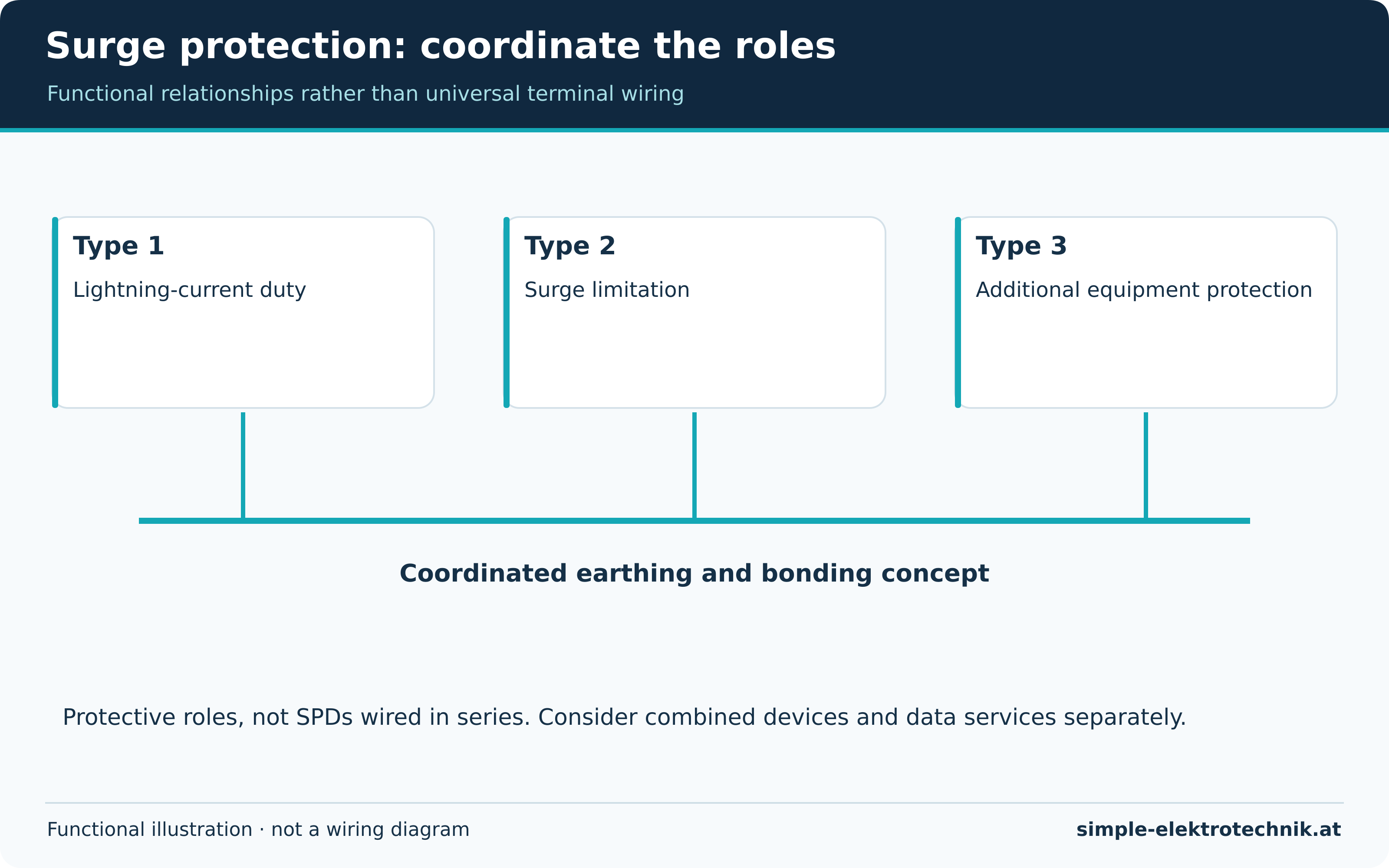
Types 1, 2 and 3
| Type | Role within a coordinated design |
|---|---|
| Type 1 | Devices designed for lightning-current duty at the planned interface. |
| Type 2 | Limiting surge overvoltages within the electrical distribution system. |
| Type 3 | Coordinated supplementary protection close to sensitive equipment. |
Combined devices can cover more than one test class. This does not mean every building needs three separate boxes in an identical sequence. The solution depends on the installation, lightning protection concept, supply and manufacturer coordination.
The illustration therefore shows protective roles and locations, not universal wiring. A Type 3 adapter cannot generally replace missing upstream protection. Signal and data circuits need protection appropriate to their interfaces where required.
Selection and connection conditions
Relevant information includes maximum continuous operating voltage, specified voltage protection level and surge-current capability. Selection must suit the earthing system and location. A device intended for a particular DC application is not an arbitrary substitute in an AC installation.
Connection lengths and routing affect the achieved protection. Installation must follow the manufacturer's arrangements; spare space on a rail is not a sufficient location criterion. Backup protection, short-circuit capability and conductor requirements also form part of the design.
Other connected services matter too. Protecting a power input may be insufficient if another connected cable introduces an unaddressed surge path. Equipment connected to both power and data networks needs a coordinated assessment.
Status indications and replacement
Many SPDs have a status indicator, and some provide remote signalling. Read the meaning for the actual product. A healthy indication does not certify that the entire building is protected against every lightning event.
Events or abnormal indications may require inspection and replacement according to instructions. Not every surge consumes an SPD, but an indicated failed module must not be treated as effective protection.
Replacement cartridges must match the base and device version. Work inside a distribution board requires suitable competence. An apparently similar module is not a substitute for identifying the correct equipment.
Common questions
Does a surge-protected power strip protect against every lightning strike?
No. Its role is limited by its design and the upstream installation. Complete lightning and surge protection needs a coordinated concept.
Does an SPD correct a permanently wrong supply voltage?
Its primary function concerns transients. A sustained abnormal voltage, for example following a neutral fault, is a different condition requiring separate assessment.
Must everything be replaced after every thunderstorm?
Not automatically. Follow indications, manufacturer instructions and the required checks. Neither blanket replacement nor unconditional reassurance is justified without assessment.
Sources and documentation
More equipment guides: Equipment overview