Measure energy use and reduce avoidable consumption
A device does not save energy merely by appearing in an app. Smart-home technology can reveal consumption and reduce unnecessary operating time. Assess the benefit using actual use, energy and total cost.
Separate three goals: needing less energy, paying less and importing less electricity. They may overlap, but shifting a washing programme to another time does not automatically reduce its kilowatt-hours.
Watts and kilowatt-hours
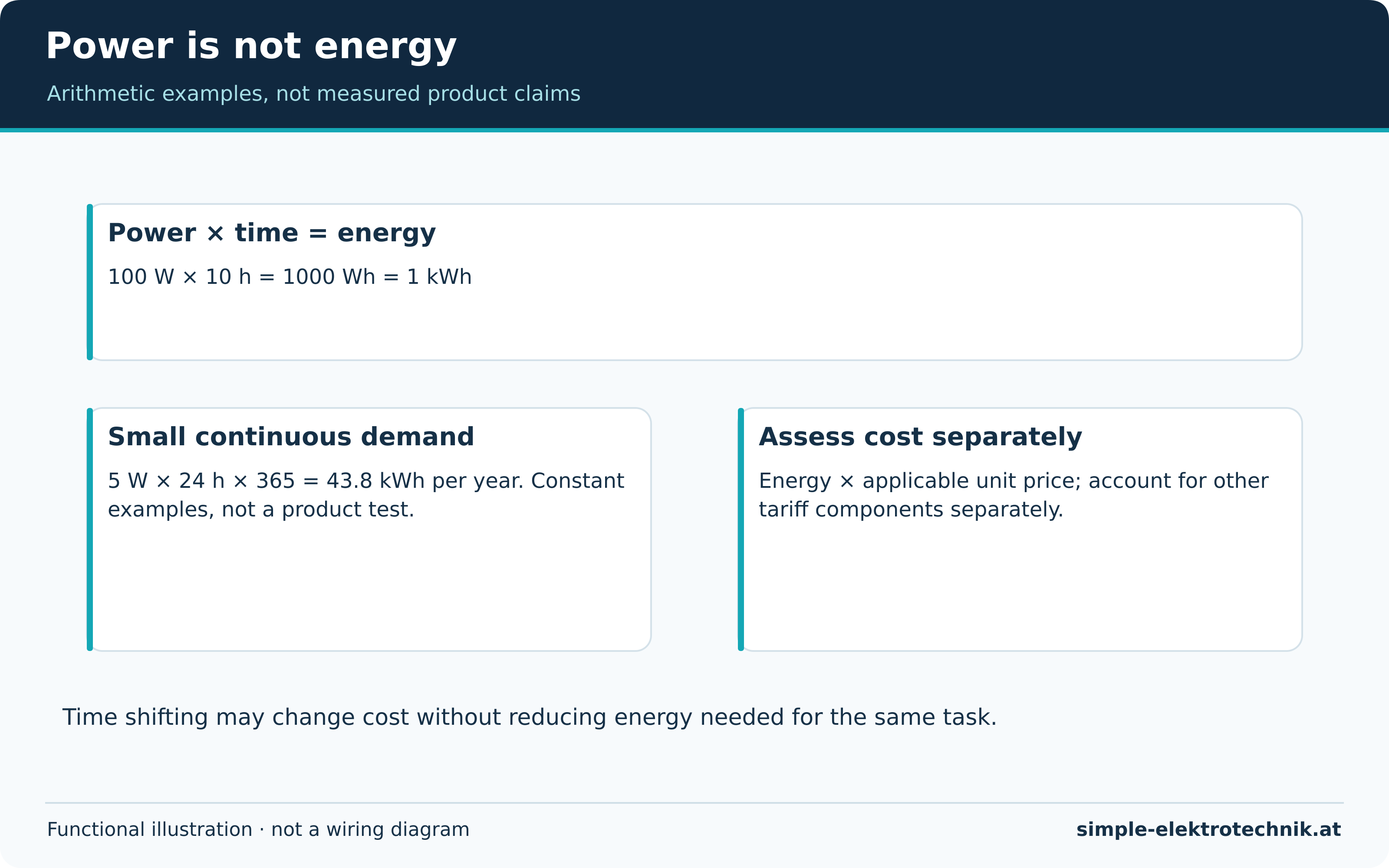
Watts, W, describe instantaneous power. Kilowatt-hours, kWh, describe energy over time. A constant 100 W for 10 hours uses 1 kWh, as the calculation diagram illustrates. Real appliances often vary their power, so the complete time profile matters.
A brief high-power event is not necessarily the largest annual consumer. Small continuous demand accumulates. An additional constant 5 W over 365 days corresponds to 43.8 kWh. This is arithmetic, not a measured claim about a particular controller.
Energy cost depends on the actual time-dependent unit prices. Standing charges and other tariff elements may also apply. A consumption display is not automatically a complete electricity bill.
What does each instrument measure?
A suitably rated plug-in monitor covers the connected load. A household meter has a different boundary. Fixed-circuit and distribution monitoring need suitable professional installation; this guide is not an instruction for work inside a distribution board.
| Reading | Meaning | Common confusion |
|---|---|---|
| Instantaneous W | Power at the measurement point now | Treating it as a whole day's energy |
| Energy register in kWh | Accumulated energy within its boundary | Confusing the register with usage during a selected period |
| Grid import | Energy obtained from the network | Treating it as all household consumption despite PV |
| PV generation | Output of the measured generation system | Adding it again as another consumption value |
A switching actuator does not necessarily measure energy. Inferring use from an on-state and an assumed wattage is an estimate; label it accordingly.
Build a meaningful overview
Start with available meter data and a few targeted measurements. Define time periods and boundaries. Do not count the same energy twice when combining a total meter with downstream devices.
Check units, signs and import/export definitions. Resetting a device register may create a discontinuity. Missing data must not silently become zero consumption. Timestamps and sampling need to suit the analysis.
Compare a known period with the relevant meter. Small loads may expose resolution and rounding limits. An app does not make a monitor suitable for regulated billing.
Reduce avoidable use
Limit unnecessary lighting while preserving suitable occupancy handling and manual control. For heating, consider the building and control strategy; aggressive setback is not universally beneficial. Efficient lamps and well-adjusted existing equipment can help without networking.
Do not disable refrigeration, frost protection or other necessary functions to improve a dashboard. Repeatedly removing power can produce unintended appliance states. Follow intended operating modes.
Compare similar periods. Weather, occupancy, equipment changes and habits affect results. One favourable week does not prove an automation's saving. A sound baseline is better than an unsupported percentage claim.
PV, storage and flexible loads
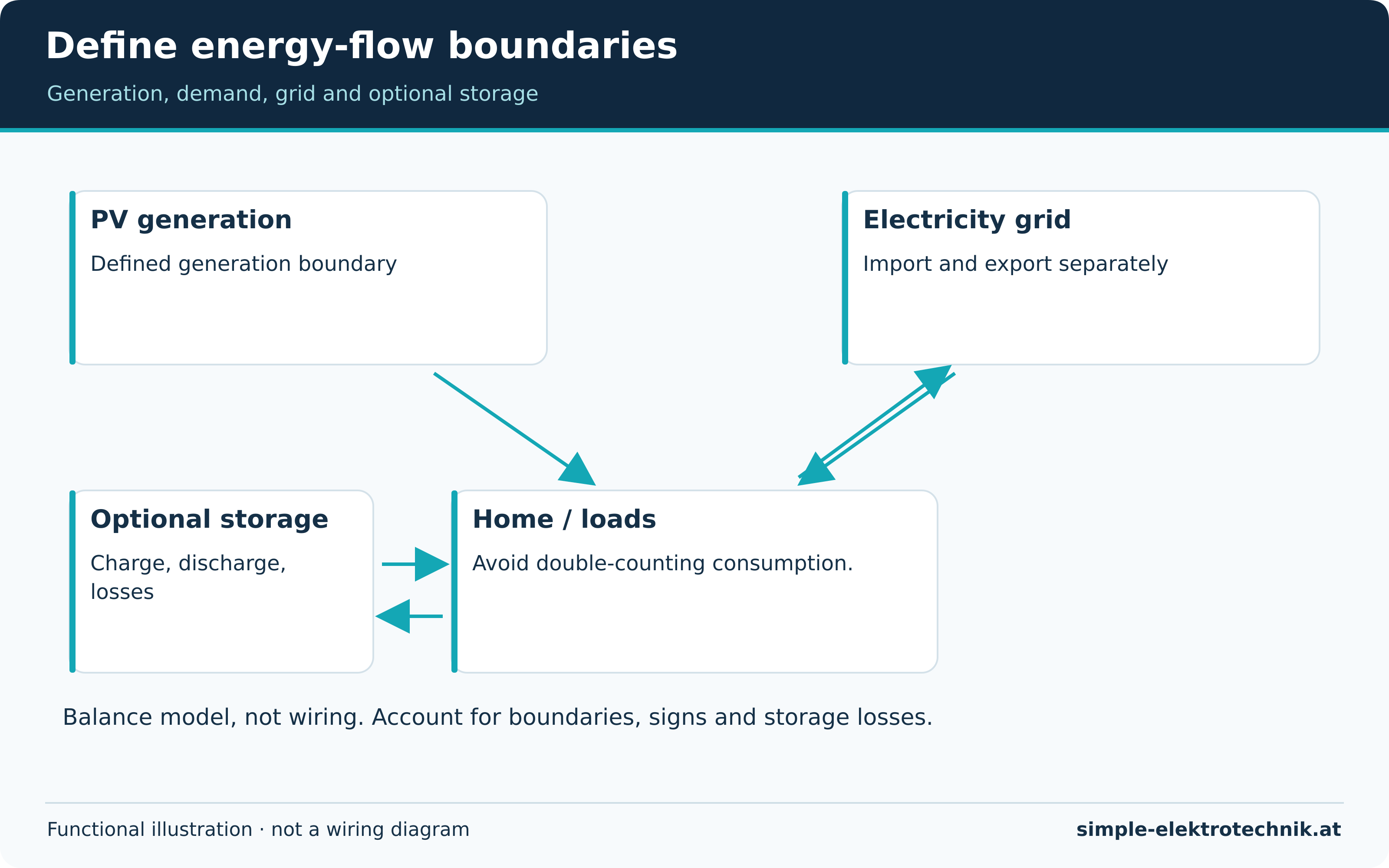
The energy-flow diagram is a balance model of generation, household use, grid and optional storage. It is not a wiring or current-transformer installation plan. Inverters, meters, storage and interfaces must be appropriate.
A flexible load can favour periods of available generation. The rule needs meaningful surplus information, permitted start conditions and a response to clouds or missing data. Rapid switching around small fluctuations is not automatically useful.
An appliance must support the intended start or restart. Turning on a smart plug does not start every washing machine. Follow requirements for operation and supervision. Batteries and vehicles need suitable controllers and interfaces rather than arbitrary socket routines.
More self-consumption does not necessarily mean lower total consumption. Storage also introduces losses. Export payment, tariffs and operation depend on country, network and contract. A general diagram promises no particular payment.
Total cost and service life
Include controllers, networking standby, batteries, subscriptions and replacement. Keeping functioning equipment may be more economical and resource-efficient than replacement merely to add an app.
Compare current energy information for the relevant product category. Old and rescaled label classes are not universally equivalent. Size, use and absolute consumption matter.
A practical improvement sequence
- Record baseline demand and use.
- Identify an avoidable component.
- Make one suitable change.
- Observe comfort and safe operation.
- Compare under similar conditions.
- Include additional system costs and measurement uncertainty.
See automation design for robust rules and reliable operation for protecting and recovering data.
Common questions
Does a cheaper tariff period save energy?
Not merely because of its time. Cost may change while energy for the same task remains unchanged.
Is grid import my complete consumption?
Not necessarily with PV or storage. The measurement boundary determines the meaning.
Should every socket be monitored?
Only where the data answers a useful question. Monitoring adds its own cost and consumption. Start with significant, actionable uses.
Sources and further information
Tools for electricians
A compact selection for cutting, stripping, screwdriving and testing. Choose the actual version for the task and follow its instructions.
Advertising / affiliate links. As an Amazon Associate I earn from qualifying purchases. Product images and names lead to the existing Amazon listings.
Weidmüller KT 8 cable cutter
- For suitable copper and aluminium conductors.
- The cutting geometry is designed for a clean cut.
Check conductor material and permitted capacity. A cable cutter is not a general-purpose bolt or steel-wire cutter.
Weidmüller stripax insulation stripper
- Automatic stripping tool for approved conductors and insulation types.
- Includes an adjustable length stop and a separate cutting function.
Stripping range and cutting capacity are different. A stripping range up to 10 mm² does not mean it can cut conductors of the same size.
Fluke LVD2 non-contact voltage detector
- Indicates AC voltage within its intended application.
- Includes two sensitivity levels and an integrated light.
No indication does not prove dead. Shielding, distance and installation affect detection; it does not replace the appropriate two-pole procedure.
PB Swiss Tools PB 5543 VDE screwdrivers
- Set for matching slotted and Pozidriv screws.
- Match the screw profile, size and marked tool version.
Tested insulation does not generally authorise live work. Tool condition and the working procedure remain essential.
Fluke T130/VDE two-pole voltage tester
- For voltage and continuity checks according to its instructions.
- This model family combines LED indication with an additional LCD.
Use the correct proving-dead procedure and required instrument checks. An isolated LCD reading does not replace them.