Selecting electrical equipment: ratings and markings
Electrical equipment suits a task when its function, ratings and operating conditions match the installation. A plug that fits or a similar-looking enclosure is not enough. The rating plate, markings and manufacturer's documentation provide a reliable starting point.
This applies to replacing a luminaire as well as selecting a connector or protective device. This guide explains how to interpret the information. The individual equipment guides then cover the relevant device in more detail.
What is electrical equipment?
Electrical equipment can generate, transmit, distribute, store or use electrical energy, or perform another function within an installation. This category focuses on equipment commonly found in buildings: protective devices, socket outlets, connectors, luminaires and connection components.
A luminaire provides light; a miniature circuit-breaker protects a circuit against overcurrent. Both need suitable conditions and correct integration, but their purposes are different. Checking the supply voltage alone cannot establish suitability.
Reading the rating plate
| Marking | What to establish |
|---|---|
| Model and article number | Identify the exact version and its documentation. |
| Rated voltage and AC/DC | Match the intended supply and operating mode. |
| Current or power | Identify different loading limits; do not treat them as interchangeable. |
| Frequency | Check where specified as an operating requirement. |
| Protection class | Identify the protective construction against electric shock. |
| IP code | Identify specified protection against access, solid objects and water. |
| Temperature and mounting conditions | Check permitted use and heat dissipation. |
The plate may not contain every detail. The connection drawing, data sheet and installation instructions work together. Check model suffixes: a related version may have different terminals, voltage or dimming features.
Current, power and protection have different roles
The current rating of a connector does not automatically establish the capacity of its cable. The cable, terminals, protective device and environment must be assessed together. Fitting a circuit-breaker with a higher current rating does not increase the capacity of an existing cable.
Input power also does not describe every switching demand. LED drivers and other electronic loads may produce significant inrush currents. Select contacts using the manufacturer's ratings for the actual load type rather than relying only on steady-state watts.
An RCD may show both a rated current and a rated residual operating current. The first concerns current carrying; the second concerns residual-current sensitivity. A larger ampere rating does not mean better protection against electric shock.
Protection class, IP and CE
Protection class and IP rating describe different things. An enclosure protected against water can still require a protective conductor. Double-insulated equipment is not automatically suitable for rain.
The CE marking communicates the manufacturer's declaration of conformity with applicable European requirements. It does not establish suitability for a particular location or replace installation instructions. Additional certification marks also need to be interpreted for the actual product and their specific scope.
A useful selection sequence
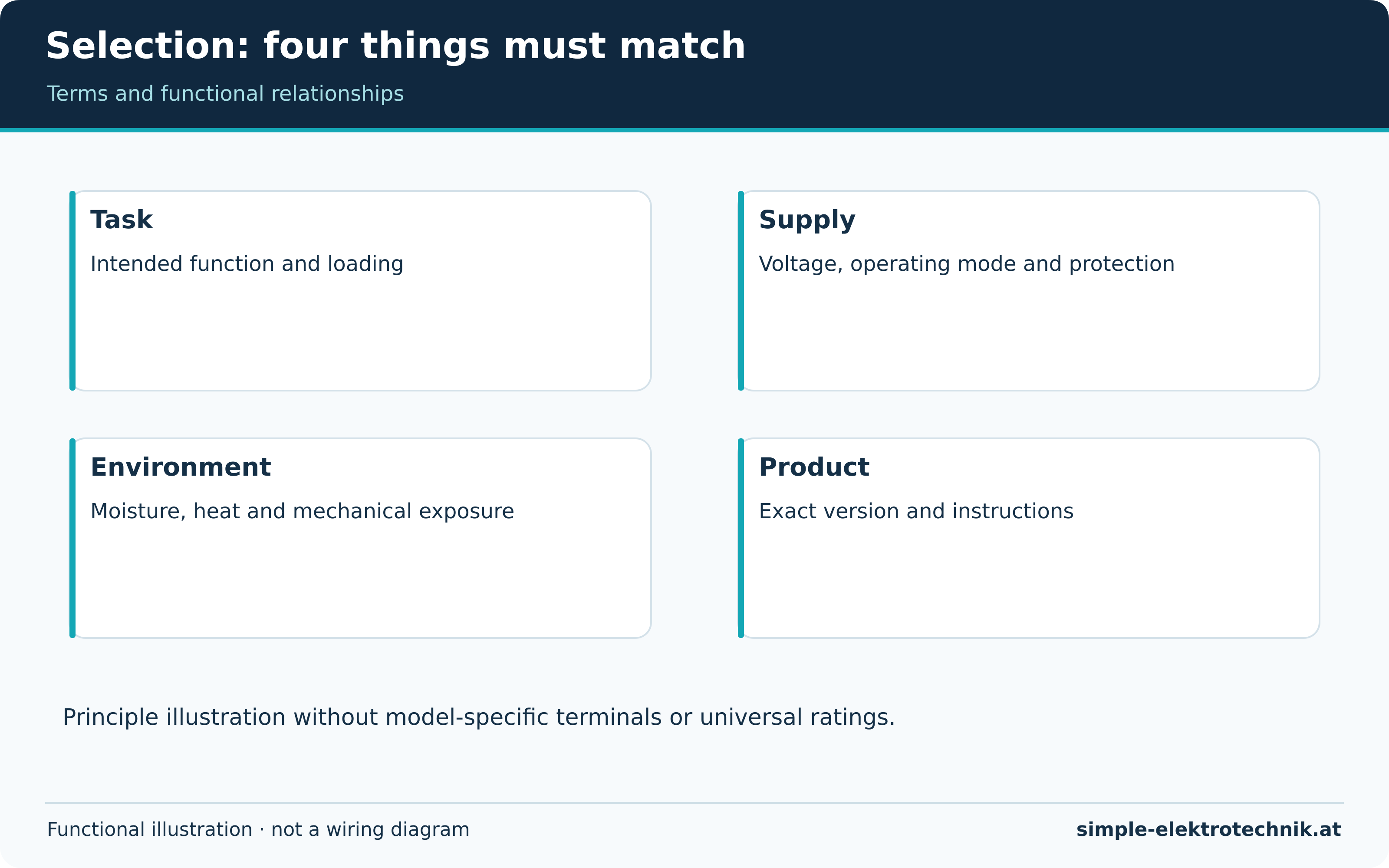
1. Define the task and environment: indoors or outdoors, fixed or portable, moisture and expected mechanical loading. 2. Have the existing supply and protective measures established by a competent person. 3. Compare the exact version, accessories, terminals and mounting conditions. 4. Plan installation and required verification, and retain the documentation.
Work on fixed installations requires the relevant competence and authorisation. The five safety rules describe establishing a safe working condition; this selection guide does not replace that process.
Common questions
Can I replace equipment with something of the same wattage?
Not on that basis alone. Supply, connection method, protection class, dimensions, temperature conditions and any control interface must also match. Lighting may additionally require a compatible lamp or driver.
Is a photograph enough to order a replacement?
A photograph can help identify equipment but may omit the complete model number and connection requirements. Read the rating plate and documentation. A photograph does not prove the functions of unidentified conductors.
Which national requirements apply?
These guides explain principles with an Austrian website context. Selection, installation and verification requirements must be checked for the actual location. Do not assume Austrian, German and Swiss requirements are identical.
Sources and documentation
More equipment guides: Equipment overview