Connecting terminals and conductor terminations
A connecting terminal makes an electrical connection between conductors. It must match conductor material, construction, cross-section and application. Size or a familiar enclosure colour is not enough for selection.
This guide covers the terminal as a component and preparation of conductor ends. The existing junction-box guide shows a complete assembly example using the site's own photographs.
Conductor construction
Solid conductors use one wire. Stranded and fine-stranded conductors use multiple wires of differing construction. They can behave differently in a terminal.
A push-wire connector approved only for solid conductors does not automatically accept fine-stranded conductors fitted with ferrules. Conversely, a suitable lever connector may accept several conductor constructions. Approval applies to the actual article, not every product from the same brand.
Material matters too. A copper terminal is not a general aluminium connection. Special materials and mixed connections need expressly suitable products and any additional preparation specified by the manufacturer.
Connection principles and internal links
Screw terminals use a defined clamping mechanism and tightening requirements. Spring and lever terminals use their intended actuation and contact force. Screwless does not mean preparation and inspection are unnecessary.
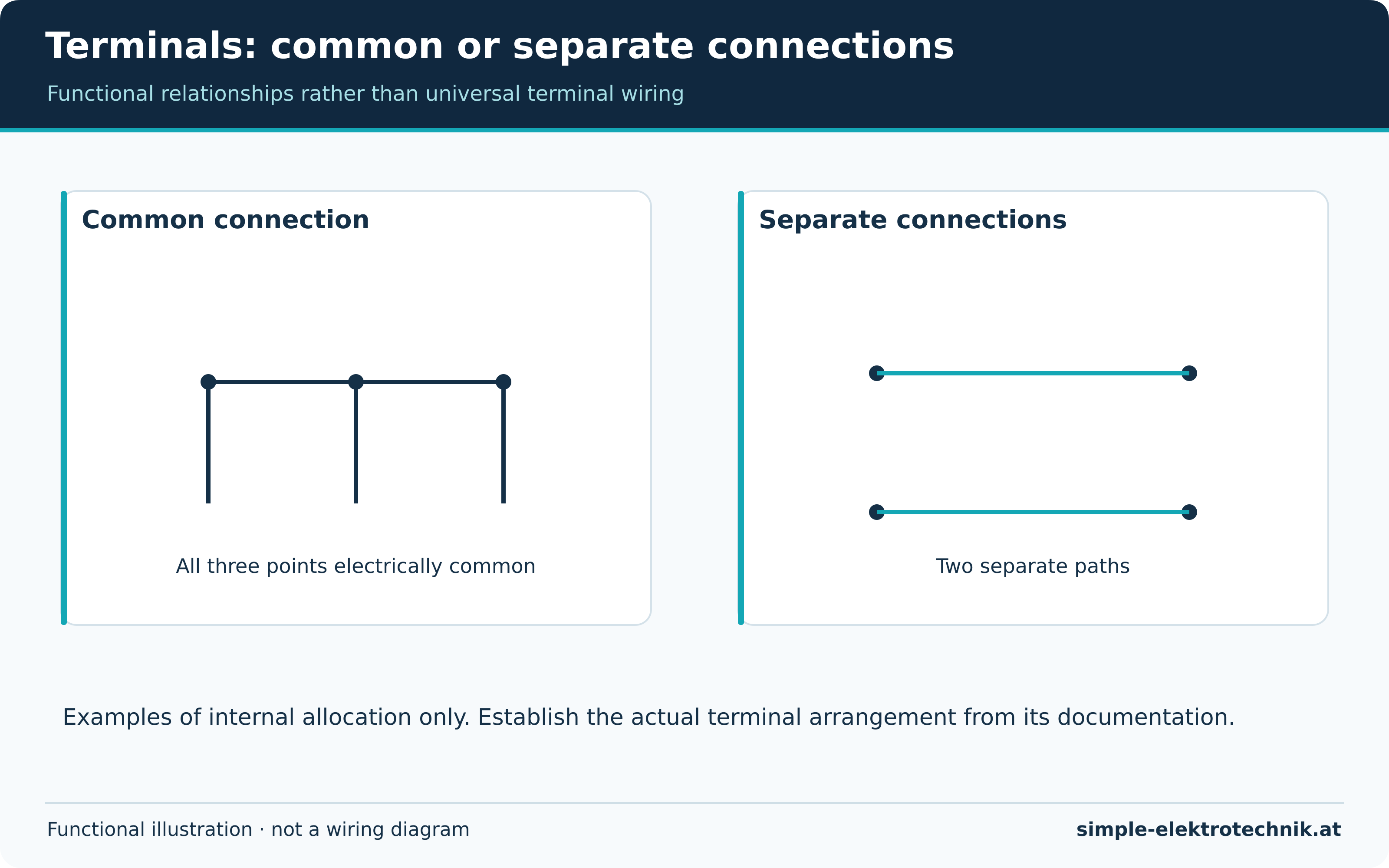
Several openings may share one electrical connection. Other products have separate levels or isolated connections. Establish the internal arrangement from markings and documentation.
The illustration deliberately distinguishes a common connection from separate connections. It is not a universal internal drawing. Line, neutral and PE must not be combined merely because the openings look alike.
Preparation
| Item | Purpose |
|---|---|
| Article number | Identifies the actual connection requirements. |
| Construction and size | Must fall within the approved range. |
| Stripping length | Must suit the terminal; no universal dimension. |
| Conductor end | Avoid impermissible nicks, lost strands and damage. |
| Insertion and actuation | Follow the intended sequence and full insertion requirements. |
| Enclosure | Provide the intended connection space and mechanical protection. |
Insufficient stripping can leave insulation at the contact point. Excessive stripping can leave exposed bare metal outside the terminal. Use the specified gauge or dimension and inspect the result.
Fine strands must not escape the intended clamping area. Use ferrules only in suitable approved combinations. Two conductors in one opening require explicit suitability of the terminal and preparation.
Inspection and environment
Check insertion, the selected opening and full operation of the mechanism. An appropriate retention check can help but does not prove every electrical contact condition. A transparent enclosure helps only where the relevant area is visible.
A terminal is not automatically strain relief or an acceptable unenclosed joint. Protection against contact and the environment comes from the complete intended system. Consider heating, grouping, loading and available enclosure space.
Clear allocation helps later fault finding. A position on the left or right of a box is not an electrical connection rule. Functions must remain identifiable even when physical routing changes.
Common faults and questions
Incorrect conductor type, stripping, incomplete closure or damaged strands can impair a joint. It may overheat without an immediate MCB trip. Repeatedly pushing it without finding the cause is not a reliable repair.
Work on existing joints requires a safe working condition. Complete the verification appropriate to the alteration. A tidy box alone does not establish electrical safety.
Is stripping length the same for every push-wire connector?
No. Even related versions can differ. Follow the actual article marking and data sheet.
Does a ferrule make every flexible conductor acceptable?
No. The conductor, ferrule and terminal combination must be approved.
Can terminals be reused?
Only as intended and in suitable condition. Do not reuse damaged terminals or those of uncertain condition without assessment.
Sources and documentation
More equipment guides: Equipment overview