Time switches and astronomical scheduling explained
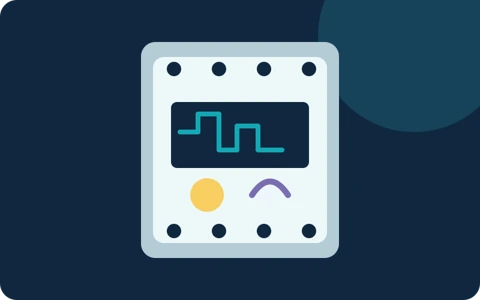
A time switch operates by clock time and a defined programme. It can enable suitable lighting on selected days. An astronomical function additionally calculates sunrise and sunset from the date and location.
That differs from a countdown device that runs for a duration after operation. The time-device overview explains the distinction. This guide covers schedules, astronomical control and understandable settings.
Construction and operation

Construction and operation
The main tasks are maintaining time, evaluating a mechanical or stored programme and operating a suitable output. Analogue devices may use segments; digital devices use programme entries. Neither description guarantees every extra function.
A channel is an intended independently controlled output function. A changeover contact is not automatically two independent schedule channels. Check output type and loading separately.
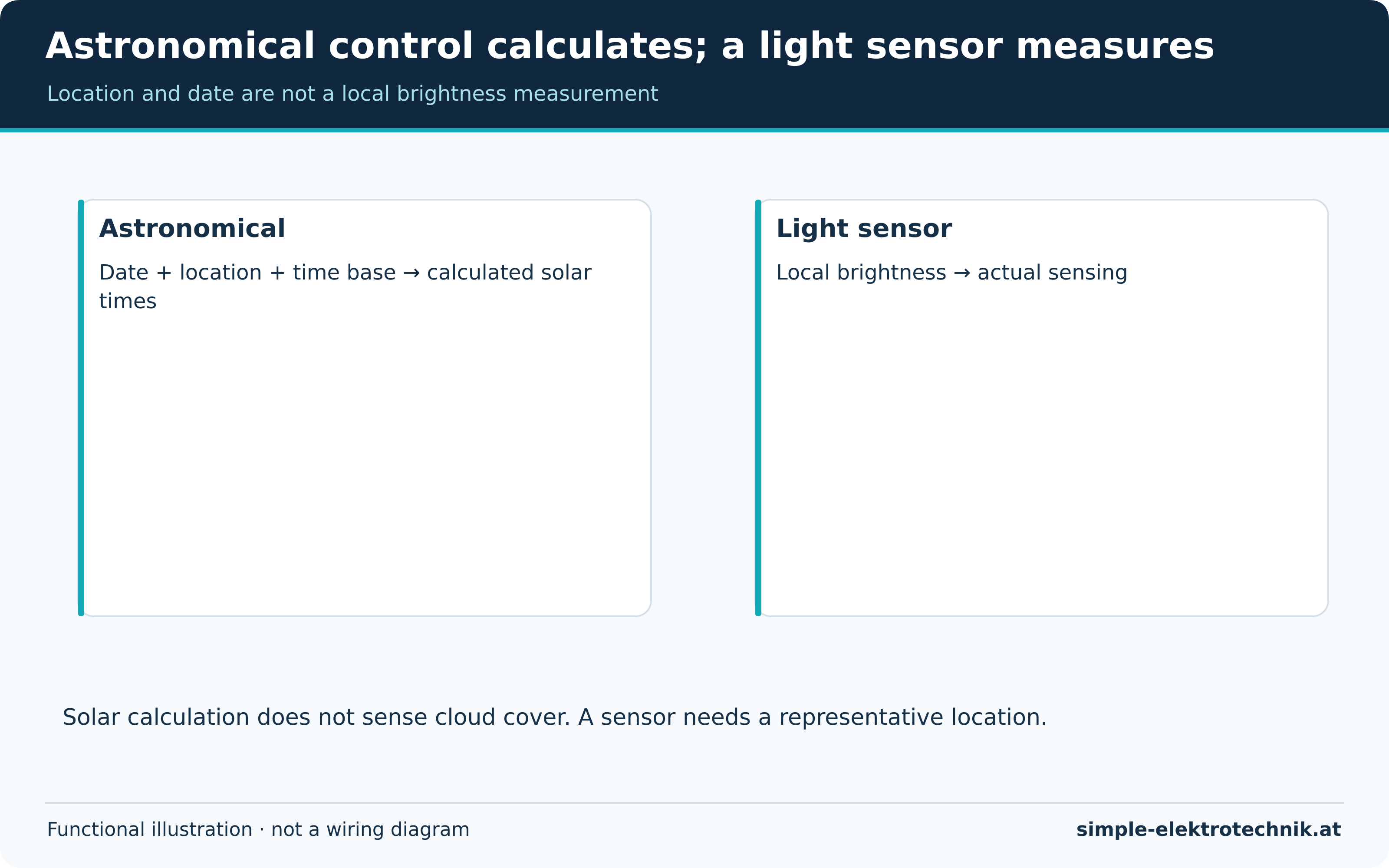
The new diagram distinguishes solar calculation from local light sensing without specifying terminals. The programme requests operation; selected mode and manual override can change the actual output.
Device illustrations and operating principle
Variants, connections and selection
Fixed times or astronomical control?
A fixed programme operates at selected clock times. An astronomical switch calculates solar times for its configured location and date. It measures neither cloud cover nor actual brightness at a facade.
A twilight switch evaluates a real sensor reading. Similar aims do not make them equivalent. When combined, define which condition enables, blocks or switches the output off.
| Setting | Effect |
|---|---|
| Date and clock time | Relates the programme to the actual moment |
| Weekdays | Determines which days an action applies |
| Location | Determines calculated solar times |
| Time zone and seasonal changes | Relates the calculation to local clock time |
| Offset | Intentionally shifts a calculated solar event |
| Night interruption | Adds a supported scheduled restriction |
Astronomical enable and a supported night interruption must interact according to the actual programming rules. An offset does not measure local daylight.
Selection and connections
Choose the required time function, channels, load, mounting and usability. Clock reserve, a replaceable battery, programme retention and restart behaviour are separate characteristics. A retained programme does not prove that current time survives an outage.
Identify supply, load contact and any control inputs from the actual instructions. Volt-free contacts differ from internally supplied outputs. Match the actual load and inrush conditions.
Bluetooth, apps or memory cards are optional tools on some devices. A digital time switch does not inherently require a cloud, and an app does not guarantee remote access or unrestricted programme portability.
Functional checks
Verify and record programmes
Check current date, time and weekday, then active entries and operating mode. Permanent-on or manual control can override an otherwise correct schedule.
Pay attention to periods crossing midnight: the evening start and following-day stop must apply to the intended days. Conflict rules for simultaneous or overlapping entries depend on the product.
A supported preview or programme simulation helps predict upcoming events. It does not verify electrical safety. Restore the intended automatic mode after testing and document the settings.
Advantages and limitations

Advantages and limitations
Schedules provide understandable repeatable control without constant manual operation. Astronomical control can account for seasonal solar changes without an outdoor light sensor.
Fixed schedules do not know actual occupancy without another input. Solar calculations do not know local cloud cover. Wrong time, location or override mode can cause unexpected operation. A programme alone does not establish energy savings.
Questions and related information
Common questions
Does clock reserve keep the load running in an outage?
No. It may keep the internal clock operating. Continuing to supply the load is a separate requirement.
Is astronomical control a light sensor?
No. One calculates and the other measures. Choose the information needed for the actual task.
Sources and product documentation
Electrical safety: scope, competence and precautions
Put electrical safety first.
- These explanations and simplified diagrams support learning. They are not complete installation designs, site-specific risk assessments or a substitute for competent professional assessment.
- Electrical work can be life-threatening. It requires the competence and authorisation appropriate to the actual task, installation and jurisdiction.
- Errors and omissions can occur. Check the actual equipment documentation, applicable requirements and the complete installation before relying on an example; a working device is not proof of electrical safety.
- Personal protective equipment must suit the assessed hazards and task. It does not replace isolation, appropriate tools, competence or a safe system of work.
- Do not work on exposed live parts on the basis of these guides. Identify every relevant source, isolate it, secure against reconnection and prove dead using suitable equipment and procedures before access.
- Responsibilities for design, installation and verification must be established for the actual work. A website statement does not determine liability or remove duties under applicable law.
- This summary is not exhaustive. Where the circuit, condition or protective arrangement is uncertain, obtain suitable professional assistance before work proceeds.
- Complete the required inspection, testing and documentation before use, and maintain the installation and equipment appropriately.
Electrical terms explained
Electric current
The rate of flow of electric charge, measured in amperes (A). Conventional current direction follows positive charge flow, which is opposite to electron drift in a metallic conductor.
Voltage
The electric potential difference between two points, measured in volts (V). Always identify the reference points, such as line-to-neutral or line-to-earth; a voltage is not a property of one isolated terminal alone.
Resistance
The opposition associated with resistive current flow, measured in ohms (Ω). For a component behaving as an ohmic resistance under the stated conditions, U = IR.
Electrical power
The rate of electrical energy transfer, measured in watts (W). P = UI applies to steady DC; in a sinusoidal single-phase AC circuit, active power is UI cos φ using RMS values. The general average depends on voltage and current waveforms.
Ohm's law
For an ohmic resistance, current is proportional to the applied voltage: I = U/R. Resistance can vary with temperature, and non-linear devices do not necessarily obey one constant-resistance relationship.
Kirchhoff's laws
The current law expresses charge conservation at a circuit node. The voltage law states that the algebraic sum of voltages around a closed loop is zero within the applicable circuit model; induced effects must be represented appropriately.
Direct current (DC)
Current that maintains one direction. Its magnitude may be constant or vary; pulsating DC is still distinguished from current that reverses direction.
Alternating current (AC)
Current whose direction reverses with time, commonly periodically. Public supplies normally use approximately sinusoidal AC, while electronic equipment can produce other waveforms.
Frequency
The number of cycles per second of a periodic quantity, measured in hertz (Hz). Many European public supplies operate at a nominal 50 Hz.
Phase difference
The relative position of periodic quantities of the same frequency, often expressed in degrees or radians. For sinusoidal quantities, a time displacement can be related to that phase angle.
Circuit diagram
A drawing representing circuit components and their electrical connections using symbols. It is distinct from a physical layout or a complete installation design.
Capacitor
A component that stores energy in an electric field. Its capacitance relates stored charge to voltage under the stated conditions; a practical capacitor also has voltage, current and other operating limits.
Strappers in lighting circuits
The pair of conductors linking the changeover contacts in conventional two-way lighting switching, including intermediate switching where used. They carry the alternative switching paths and are not transformer windings; identify their actual functions from the circuit.
Coil or winding
A conductor arranged in turns, commonly to produce magnetic effects. Its behaviour includes inductance as well as the resistance and other properties of the actual winding.
Inductance
The relationship between flux linkage and current in the applicable model, measured in henries (H). Changing current produces an induced voltage; for a constant inductance its magnitude relates to L di/dt with the appropriate sign convention.
Capacitance
The relationship between stored charge and voltage, measured in farads (F). For a constant capacitance, changing voltage produces current according to i = C dv/dt.
Transistor
A semiconductor device used for switching, amplification or other control functions. Its operating principle and control quantities depend on whether it is, for example, a bipolar transistor or a field-effect device.
Semiconductor
A material whose electrical behaviour can be controlled through composition, electric fields, light or other conditions. Semiconductor devices use this behaviour for functions such as rectification, switching and amplification.
Diode
A device with a strongly directional current-voltage characteristic. Real diodes have forward losses, reverse leakage and limits; they do not act as perfect one-way valves at every voltage.
Relay
A device that changes an output in response to a control input. An electromechanical relay uses a coil and contacts, while a solid-state relay uses electronic switching elements.
Switch
A device that makes, breaks or changes electrical connections. Its rating, contact arrangement and permitted duty determine the applications for which it is suitable.
Electrical network
An interconnection of electrical components and branches. Series, parallel and more complex arrangements can be analysed with an appropriate circuit model.
Transformer
A device transferring energy between magnetically coupled windings through changing flux. Turns ratio influences voltage and current relationships; losses, limits and any conductive connection depend on its construction.
Electromagnet
A magnetic arrangement energised by electric current, commonly using a coil and magnetic core. Contactors, relays and actuators use electromagnetic force for mechanical operation.
Impedance
The relationship between voltage and current phasors in a sinusoidal steady-state model, measured in ohms. It combines resistance and reactance and can vary with frequency.
Short circuit
An unintended low-impedance connection between points at different potentials. Current is limited by the complete source and fault-path impedance, not literally unrestricted.
Electric circuit
An arrangement of sources, conductors and components. Current flows where a complete conductive path exists, although a circuit can also be described in an open or disconnected state.
Series connection
Components in one unbranched path carry the same current. Their voltages add algebraically; the individual voltage shares depend on their electrical behaviour.
Parallel connection
Branches connected between the same two nodes share the same voltage. The branch currents depend on their loads and add algebraically at the connection points.
Fuse
An overcurrent protective device with an element designed to melt and interrupt the circuit under specified conditions. Its rating, characteristic and breaking capacity must suit the application.
Overcurrent protection
Protection against overload and short-circuit effects, commonly using fuses or circuit-breakers. A sensing relay may require a separate interrupting device; an ordinary RCCB does not provide this protection by itself.
Earthing
A deliberate connection of a system point or conductive part to earth. Protective earthing forms part of an electric-shock protection arrangement; it must not be confused with neutral, functional earth or a guarantee of zero touch voltage.
Frequency converter or variable-speed drive
Electronic equipment that produces a controlled output frequency, commonly with controlled voltage, to operate a suitable motor. Its pulsed output, protection and compatibility requirements differ from a direct mains supply.
Electromagnetic compatibility (EMC)
The ability of equipment to operate satisfactorily in its electromagnetic environment without causing unacceptable disturbance to other equipment. Both emissions and immunity matter.
Power loss
Energy dissipated per unit time, commonly as heat in conductors, cores, insulation or semiconductor devices. Ideal inductors and capacitors exchange stored energy without average loss; practical components have additional loss mechanisms.
Short-circuit current
The current resulting from a short circuit. Prospective fault current is assessed to select protective devices with adequate interrupting capability and to check thermal and mechanical effects.
Power factor
The ratio of active power to apparent power. For sinusoidal voltage and current it equals cos φ; with distortion it also reflects waveform effects. It is not the same as energy-conversion efficiency.
Insulation resistance
Resistance measured between specified conductive parts separated by insulation under stated test conditions. The test voltage, connected equipment and interpretation must suit the circuit; it is not a complete assessment of insulation performance on its own.