

Understanding DC and AC

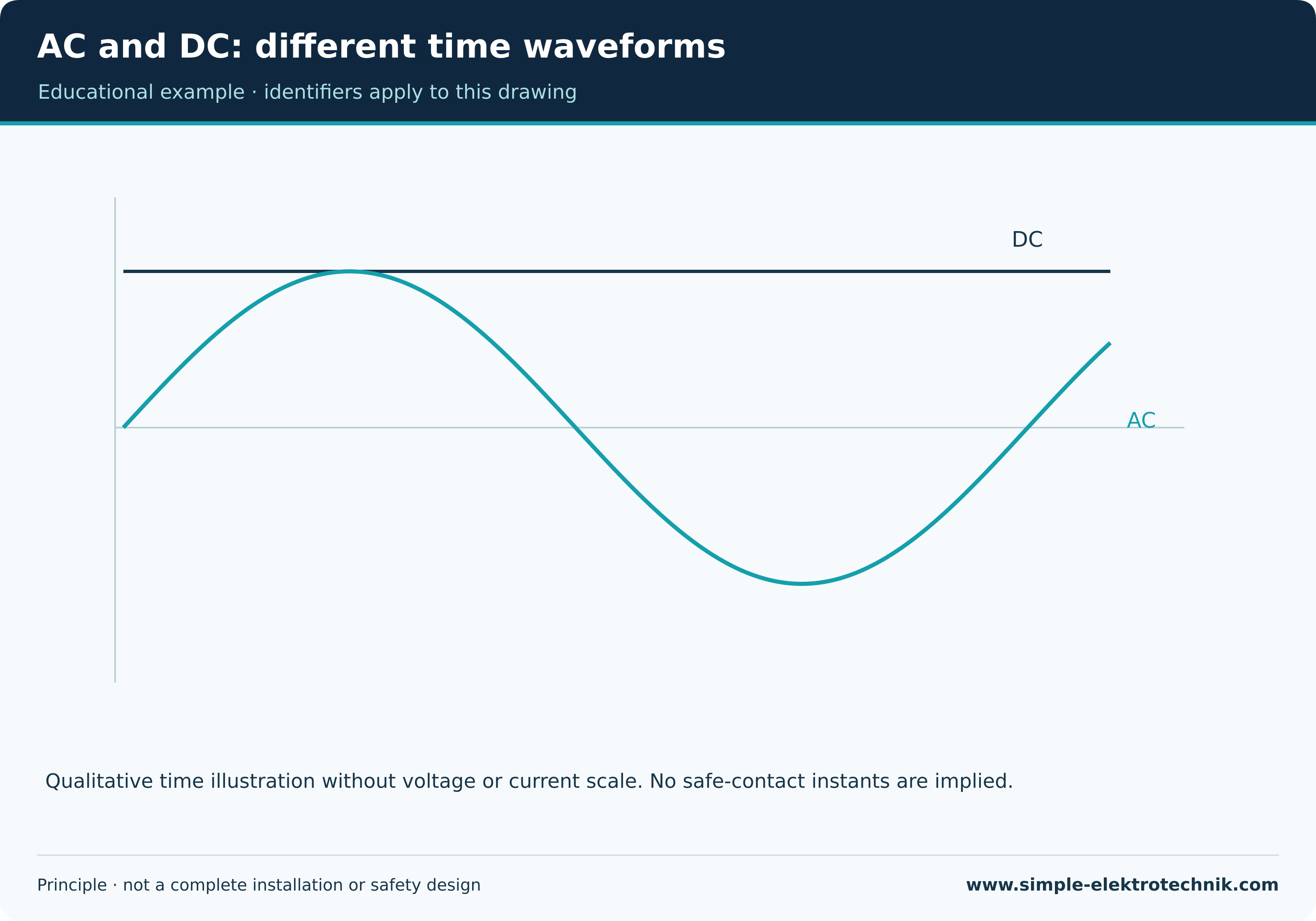
Direct current keeps the same direction; alternating current changes direction. Their time waveforms can differ. A pulsating unidirectional current is not automatically sinusoidal AC.
Both occur in everyday equipment. Batteries and electronics often use DC. Public distribution commonly uses AC or three-phase AC, with power supplies converting it for connected devices.
Direct voltage and current

An ideal DC source maintains constant polarity and voltage. A real battery changes state during charging and discharge. DC does not mean every practical value is perfectly constant over time.
Positive and negative identify DC poles. They are not alternative names for line and neutral in an AC installation. Confusion can damage equipment and create hazards.
Alternating quantities and frequency
Sinusoidal voltage changes polarity and magnitude periodically. Frequency counts complete cycles per second. At 50 Hz there are 50 cycles each second, so one cycle lasts 20 ms.
Current also depends on the load. Electronics may draw nonsinusoidal current from an approximately sinusoidal supply. Supply voltage and load current must not be treated as identical waveforms.
| Property | DC quantity | Sinusoidal AC quantity |
|---|---|---|
| Direction or polarity | Remains the same | Changes periodically |
| Description | Value and any ripple | RMS, peak, frequency and phase |
| Typical example | Battery and suitable load | Simplified public AC supply example |
AC and DC: different time waveforms
RMS and peak
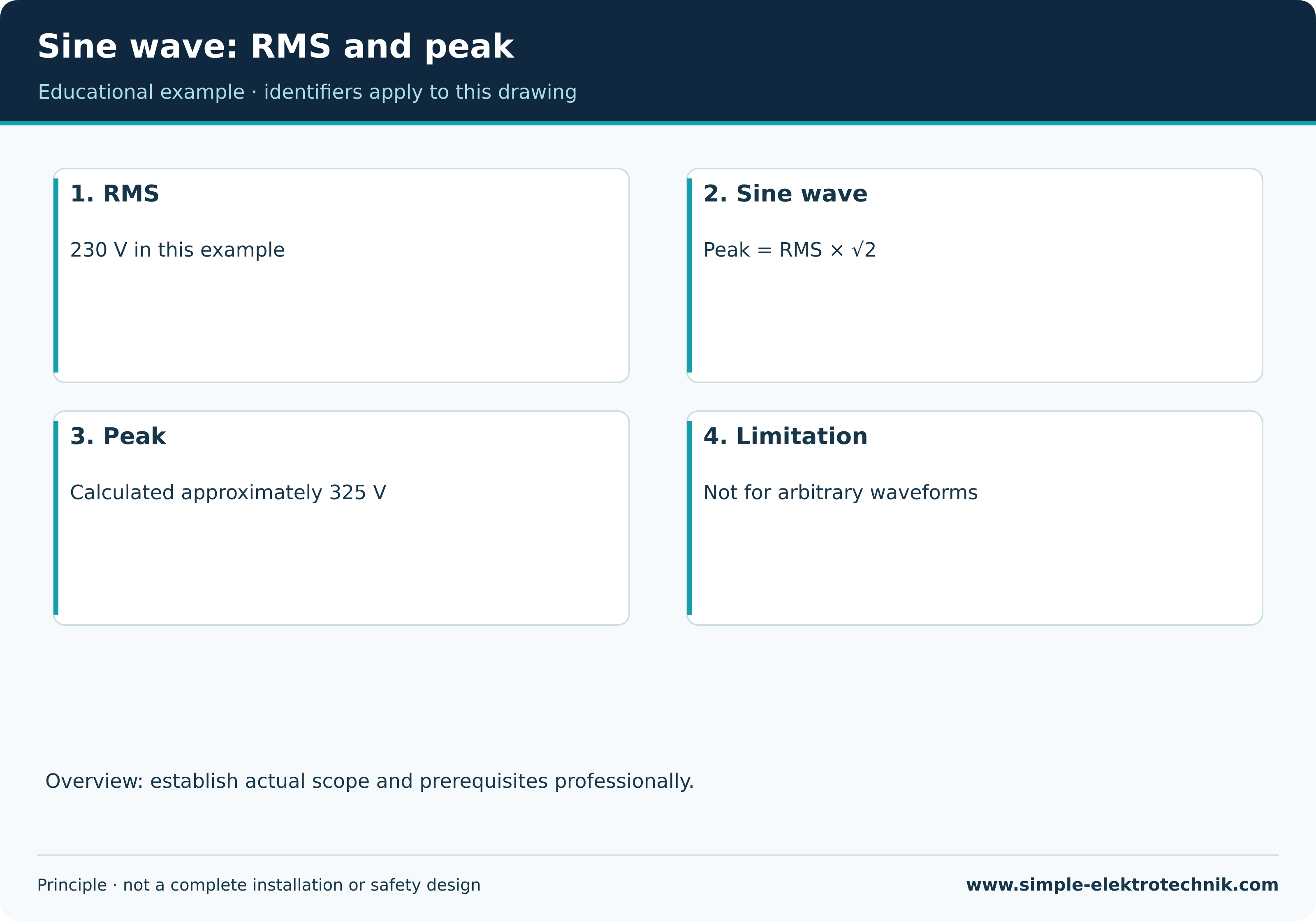
RMS relates a quantity to its equivalent heating effect in an ohmic resistor. For a sine wave, peak = RMS · √2. A 230 V RMS sine therefore has a calculated peak of about 325 V.
That relationship concerns the stated waveform, not arbitrary pulses. A zero crossing also does not turn a mains installation into a safely released work area for an instant.
Sine wave: RMS and peak
What a power supply changes
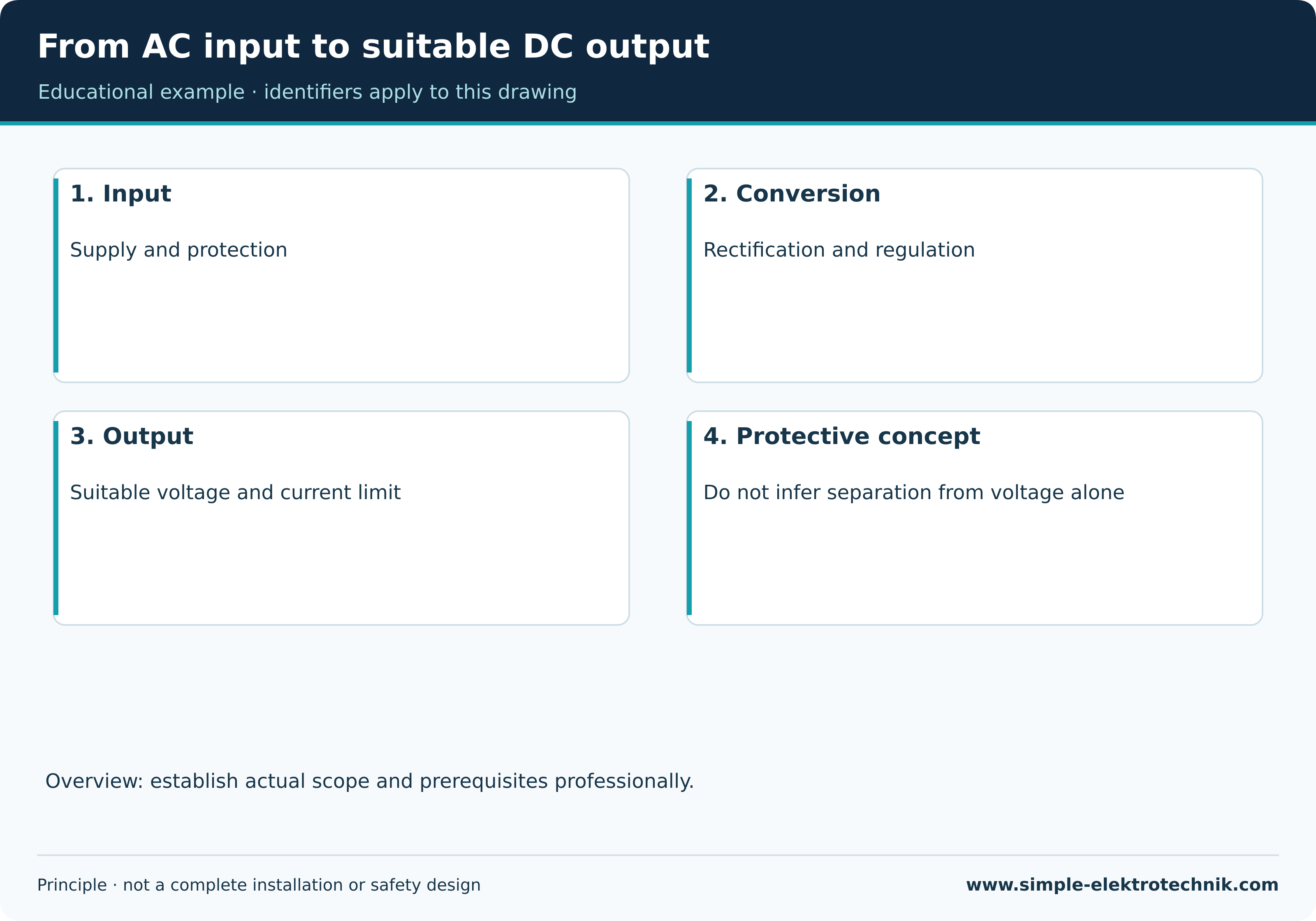
A supply may rectify, filter and regulate AC. Input and output have different properties. Low output voltage alone does not prove adequate protective separation. The protective concept and instructions remain essential.
A transformer transfers energy through a changing magnetic field. An ordinary winding is not suitable for arbitrary connection to steady DC. A switch-mode supply deliberately generates high-frequency operation; that is different from applying DC directly to a mains transformer.
From AC input to suitable DC output
Switching and measuring
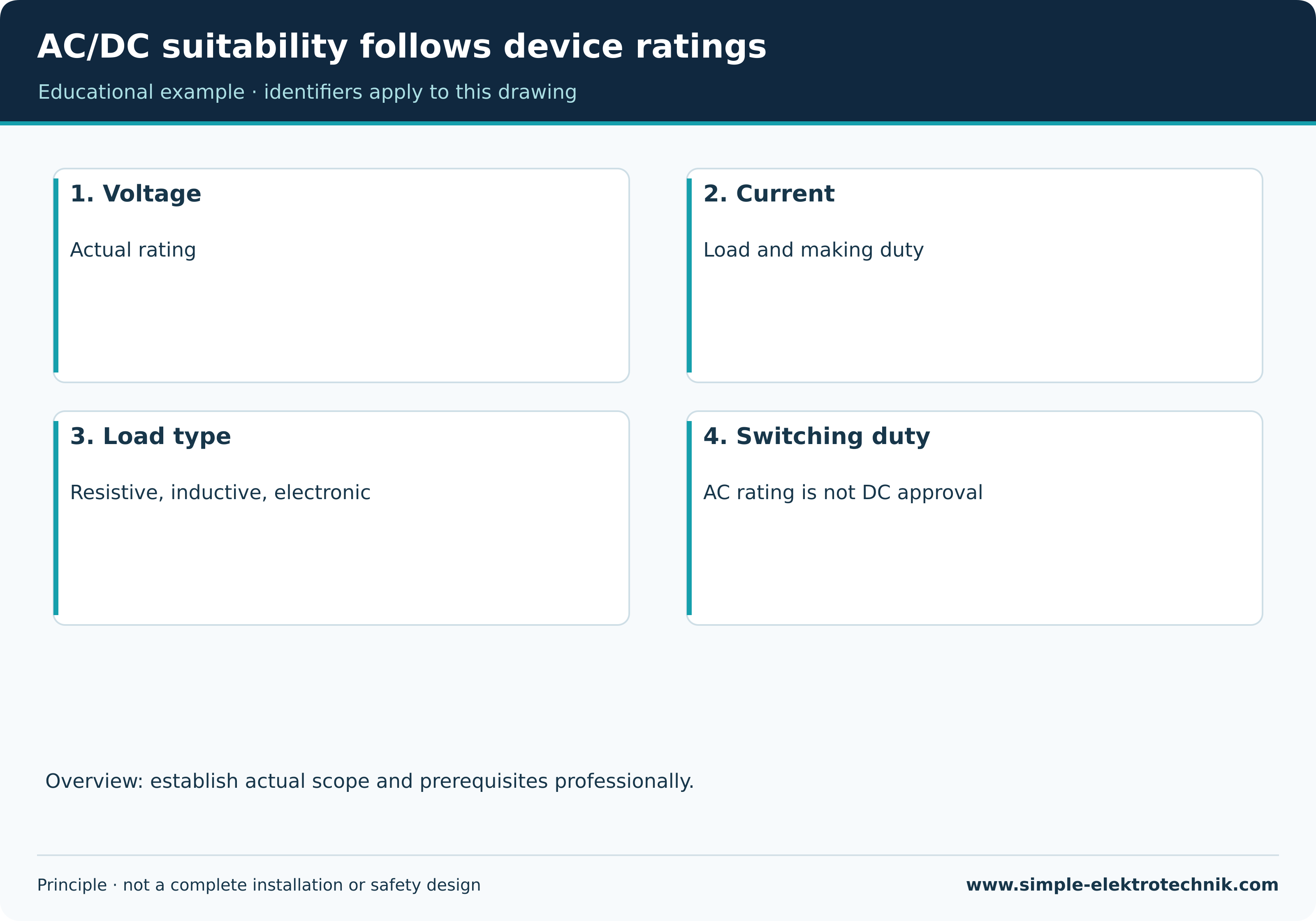
Devices may have different AC and DC ratings. Interrupting current depends on voltage, load and switching conditions. An AC rating does not automatically authorise the same DC application.
Instruments must suit the signal. AC, DC and combined functions may display different components. True RMS applies within the actual specification; it does not promise perfect measurement of every waveform.
AC/DC suitability follows device ratings
Common questions
Is DC inherently harmless?
No. Voltage, path, duration, available energy and other conditions determine risk. Batteries can also supply high short-circuit currents.
Does 50 Hz mean 50 volts?
No. Hertz describes repetition rate; volts describe voltage.
Can every AC switch also switch DC?
No. Manufacturer ratings for the actual duty establish suitability.
Continue learning
Sources and technical context
The references support basic principles; they do not replace assessment of the actual installation.