

Choosing LED lamps

A suitable LED lamp matches the lampholder, supply and desired lighting effect. Luminous flux in lumens is more useful for comparing light output than wattage alone. Colour temperature, colour rendering, distribution and dimming are separate properties.
This guide concerns replaceable lamps. The luminaire guide covers the complete fitting and its connection. An integrated LED module is not automatically replaceable like a screw-base lamp.
Lumens, watts and kelvins
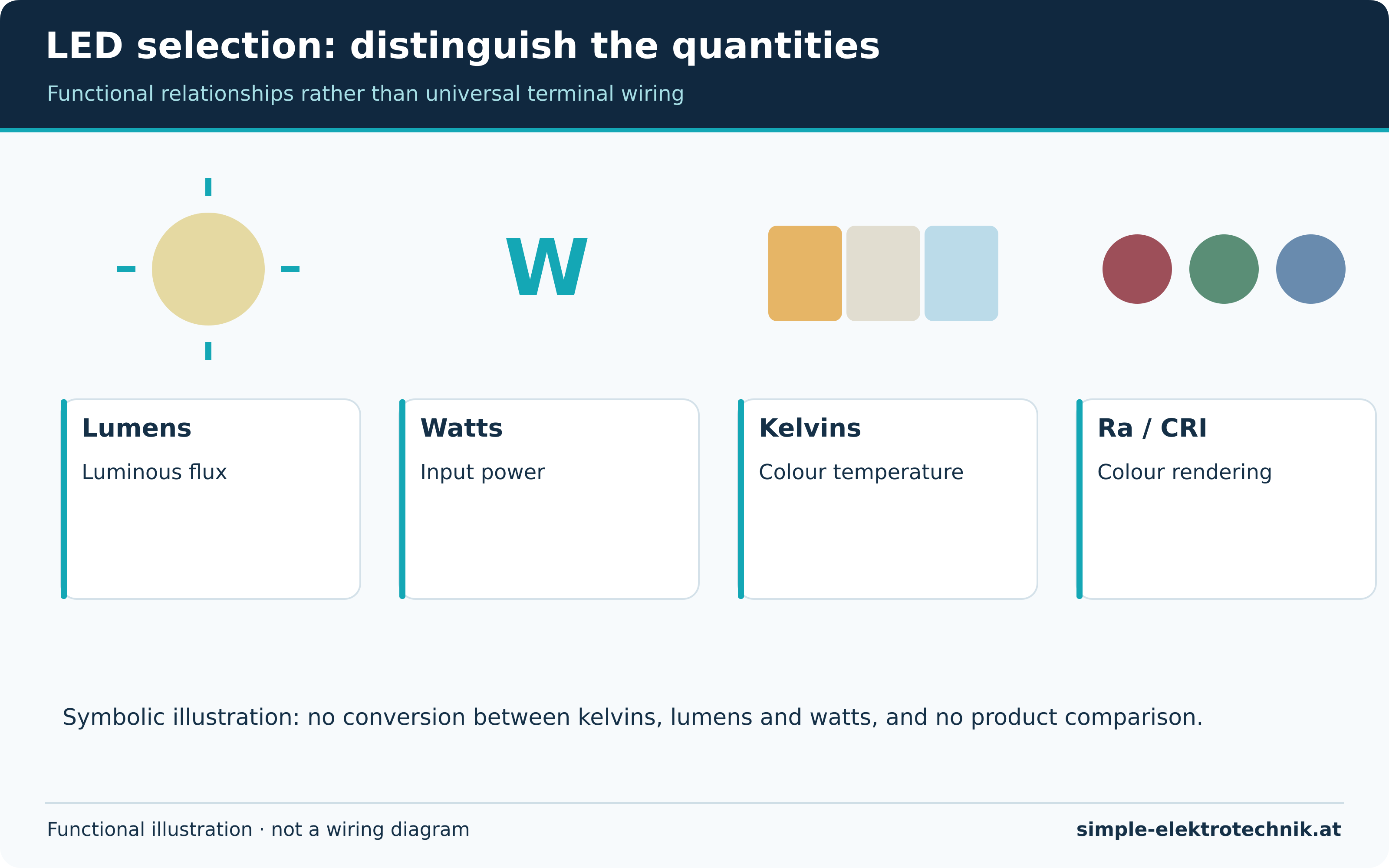
Lumens describe luminous flux: total visible light output according to the relevant photometric weighting. Watts describe electrical input power. Two LED lamps consuming the same power can produce different light output.
Kelvins describe correlated colour temperature for white sources. A higher value does not automatically mean more light or a hotter enclosure. It identifies a warmer or cooler appearance, while the perceived result also depends on the room and task.
Lux describes illuminance at a surface. Light reaching a table also depends on distance, optics, beam angle and surroundings. A lumen figure alone cannot guarantee adequate lighting in every room.
Selection criteria
| Property | Useful question |
|---|---|
| Base and dimensions | Does it fit with the required clearance? |
| Voltage | Is it intended for the actual supply? |
| Luminous flux | Does it provide the desired light output? |
| Colour temperature | Does the warmer or cooler appearance suit the use? |
| Colour rendering | Are colours reproduced adequately for the task? |
| Beam angle | Is broad distribution or a directed beam required? |
| Dimming and temperature | Are controls and installation conditions compatible? |
The general colour-rendering index Ra does not describe every aspect of colour perception. Demanding applications may need further spectral or product-specific information. For everyday selection, start by keeping colour rendering separate from colour temperature.
Base and supply compatibility
Similar shapes can use different supply arrangements. A mains lamp may include its electronics; another lamp may need a suitable external supply. Mechanical fit alone does not decide compatibility.
When replacing lamps in an existing low-voltage system, check the transformer or power supply too. Minimum load, output type and behaviour with electronic loads may matter. Lower power consumption does not make an LED compatible with every older supply.
Fluorescent replacement tubes have additional product-specific conditions. A retrofit designed for one ballast type is not permission to modify every luminaire. Existing fluorescent-circuit guides explain their operation; actual conversion needs the appropriate instructions.
Dimming is a system property
A dimmable marking must match the control method. Leading-edge, trailing-edge and other interfaces are not interchangeable. Check permitted lamp count, minimum load and inrush as applicable.
Flicker at a low setting may indicate incompatibility rather than proving either component defective. Consult compatibility information for the actual models. The dimmer guide explains the device side.
A smart lamp often requires its intended supply even when its light is off by radio command. Do not assume it can operate behind an existing dimmer. Establish the control arrangement before purchase.
Temperature and replacement
LED equipment is efficient but still produces heat. Closed fittings, blocked ventilation and unsuitable ambient temperatures can shorten life. Lifetime claims relate to stated conditions, not every installation.
Make the fitting safe as instructed and allow it to cool before replacement. A new lamp does not repair a damaged base or discoloured lampholder. Treat integrated components according to the manufacturer's replacement provisions.
Common questions
Can kelvins be converted to lumens?
No. Colour temperature and luminous flux describe different properties.
Is more light always better?
No. Glare, distribution and the intended task matter. A suitably directed source may work better than excessive output in the wrong direction.
Do all LEDs save the same amount of energy?
No. Energy depends on power, running time and use. Compare equivalent lighting tasks rather than promising a universal saving.
Sources and documentation
More equipment guides: Equipment overview