

LED drivers and power supplies explained

An LED driver supplies an LED module in its intended operating mode. The key distinction is constant current versus constant voltage. A replacement with the same physical size and wattage is not automatically compatible.
This guide explains the supply/load relationship. Mains-side connections and luminaire repairs require appropriate competence.
Constant current and constant voltage

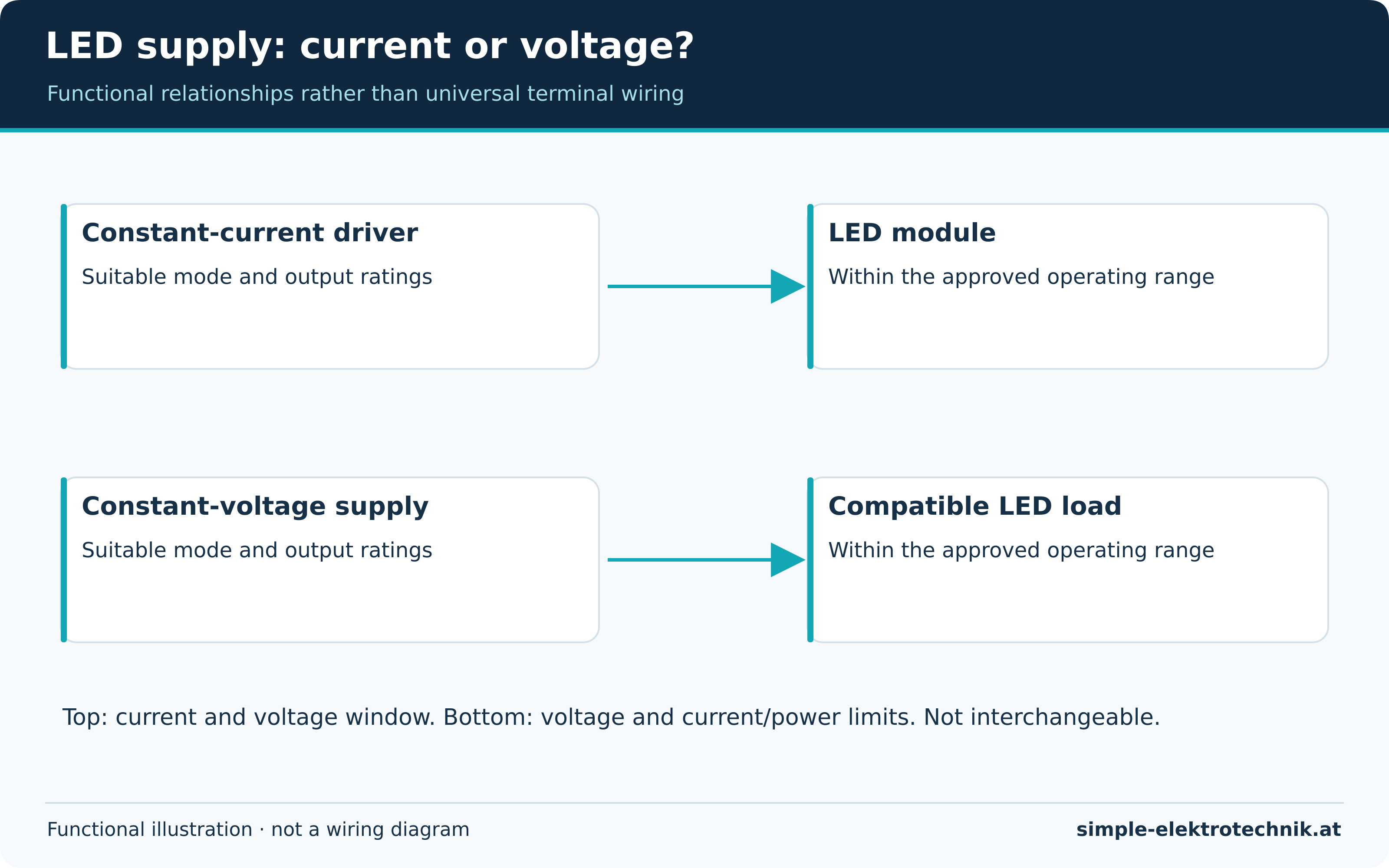
A constant-current driver regulates its intended output current within a specified operating range. Output voltage follows the LED load and must remain inside the permitted window. Match the current setting and load together.
A constant-voltage supply maintains its intended output voltage within specified conditions. The load must be designed for that voltage and supply method. Many LED strips use this arrangement, but not all strips and modules are alike.
The illustration compares the principles. It is not permission to interchange drivers or connect bare LEDs to an arbitrary supply. Matching maximum power alone does not establish compatibility.
Matching the ratings
| Constant current | Constant voltage |
|---|---|
| Match the set output current to the LED. | Match output voltage to the load. |
| Keep LED voltage within the operating window. | Keep load current and power within limits. |
| Check power and permitted module arrangement. | Consider routing, voltage drop and load-side protection. |
| Check dimming and starting behaviour. | Match the dimming method and controls. |
For adjustable drivers, the documented setting is part of selection. A factory default may not suit the module. Excessive current can overload LEDs; an unsuitable load voltage can prevent correct starting or regulation.
Do not parallel outputs unless expressly permitted. Series or parallel module arrangements depend on the supply concept. Adding wattages alone cannot determine the correct arrangement.
Input, output and protection
Primary side here means the supply input; secondary side means the LED output. These terms do not automatically establish safe galvanic separation. Check output voltage, insulation and suitability for the luminaire's protection class.
A low output-voltage marking alone does not establish a complete SELV protective arrangement. Control terminals are not automatically touch-safe extra-low voltage either. Treat DALI, button inputs and other interfaces according to their actual insulation and connection requirements.
A built-in driver may rely on protection provided by the luminaire. An independent driver may provide different enclosure and terminal provisions. The terms are not interchangeable. Strain relief and protection against contact must remain effective after assembly.
Dimming and temperature
Drivers may be non-dimmable or support particular methods. Mains phase control differs from a digital control interface. Check the complete combination of controller, driver and LED load.
Manufacturers specify environmental limits and may identify a case-temperature measuring point. Do not confuse that limit with room temperature. Installation beneath insulation imposes different thermal conditions from free air.
Clearances, mounting, conductor sizes and cable lengths depend on the product. Replacement must not unintentionally alter the luminaire's IP rating or protection class. Consult both the original arrangement and replacement instructions.
Fault finding and replacement
Flicker, repeated restarting and shutdown can indicate an unsuitable load, overheating, control problems or failure. They do not alone prove that the driver is defective. Record models, operating mode, settings and LED load first.
Compare mode, current or voltage, operating window, power, dimming, insulation and mounting together. Account for stored energy as instructed. An arbitrary delay is not a substitute for establishing a safe working condition.
Common questions
Can a higher-power driver be used?
Possibly, but maximum power alone does not decide. Constant-current systems particularly require the correct current and voltage window.
Are all 24 V supplies equivalent?
No. Isolation, protection, environment, controls and output behaviour can differ. Voltage is only one selection criterion.
Is every LED driver dimmable?
No. The method must be expressly supported and compatible with the LED load and control.
Sources and documentation
More equipment guides: Equipment overview