Line, neutral, protective conductor and PEN
L, N, PE and PEN identify different conductor functions. Insulation colour alone does not establish an installation's actual arrangement. Identity, earthing system and protective concept matter.
Neutral and protective conductor are not interchangeable. Green-and-yellow is not a spare core. PEN is a defined combined function, not an arbitrary N-to-PE bridge added at a socket.
Roles at a glance
| Marking | Function | Important distinction |
|---|---|---|
| L, L1, L2, L3 | Line conductor | May have operating voltage to earth and other conductors |
| N | Neutral | A live conductor that can carry load current and become hazardous |
| PE | Protective conductor | Protective function, not ordinary load return |
| PEN | Combined protective and neutral function | Subject to specific conditions, not freely created |
A switched line remains a live conductor. Terms such as lamp wire describe a task in a particular circuit, not a replacement for correct identification.
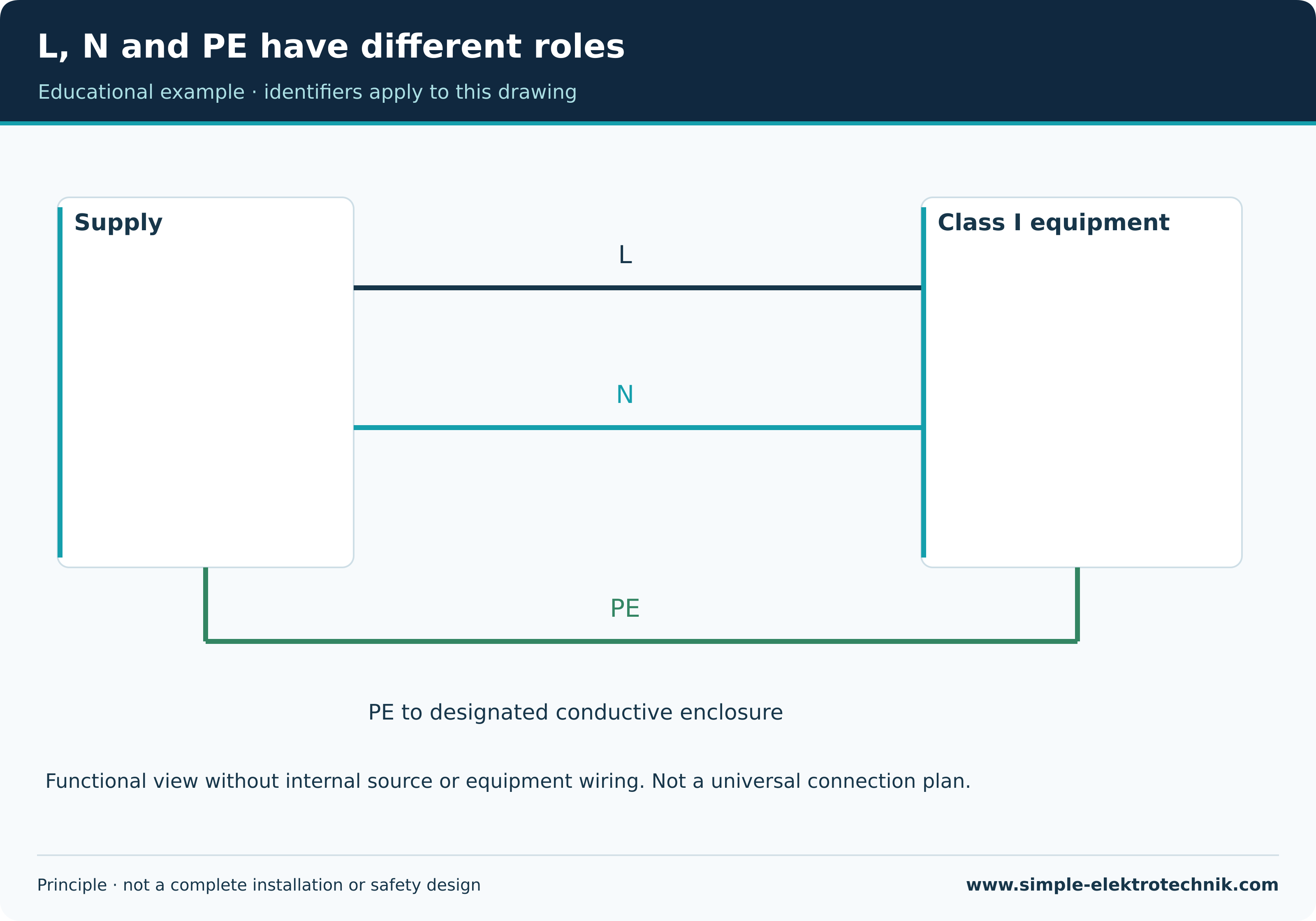
L, N and PE have different roles
Line and neutral in a circuit

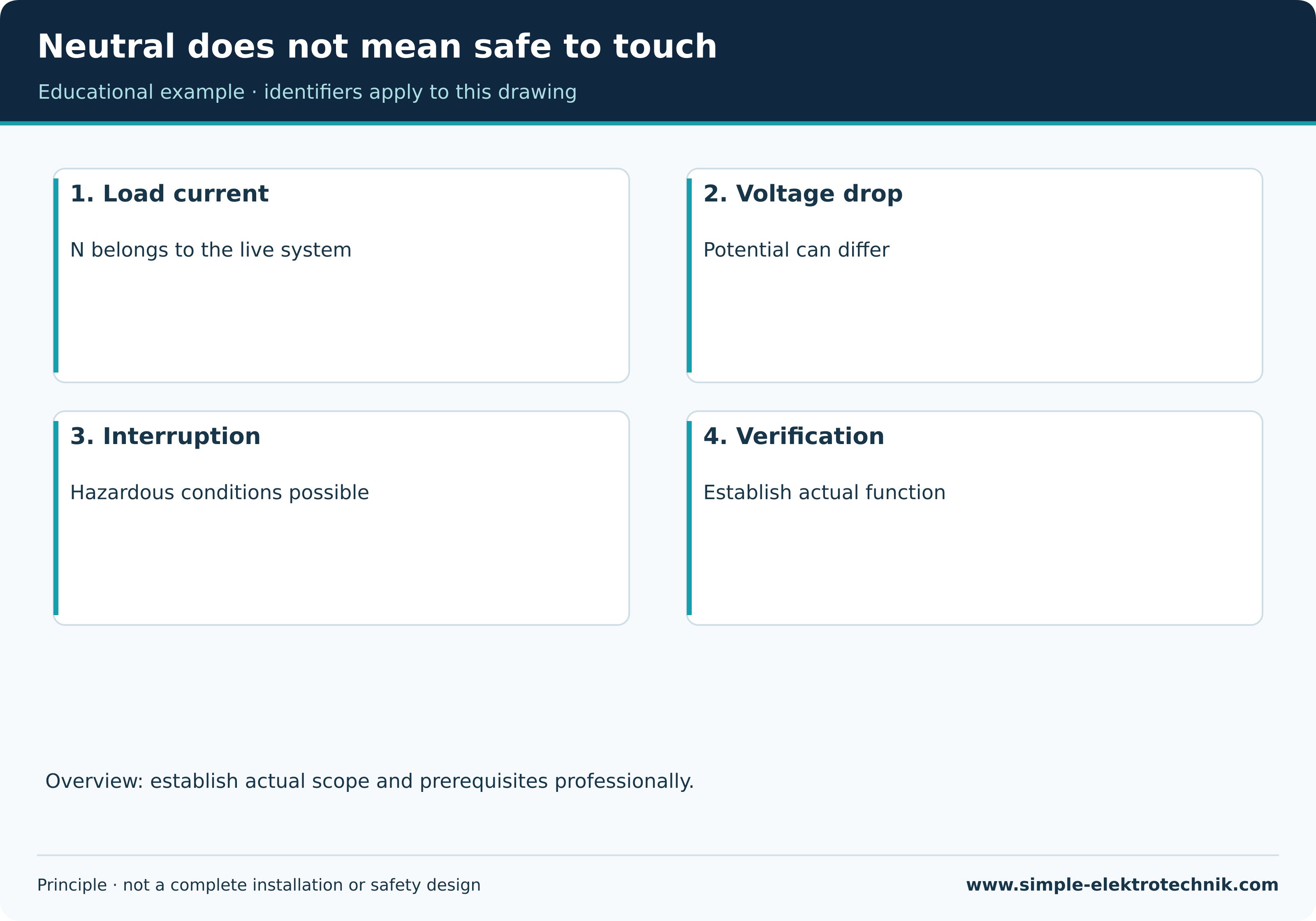
In a simple single-phase load path, current flows through line and neutral. The load converts energy rather than consuming charge, so the return belongs to the circuit's function.
Neutral is not automatically dead. Voltage drop, incorrect identification, interruption and other supplies can create hazards. Its name cannot justify omitting it from the appropriate proving-dead procedure.
Neutral does not mean safe to touch
PE has an independent role
PE connects designated conductive parts to the protective conductor system. It forms part of a protective concept intended to achieve the necessary effectiveness during a fault. PE alone does not promise zero volts at every point at every time.
Operational leakage may flow in PE. That does not make it an acceptable replacement neutral. Nor may it be removed experimentally to stop an RCD tripping.
The PEN concept
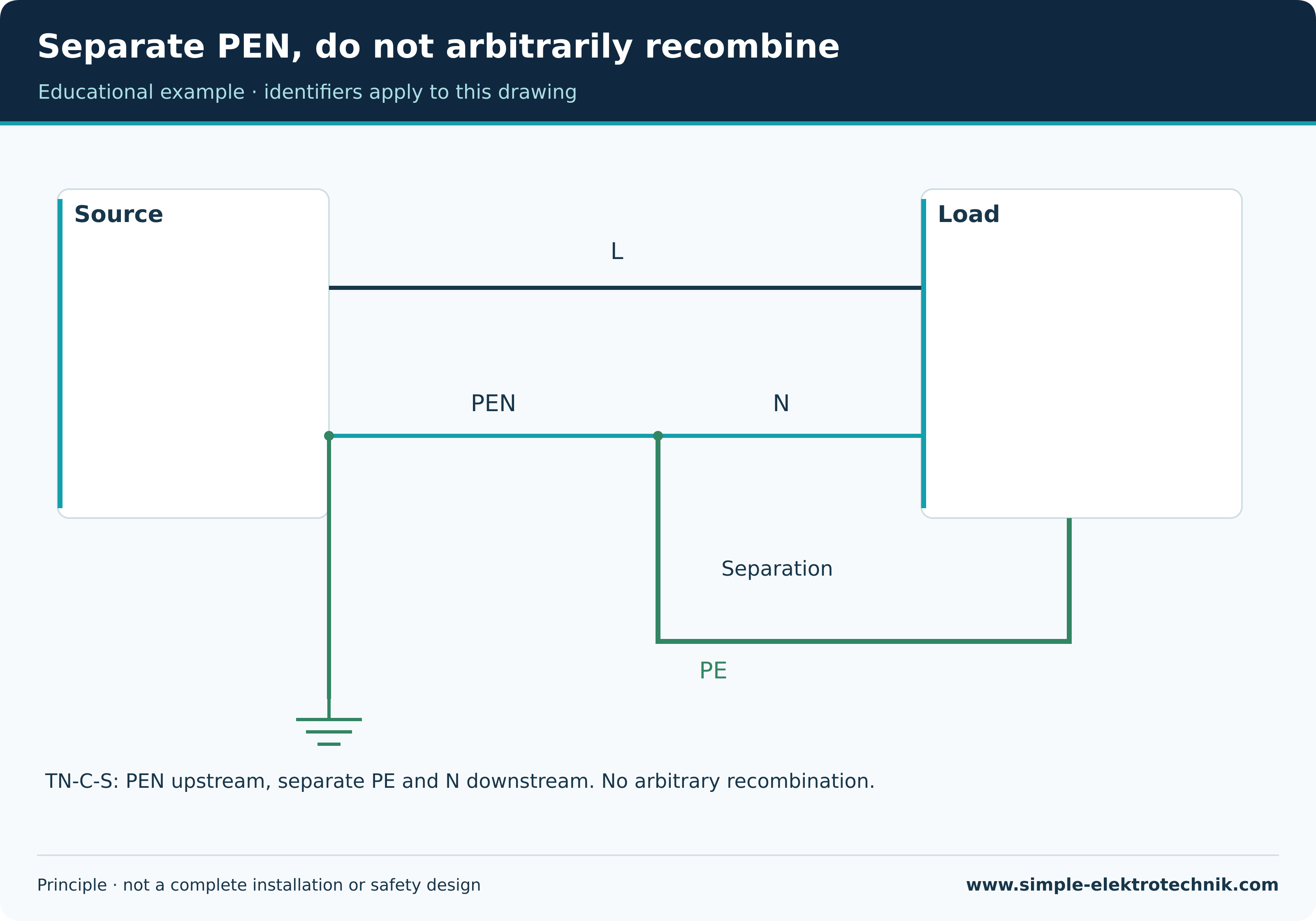
In a suitable TN-C section, protective and neutral functions are combined in PEN. A correctly designed separation creates distinct PE and N functions. Arbitrary recombination downstream is not permitted.
An interrupted PEN can impair both protection and load return. Its construction and connections are particularly important. Size, marking and connection requirements follow applicable rules; this is not a universal retrofit or bridging guide.
Separate PEN, do not arbitrarily recombine
Colour is a clue, not proof
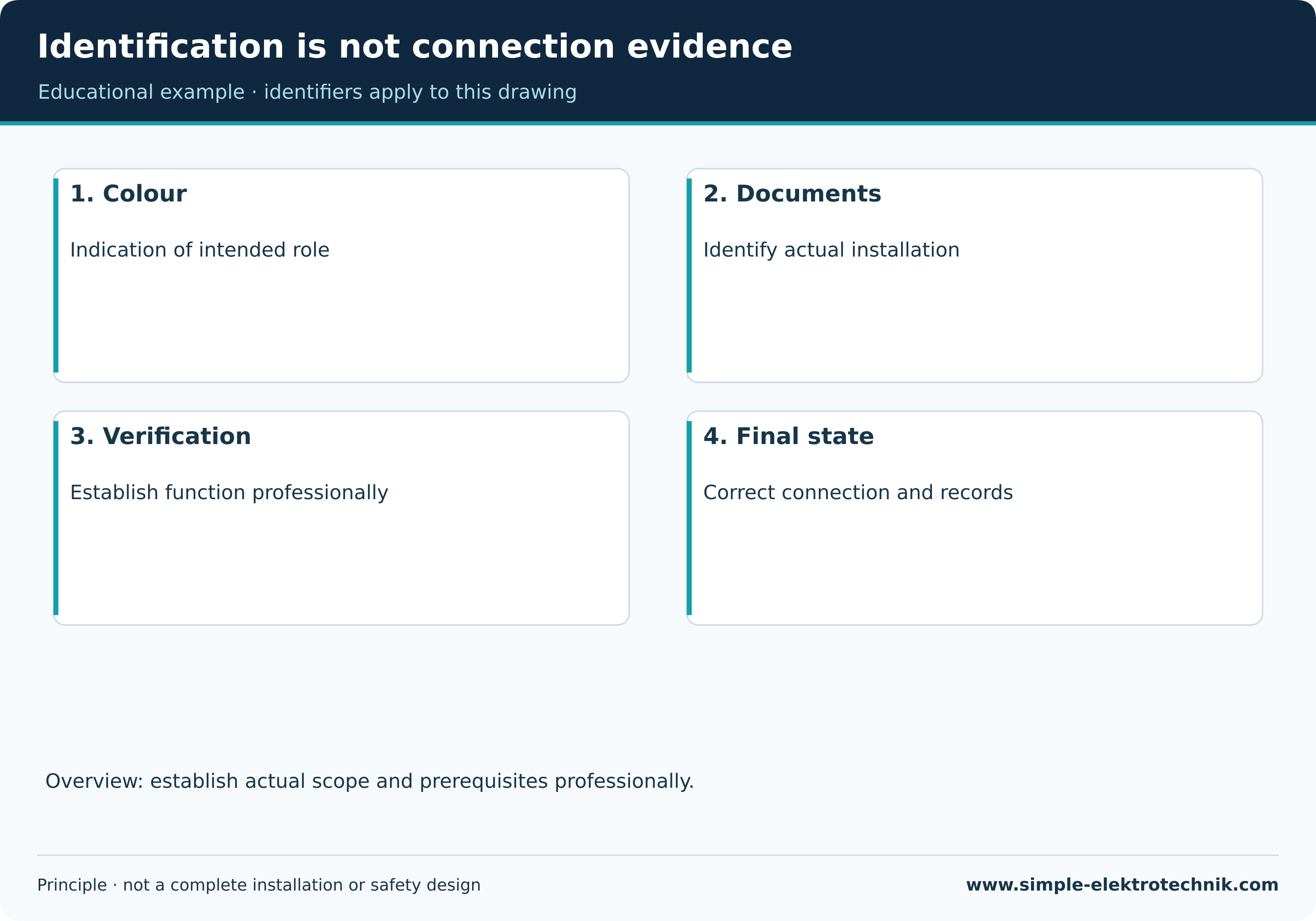
In usual present identification systems, green-and-yellow denotes protection and blue is used for neutral subject to applicable provisions. Historical systems, special uses and incorrect work require verification of actual function.
A green-and-yellow core is not automatically a correctly connected PE. Incorrect use is not acceptable merely because equipment works. The wire-identification guide explains current and historical systems more fully.
Identification is not connection evidence
Connection and verification
Use terminal markings and manufacturer diagrams. Terminal position, a picture of a similar product or a drawing's orientation cannot establish a universal connection rule.
Complete the necessary verification after work. Operating equipment does not prove PE continuity or correct conductor assignment. The inspection and testing category explains the methods.
Common questions
Why not connect N and PE together anywhere?
It changes the intended protection and return arrangement. An arbitrary bridge may place operational current on protective paths and impair protection.
Is every blue core definitely neutral?
No. Colour is identification information, not documented or measured proof of function.
May an unused protective core become a switched line?
No. A core identified for protection is not available as an arbitrary functional conductor.
Continue learning
Sources and technical context
The references support basic principles; they do not replace assessment of the actual installation.