

Power, energy and electricity consumption

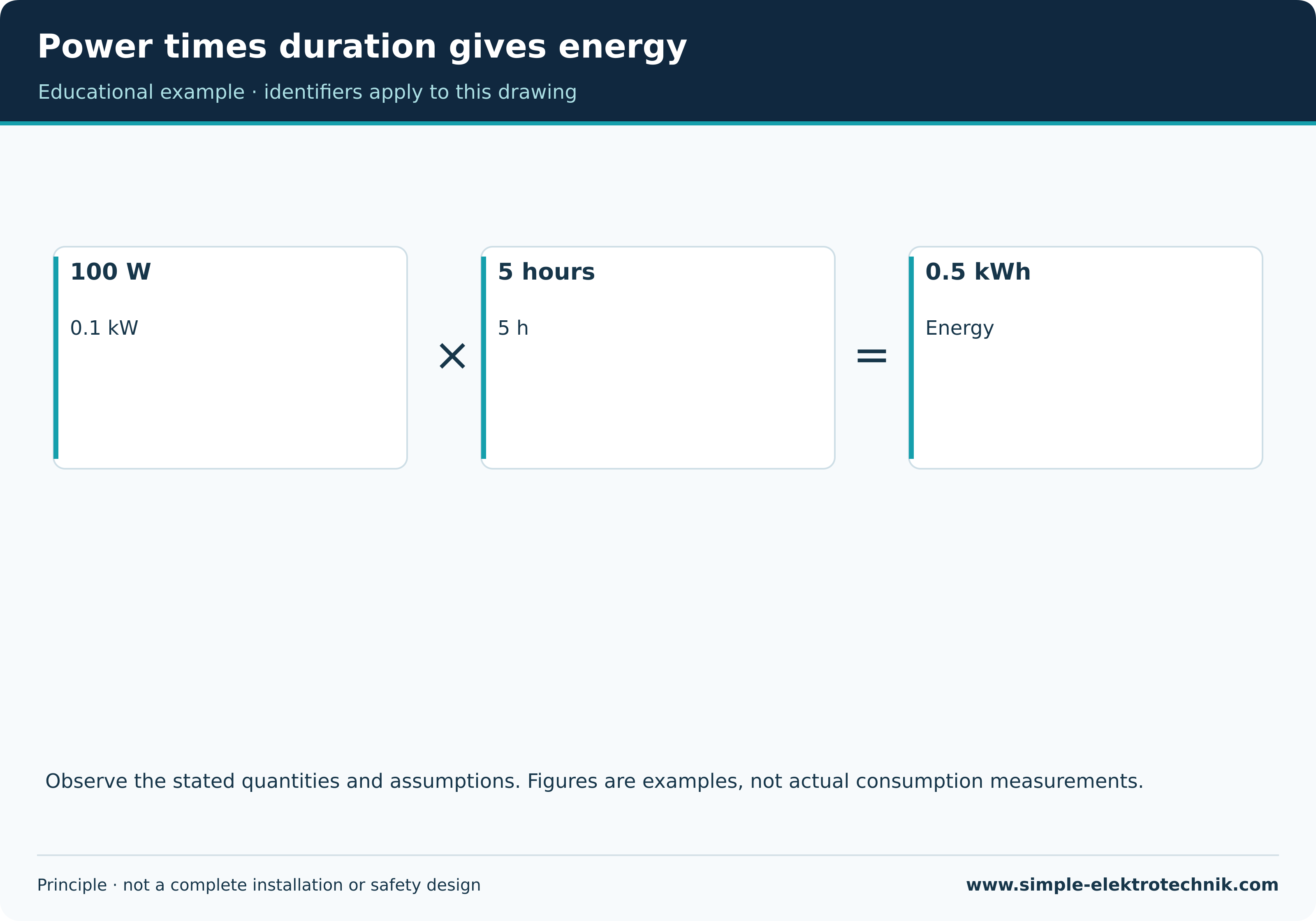
Power describes the rate of energy transfer or conversion. Energy is the amount transferred over time. Watts and kilowatt-hours therefore describe different quantities. A 100 W lamp has a power rating; operating it over time uses energy.
Both quantities matter when interpreting bills. High-power equipment used briefly may consume less energy than a small load running continuously.
Watts, kilowatts and kilowatt-hours
| Quantity | Unit | Example |
|---|---|---|
| Power | W or kW | 100 W = 0.1 kW |
| Duration | h | 5 hours |
| Energy | Wh or kWh | 0.1 kW · 5 h = 0.5 kWh |
For constant power, E = P · t. Variable power requires adding contributions over time. 1 kWh equals 3.6 MJ. A kilowatt-hour is energy, not power “per hour”.
Power times duration gives energy
A worked consumption example

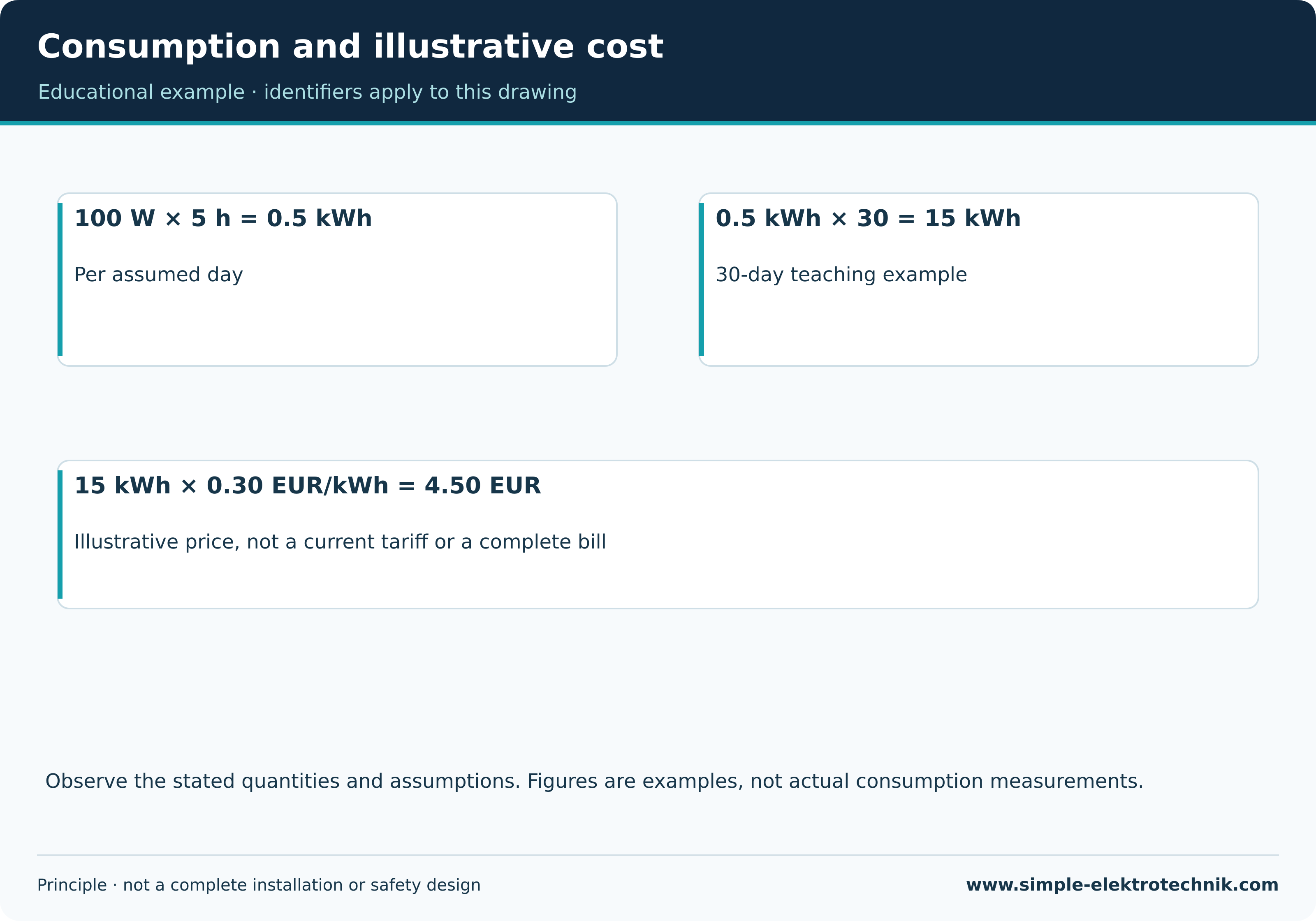
Assume a constant 100 W load operating five hours daily. It uses 0.5 kWh per day and 15 kWh over 30 such days. This is explicitly a 30-day calculation; calendar duration and operation can differ.
At an illustrative energy price of EUR 0.30 per kWh, those 15 kWh cost EUR 4.50. This is not a current tariff or complete bill. Fixed charges, network charges and other components depend on the actual contract.
Consumption and illustrative cost
Continuous operation and standby
An assumed constant 10 W over 24 hours uses 0.24 kWh, or 7.2 kWh over 30 days. Small loads can matter over time. Establish whether the equipment actually draws that power continuously.
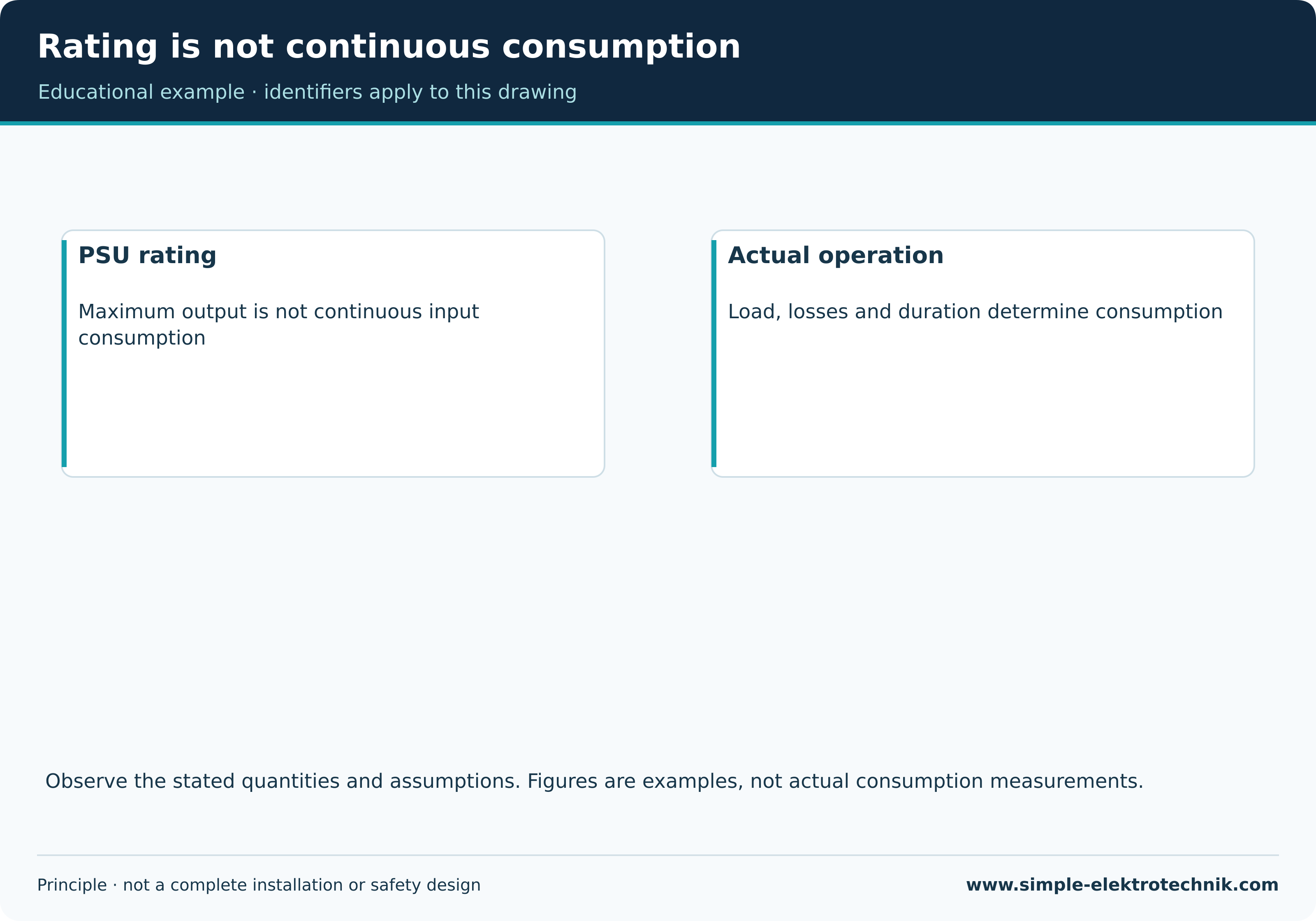
A PC power supply's maximum output rating is not the computer's continuous input. A heater likewise need not operate continuously at rated power. Load, control and efficiency affect actual consumption.
Rating is not continuous consumption
Calculate electrical power
For DC quantities, P = U · I. Our 12 V, 0.1 A example gives 1.2 W. Instantaneous AC power is p(t) = u(t) · i(t); active power is its time average.
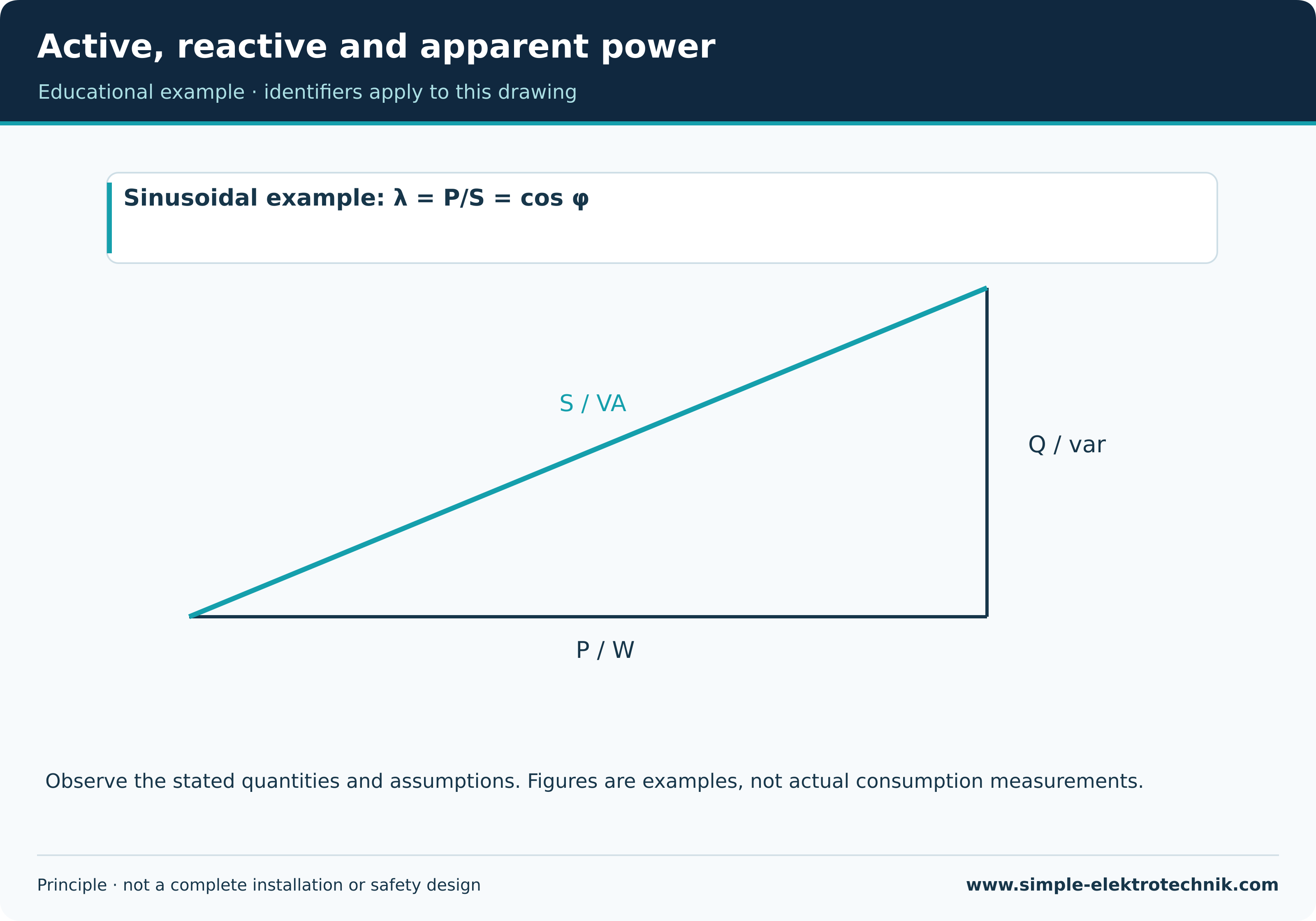
Active power P is expressed in watts. Apparent power S uses voltamperes and, in the usual RMS treatment, is obtained from voltage and current. Power factor λ = P/S differs from efficiency. It equals cos φ only under the appropriate sinusoidal conditions.
Active, reactive and apparent power
Current alone is insufficient
A clamp reading does not automatically establish billed energy. Voltage, power factor, waveform and duration may matter. Suitable energy instruments measure the relevant quantity over time.
An approved plug-in meter can help with suitable plug-connected loads. Respect ratings and conditions. Fixed wiring and distribution-board work are not appropriate for improvised setups.
Losses and efficiency
Real equipment does not deliver all input as desired useful output. Efficiency compares useful output with input within a defined boundary. Heat is the intended output of a heater but can represent loss in a power supply.
Savings also need a comparison basis. Lower power for the same duration is a meaningful improvement only if the required function and quality remain. Switching lighting off saves energy but provides no illumination.
Common questions
Does a 1000 W PSU always draw 1000 W?
No. Its rating is not continuous consumption. Actual load and losses determine input.
Does a high kW rating automatically mean high cost?
Not without duration. Actual power and operating time determine energy together.
Continue learning
Sources and technical context
The references support basic principles; they do not replace assessment of the actual installation.