
Understanding voltage, current and resistance
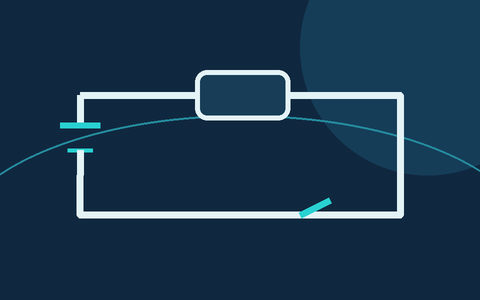
Voltage describes a difference in electrical potential. Current describes the transport of electric charge. Resistance describes the relationship between voltage and current for a component. These quantities are related but are not interchangeable.
A battery can have terminal voltage without a connected load. A suitable closed circuit permits sustained current. Its magnitude depends on the source, load and connections.
Three quantities with different roles
| Quantity | Symbol | Unit | Meaning |
|---|---|---|---|
| Voltage | U | volt, V | Potential difference between two points |
| Current | I | ampere, A | Charge passing a considered cross-section per unit time |
| Resistance | R | ohm, Ω | Voltage-to-current ratio at the considered operating condition |
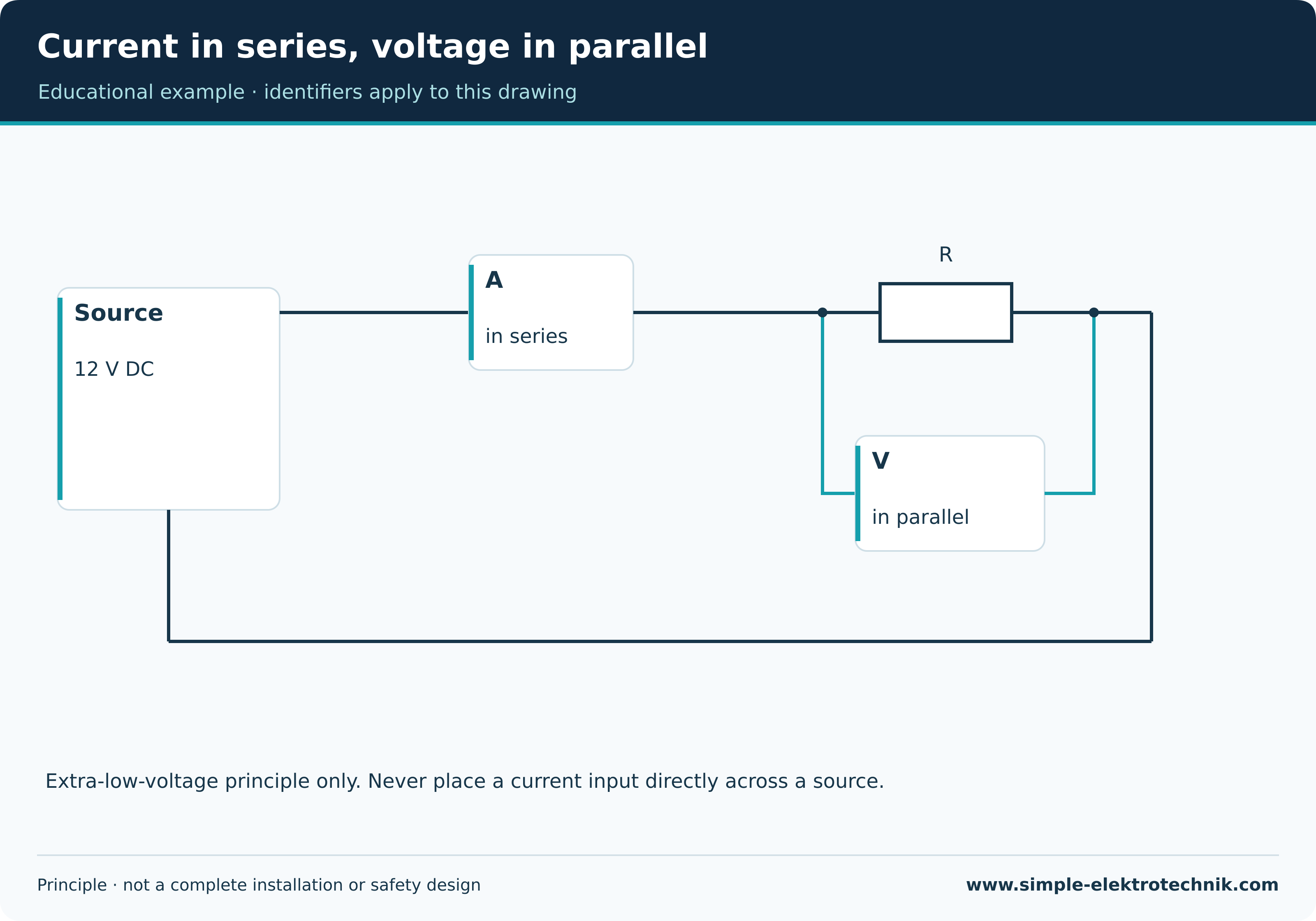
Voltage exists between points. Current passes through a conductor or component. This language helps with diagrams: measure voltage between references and consider current in an identified path.
Current in series, voltage in parallel
A simple circuit

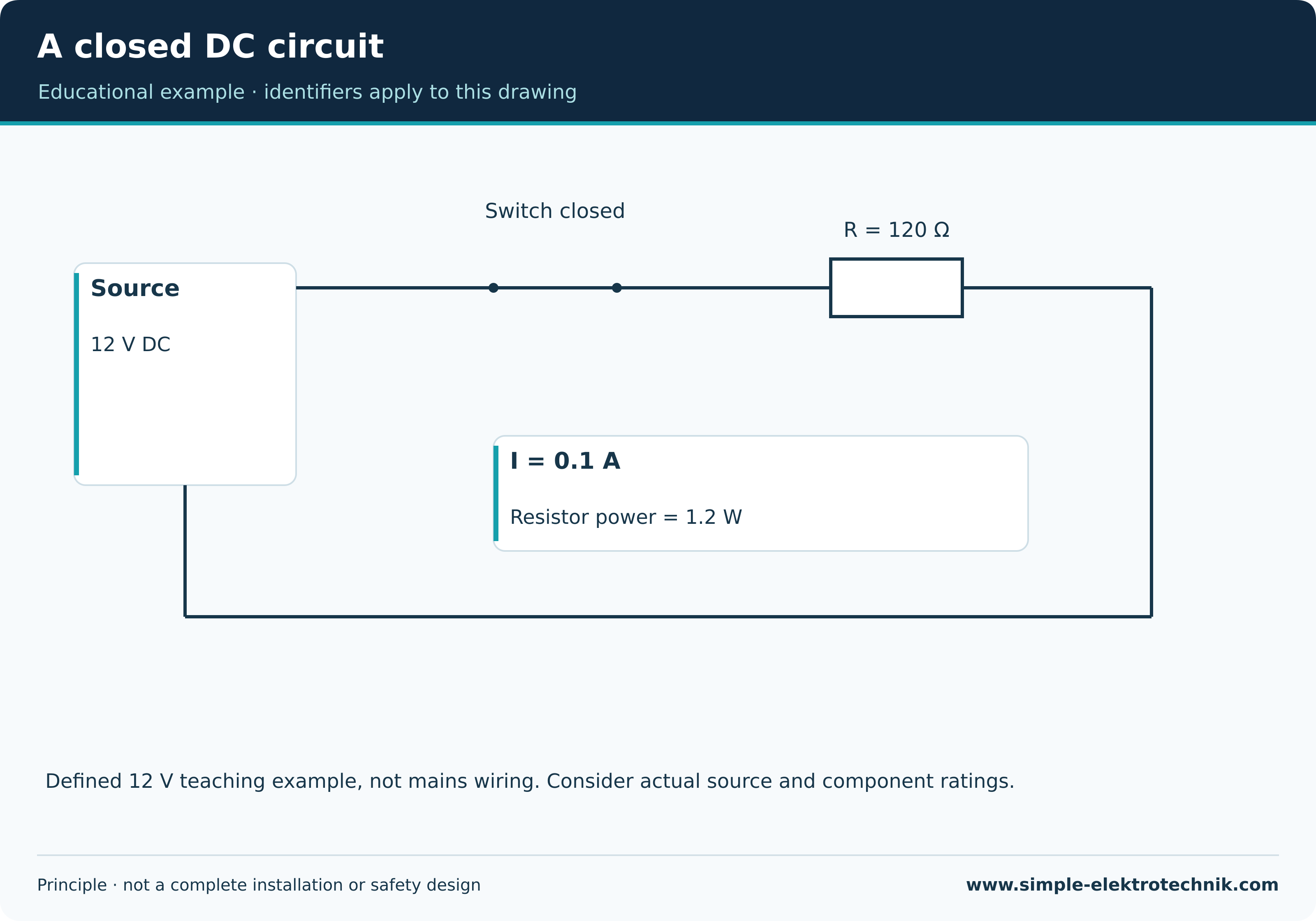
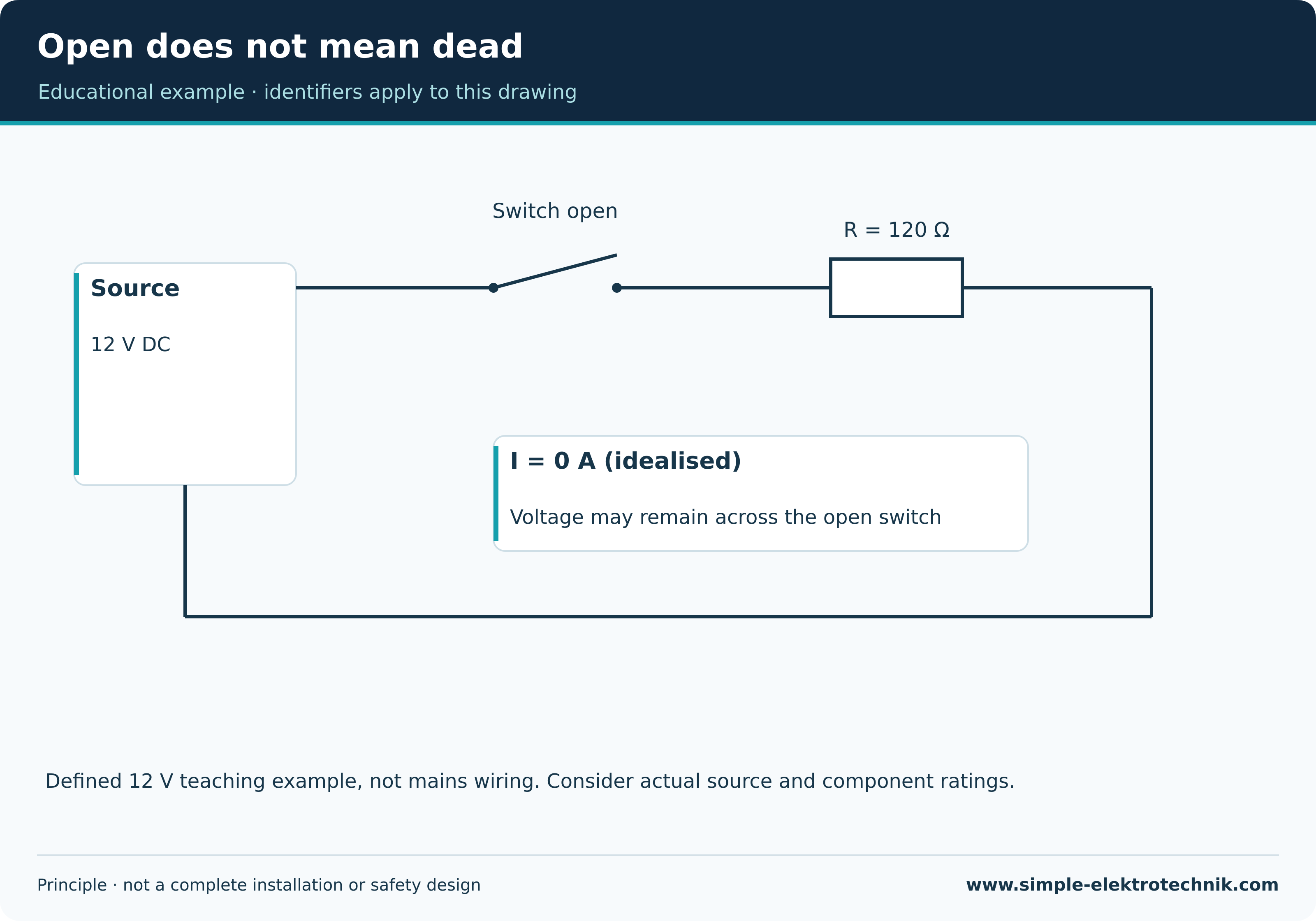
Our teaching example uses an idealised 12 V DC source, switch, 120 Ω resistor and connections. With the switch closed, the stated assumptions give 0.1 A. The resistor converts 1.2 W. A real experiment needs suitable construction and component rating; this is not mains installation wiring.
With the switch open, sustained current in the ideal circuit is zero. The source voltage can nevertheless appear across the open contacts. No current at present does not establish absence of voltage.
Real sources are not always ideal. Batteries have internal resistance, supplies have current limits and connections develop voltage drops. A short circuit can produce very high current, so source limitation and appropriate protection matter.
A closed DC circuit
Open does not mean dead
Conventional current and electrons
Conventional current in an external DC circuit is indicated from the positive to the negative terminal. Electrons in metal drift in the opposite direction. Keep the two descriptions distinct.
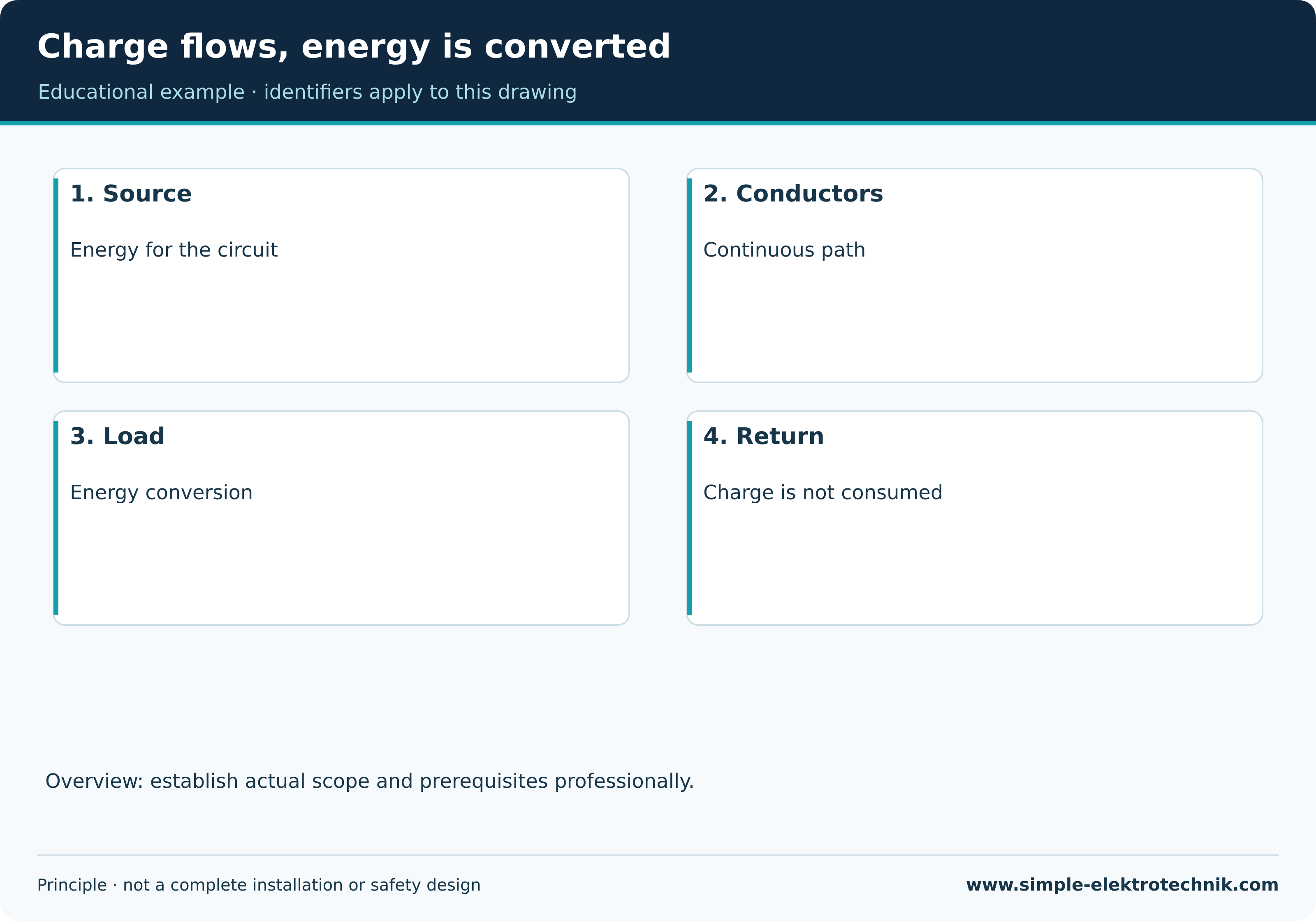
A load does not consume electric charge. It converts electrical energy to heat, light or motion, for example. In a simple unbranched steady circuit, current is the same before and after the load.
Charge flows, energy is converted
Resistance in the model
For an ideal ohmic resistor under unchanged conditions, voltage and current are proportional. Twice the resistance gives half the current at the same voltage; twice the voltage gives twice the current at the same resistance.
Not every device behaves as constant resistance. A regulated power supply or hot incandescent filament may respond differently. The simple model is insufficient for those cases. The Ohm’s law guide explains this limitation.
Read the units correctly
1 A equals 1000 mA. Thus 100 mA equals 0.1 A. A kilohm is 1000 Ω; a megohm is one million Ω. Prefixes change the numerical scale, not the physical quantity.
Current alone does not determine equipment energy consumption. Voltage, additional AC relationships where applicable and operating duration matter too. Power and energy therefore have a separate guide.
Common questions
Does higher voltage always mean higher current?
Only with suitable unchanged conditions, such as constant ohmic resistance. Regulated equipment may alter its behaviour. This is not a universal rule for every load.
Why does a conductor warm up?
Real conductors have resistance. Current converts some electrical power to heat. Acceptable temperature rise depends on construction, loading and conditions.
Can PE be used as a return conductor?
No. Neutral and protective conductor have different roles. The L, N, PE and PEN guide explains their purposes and limitations.
Continue learning
Sources and technical context
The references support basic principles; they do not replace assessment of the actual installation.