

RCBOs: residual-current and overcurrent protection

An RCBO combines residual-current and overcurrent protection in one device. It can respond to suitable residual currents and disconnect under overload or short-circuit conditions. Each protective function must still be selected for the installation.
Individual RCBOs can help separate the residual-current protection of final circuits. They are not an automatic requirement for every existing circuit, nor a guarantee that only one device will operate in every fault.
Two protective functions
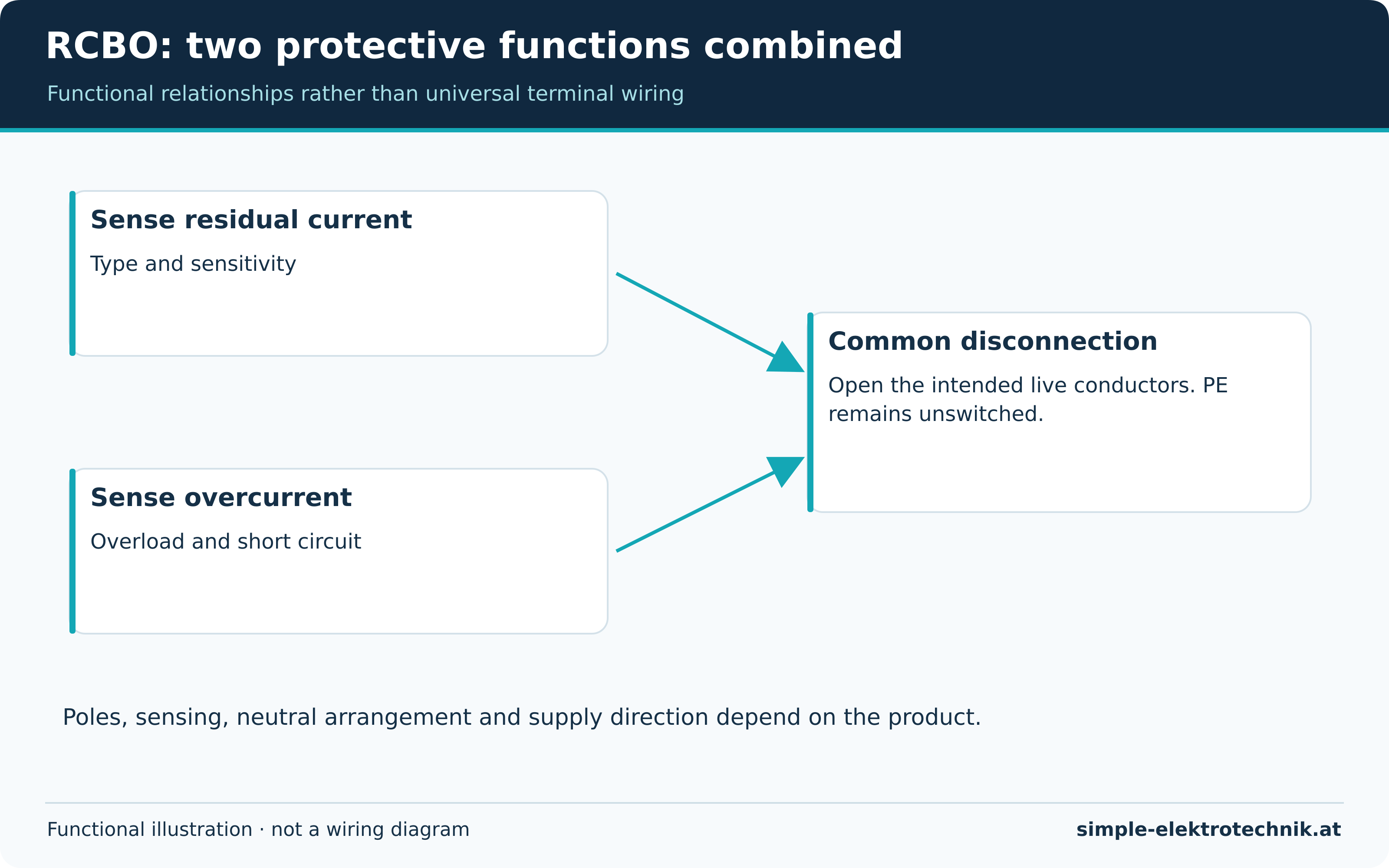
The residual-current section compares currents in the monitored live conductors. A suitable imbalance can initiate tripping. The overcurrent section responds to overload and short circuit according to its characteristic. A common mechanism opens the intended conductors.
Sensing and switching arrangements vary. A neutral pole may, for example, be switched without having its own overcurrent release. Neither enclosure width nor the number of handles reliably establishes this; use the product diagram.
PE remains outside the current comparison and is not switched. Neutrals from separate downstream circuits must not be interconnected indiscriminately. The monitored paths must match the intended circuit allocation.
Ratings to check together
| Function | Relevant information |
|---|---|
| Residual-current protection | RCD type, rated residual operating current and any time delay. |
| Overload protection | Rated current and circuit current-carrying capacity. |
| Short-circuit protection | Tripping characteristic, breaking capacity and disconnection conditions. |
| Installation | Poles, neutral arrangement, supply direction, terminals and busbars. |
| Operation | Temperature, mutual heating and specified device behaviour. |
Do not confuse RCD types A or B with MCB characteristics B or C. Similar letters describe different properties. Read the complete marking in context.
Individual RCBOs or a shared RCCB?
A shared RCCB followed by several MCBs divides protection differently from an RCBO for each circuit. Individual protection can limit some faults to a smaller area, make allocation clearer and reduce shared tripping caused by accumulated leakage.
Space, cost, wiring and actual product capabilities also matter. A narrow device may save space but does not remove requirements for temperature control and conductor routing. Conversion is not simply replacing equipment with something of the same width.
Upstream protection may also operate during a fault. Selectivity must be assessed for the actual combination. Planning should consider the consequences of losing a circuit, including lighting, refrigeration or communications.
Connections and fault finding
Follow the exact product diagram. Supply and load direction, neutral connections, terminal torque and accepted conductor types are not identical across all RCBOs. Do not assume an existing neutral bar can remain unchanged.
After alteration, verify both protective functions using the required procedures. A successful test-button operation does not establish all overcurrent protection conditions. A satisfactory loop measurement does not verify the entire residual-current function. These are complementary checks.
Product-specific trip indicators may help identify a cause. Where the device does not distinguish causes, handle position alone cannot establish whether residual current, overload or short circuit caused operation. Clear circuit records and the correct documentation help fault finding.
Common questions
Is an RCBO always safer than every other arrangement?
The complete protective design matters. Individual allocation can improve availability and investigation, but cannot compensate for wrong selection or wiring.
Is the test button still needed?
Yes, follow the requirements for the device and application. The integrated overcurrent section does not replace the intended check of the residual-current section.
Can neutrals remain shared between circuits?
Not indiscriminately. Every monitored circuit needs the correct live-conductor allocation. This is an important professional check during conversion.
Sources and documentation
More equipment guides: Equipment overview