

Electronics and components

Diodes, transistors and other components form the basis of many devices. Here their roles and key signal terms are explained while keeping the distinction between ideal models and real components clear.
A diode is not an ideal one-way conductor at arbitrary voltage. A transformer does not automatically guarantee protective isolation, and a high bit count alone does not make an accurate instrument. Entries therefore also identify limits of the simplified explanation.

How these terms connect
Components, signals and basic electronic functions. The short definition supports quick lookup. Open an entry for its example, important distinctions and useful references. Related terms link to further entries in the glossary.
The linked guides explain applications in greater detail. This glossary explains terminology and replaces neither product documentation nor assessment of an actual installation.
Look up a term
34 terms found
A
AmplifierAn amplifier changes a signal quantity using an additional energy supply and suitable circuitry.
Voltage, current and power gain are different properties. Input range, output load and frequency response limit actual operation.
Example
A small sensor signal can be conditioned suitably for a following measurement stage.
Important distinction
Amplification creates no free energy and does not automatically remove noise. A switching stage serves different tasks from a linear signal amplifier.
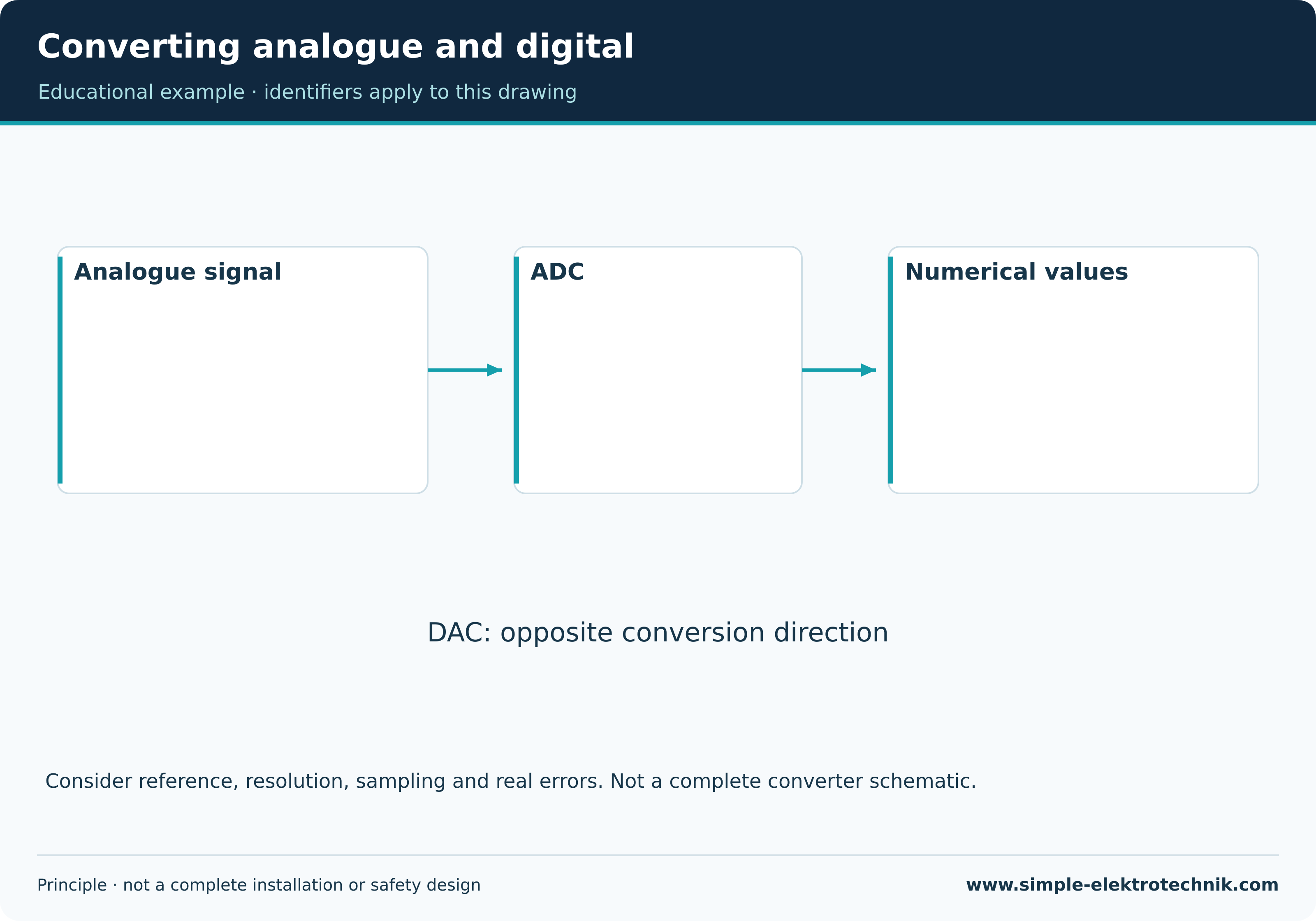
Analogue-to-digital converter (ADC)An ADC assigns digital numerical values to an analogue input using its intended conversion method.
Input range, resolution, sampling, reference and real errors influence the result. A high bit count alone does not establish matching measurement accuracy.
Example
An instrument may digitise a conditioned sensor voltage and calculate a reading.
Important distinction
Digitisation does not create real information beyond the suitable input and sampling range. It does not replace safe input circuitry.
B
Bridge circuitA bridge circuit has multiple branches with a considered cross-connection. Its actual purpose depends on the circuit.
Measurement bridges may compare component ratios. Other bridge arrangements perform rectification or controlled load operation.
Example
A Wheatstone bridge can express a resistance change as a differential signal.
Important distinction
Not every bridge is a measurement bridge. Rectifier bridges and H-bridges must not be described as having identical functions.
C
CapacitanceIn the simple linear case, capacitance is the ratio of stored charge to the associated voltage: C = Q/U.
Its unit is the farad. Construction and dielectric affect real capacitor properties; stored energy is a separate derived quantity.
Example
At the same applied voltage, a larger ideal capacitance stores more charge.
Important distinction
Farads do not express voltage rating. A matching capacitance value does not automatically make a capacitor suitable for a supply.
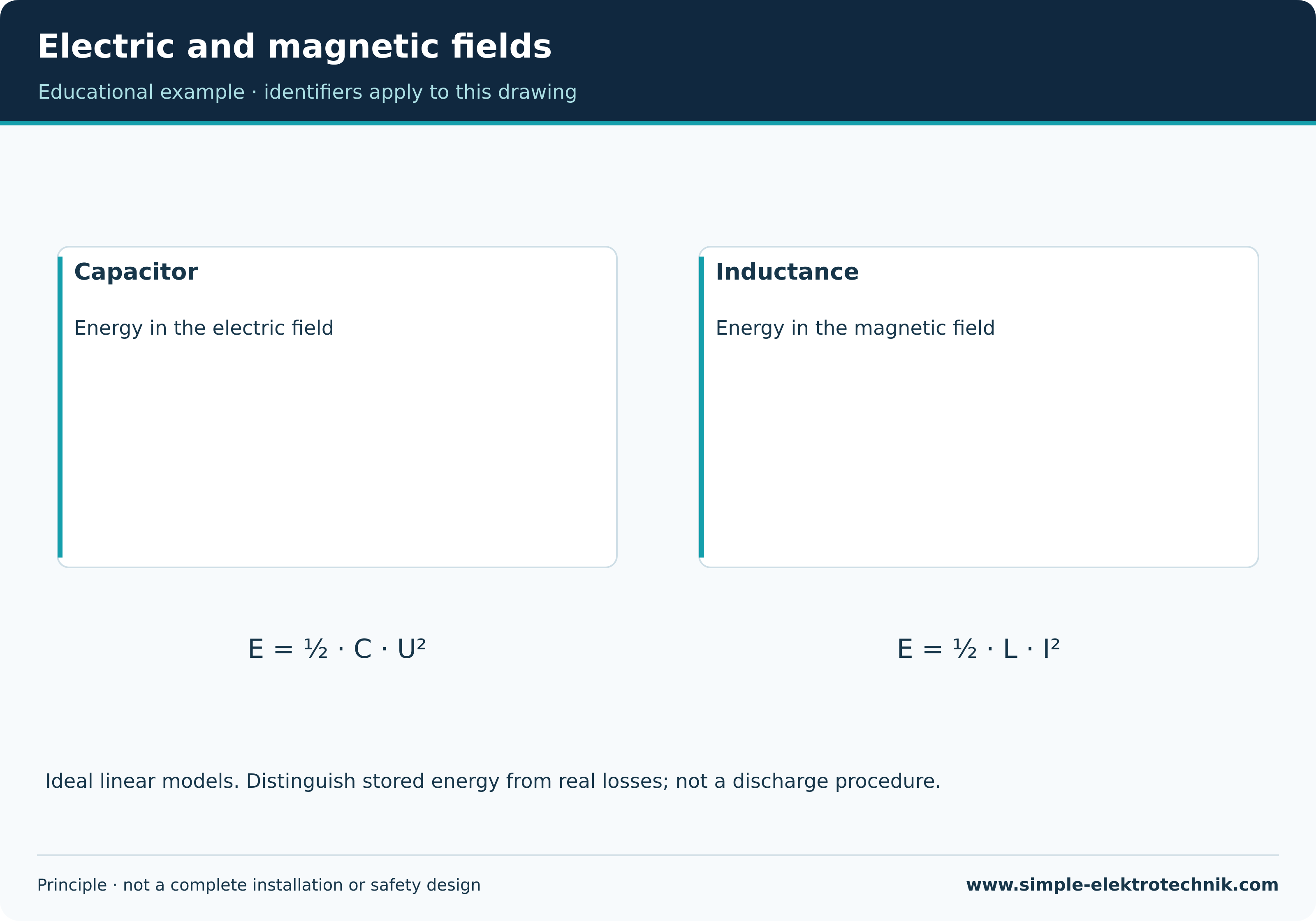
CapacitorA capacitor has capacitance and can store energy in an electric field.
Its behaviour depends on capacitance, voltage, construction and frequency. Real components have additional losses and limits.
Example
A suitable capacitor may reduce voltage variation in a supply.
Important distinction
Switched-off equipment may retain stored energy. Voltage rating and any polarity must not be guessed from case size.
Circuit analysisCircuit analysis examines currents, voltages and behaviour of an electrical circuit model.
Component models, sources and boundary conditions need definition. Ohm’s law, Kirchhoff’s laws and time- or frequency-dependent models provide different tools.
Example
An ideal resistor network can be calculated using node and loop relationships.
Important distinction
A mathematically consistent diagram does not prove a suitable real installation. Component ratings, protection and construction are additional matters.
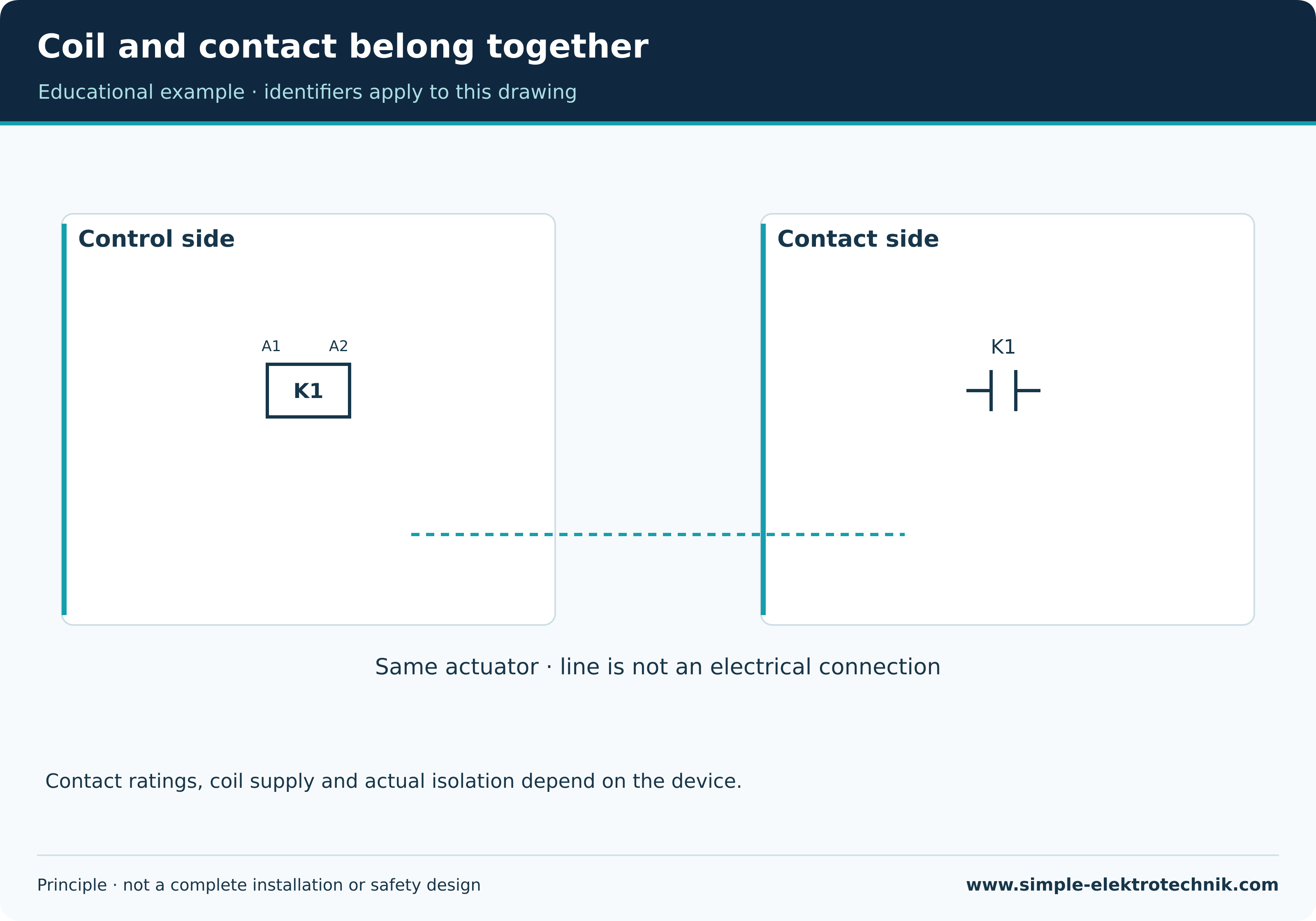
CoilA coil consists of one or more conductor turns. Current produces a magnetic field within it.
Current changes produce induced voltage in the relevant relationship. A core can influence behaviour but is not essential to every coil.
Example
A relay coil produces the magnetic action for its intended mechanical actuation.
Important distinction
Conductor resistance, inductance and real losses are different properties. Switching off a coil can cause particular voltage stresses.
D
Digital-to-analogue converter (DAC)A DAC produces an associated analogue output quantity from digital input values.
Reference, output circuitry, resolution and timing determine its properties. A following amplifier or filter may perform additional functions.
Example
A controller may use a suitable DAC to produce an analogue command voltage from a digital setpoint.
Important distinction
A DAC output is not automatically a power output for a motor. Load capability and signal range must be known.
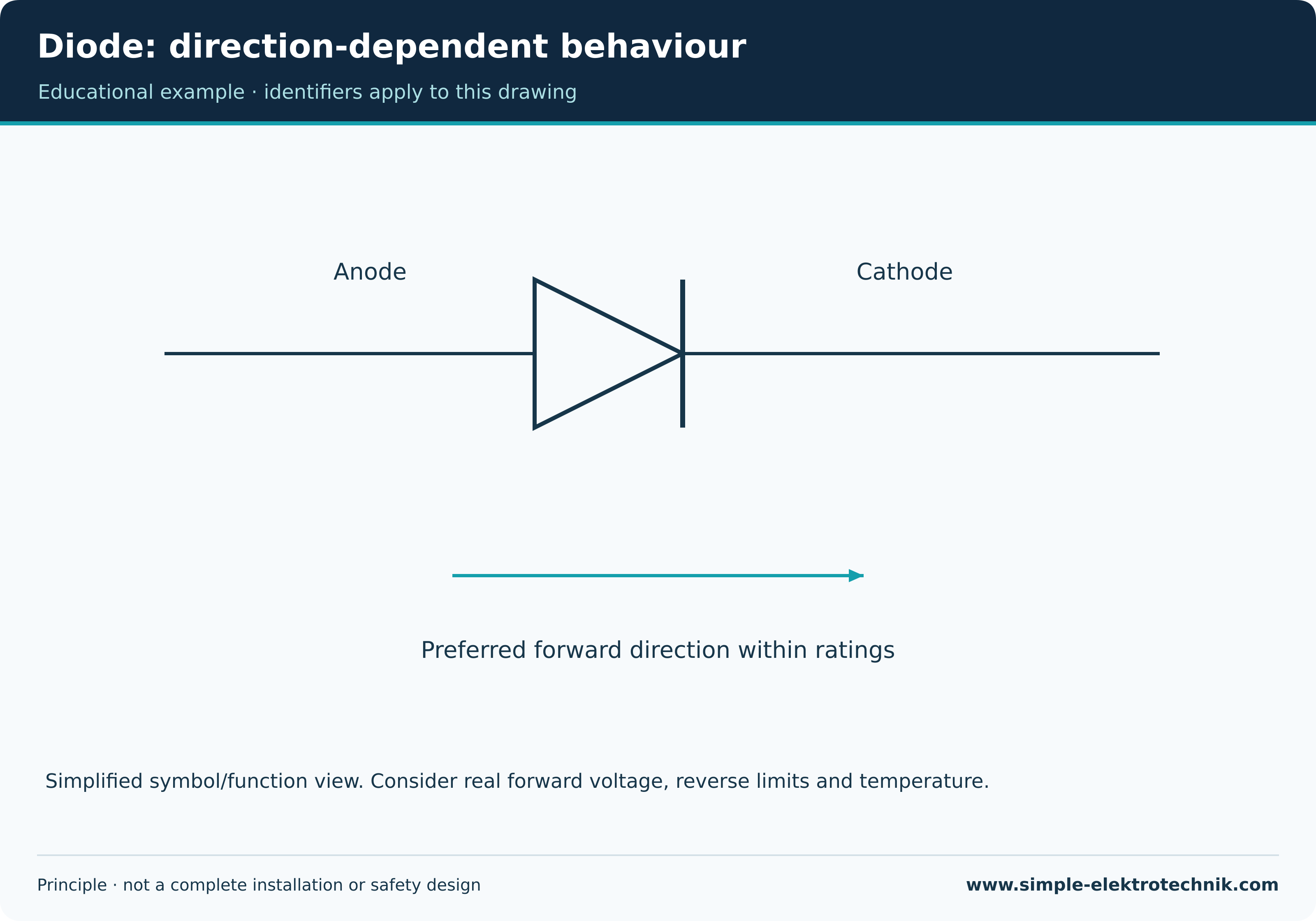
DiodeA semiconductor diode has direction-dependent electrical behaviour. Within its intended operating range, it conducts mainly forward and blocks in reverse.
Forward voltage, permitted current, reverse voltage and temperature are real component properties. Special diodes intentionally use additional effects.
Example
A rectifier may use suitable diodes to rectify AC quantities.
Important distinction
A diode is not an ideal one-way conductor at arbitrary voltage. LEDs, Zener and rectifier diodes are not interchangeable without checking.
E
Electric and magnetic fieldsElectric and magnetic fields describe electrical and magnetic effects in space.
Charges and time-dependent processes are associated with these fields. A current path’s magnetic field depends on current and geometry, among other factors.
Example
The arrangement of outgoing and returning conductors can affect the external field of a connection.
Important distinction
The term field alone supports no general claim about health effects or limits. Frequency, strength, exposure and appropriate technical evidence are needed.
ElectromagnetAn electromagnet produces its magnetic field through current in a designated coil.
A suitable core can influence and concentrate the field. Magnetic and thermal design determine intended operation.
Example
An electromechanical relay uses magnetic action to operate contacts.
Important distinction
A core is not essential to every electromagnet. A coil must not be connected to a supply merely on the basis of physical size.
Electromagnetic compatibilityEMC is the ability to operate as intended in an electromagnetic environment without causing unacceptable disturbance to other equipment.
Emissions and immunity are different aspects. Equipment, cables, installation and environment interact.
Example
Cable routing and specified screen connections may form part of a drive manufacturer’s requirements.
Important distinction
One filter or metal enclosure does not prove complete EMC suitability. Improvised screen connections can conflict with other requirements.
F
FeedbackFeedback returns part of a system’s output to an input.
Sign, gain and timing determine whether desired behaviour is stabilised or oscillation may be produced. The complete loop matters.
Example
Suitable negative feedback helps establish an amplifier’s intended transfer ratio.
Important distinction
Negative feedback is not automatically stable under arbitrary conditions. Delays and phase shifts can alter loop behaviour.
FilterA filter modifies a signal according to frequency or other specified properties.
Analogue and digital methods can attenuate or favour different ranges. Actual frequency response includes transitions and possible phase changes.
Example
A low-pass filter can attenuate fast signal components relative to slower ones.
Important distinction
A filter does not automatically eliminate every disturbance completely. Desired signal, interference spectrum and waveform effects need joint consideration.
Frequency responseFrequency response describes how a system transfers sinusoidal inputs at different frequencies in magnitude and phase.
Measurement or model conditions must be known. The response may show gain, attenuation, resonance and phase change.
Example
A filter has a different transfer ratio in its transition region than in its intended passband.
Important distinction
One cutoff frequency does not describe complete time and transfer behaviour. Loading can also alter actual response.
H
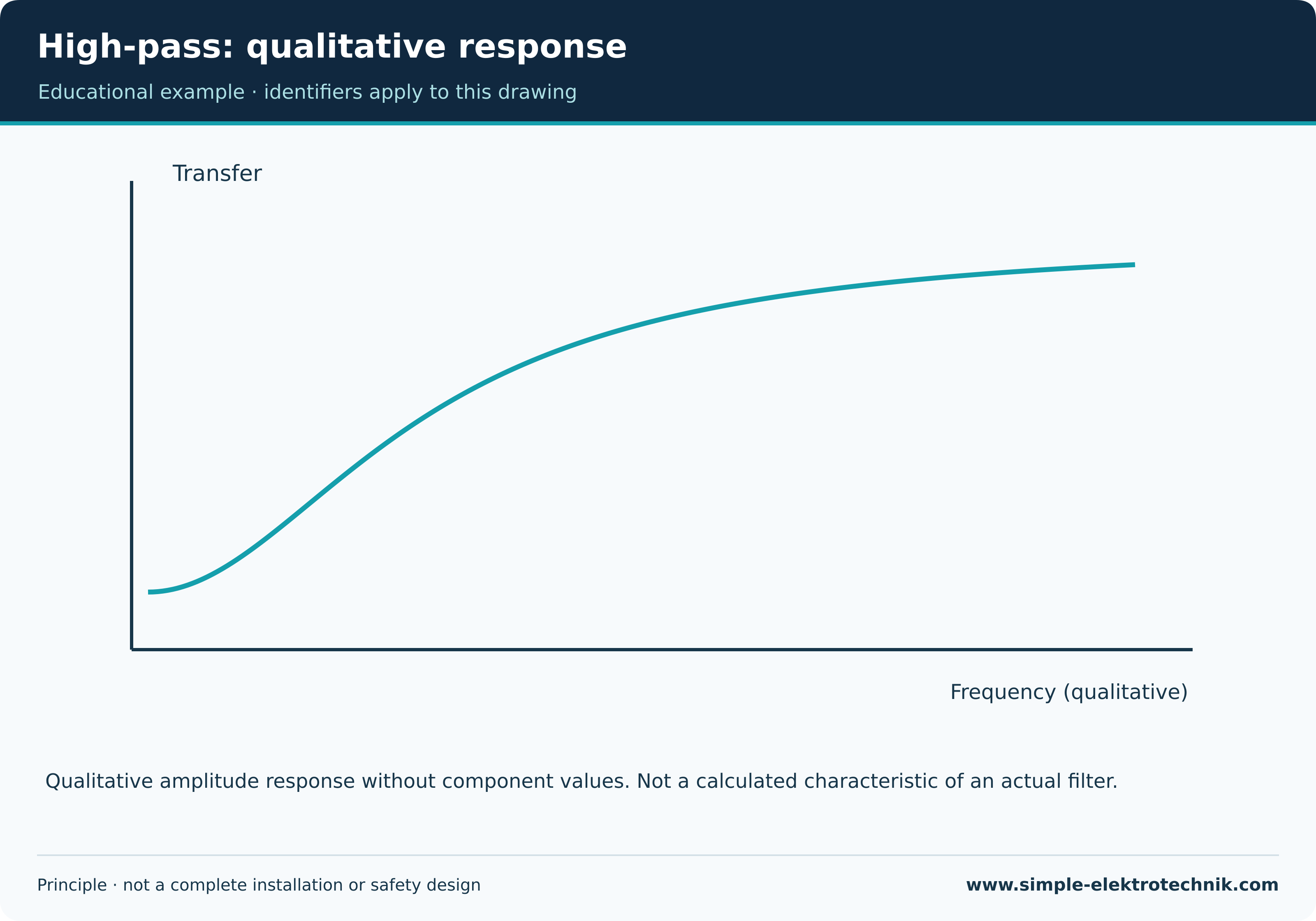
High-pass filterA high-pass filter favours higher frequencies over lower ones within its intended range.
Transition region, component values and loading affect actual response. The circuit may reduce low-frequency or constant signal components.
Example
Suitable signal coupling may keep a DC component out of a following stage.
Important distinction
This does not imply arbitrary galvanic or protective isolation. Signal filtering and electrical protection are different functions.
I
InductanceInductance describes the relationship between electric current and magnetic flux linkage. Its unit is the henry.
In a simple linear model, a changing current produces induced voltage according to its rate of change. Geometry, core and operating state can affect real behaviour.
Example
A choke uses inductive properties, for example to influence current waveform.
Important distinction
Inductance is not ohmic resistance. An ideal inductive element stores energy, while real windings also have losses.
L
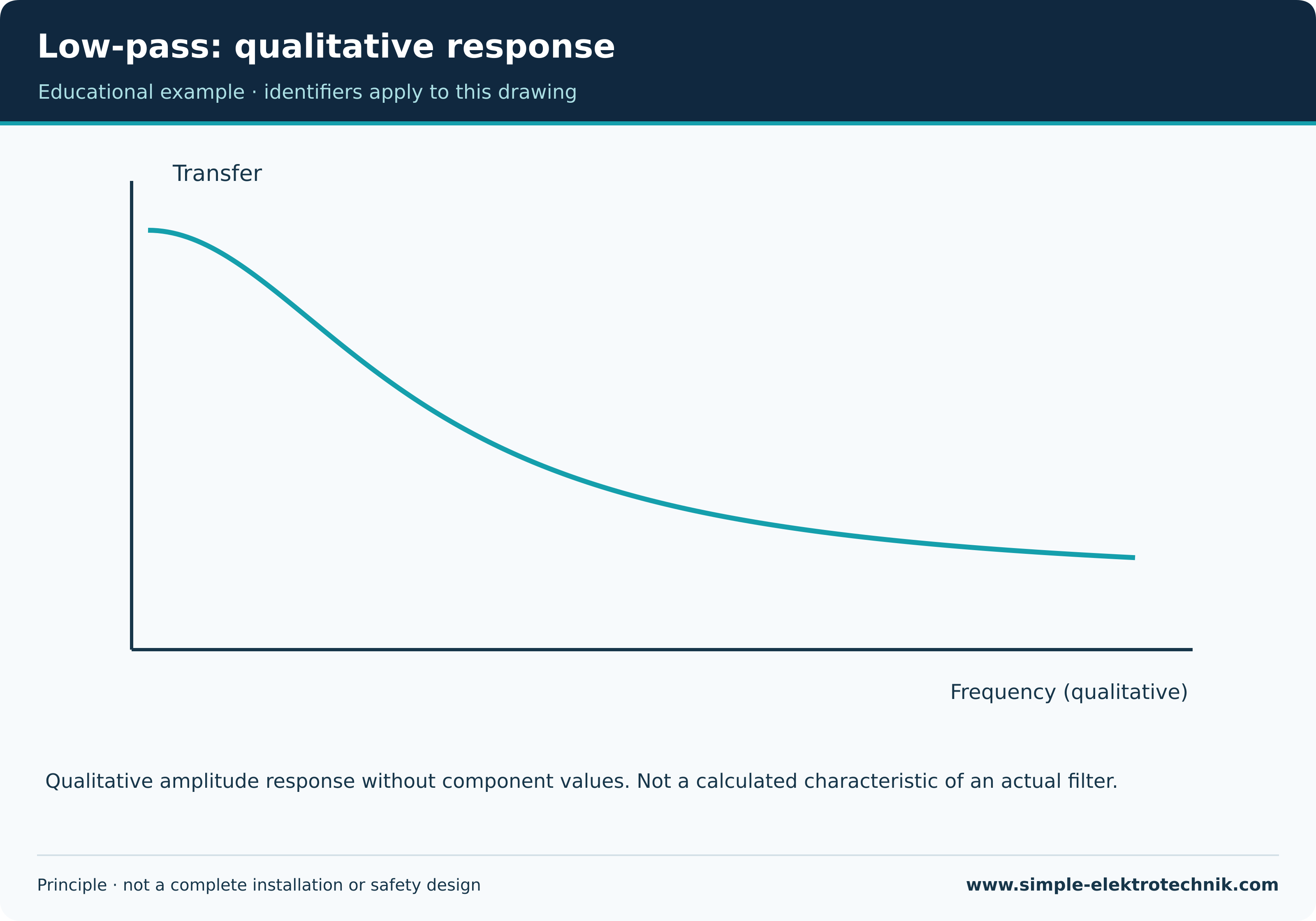
Low-pass filterA low-pass filter favours lower frequencies over higher ones within its intended range.
Cutoff, order and actual circuitry determine the transition. Outside an idealised model, attenuation is not a hard all-or-nothing boundary.
Example
A suitable filter can reduce particular fast components of a measured signal before further processing.
Important distinction
Filtering may also delay changes or alter useful information. A steadier displayed number does not therefore prove better accuracy.
N
NoiseNoise describes irregular signal components that can overlay the desired signal in transmission or measurement.
Sources may lie within a component or its environment. Noise, deliberate periodic interference and systematic measurement error are not identical in every assessment.
Example
A very small sensor signal may be difficult to resolve relative to unwanted components.
Important distinction
A filter may also alter useful information. Reduced visible variation alone does not prove a correct result.
O
Operational amplifierAn operational amplifier is an electronic amplifier building block with differential inputs that can perform many signal functions in a suitable external circuit.
Feedback and surrounding circuitry determine functions such as gain or filtering. Supply, input range, output range and dynamic limits must be respected.
Example
A suitable op-amp can condition a sensor signal for subsequent digitisation.
Important distinction
The ideal op-amp model has limits. An arbitrary op-amp is not automatically suitable as a comparator or power driver.
OscillationAn oscillation is a variation about a state that repeats after a defined time in the periodic case.
Amplitude, frequency and phase describe different properties of a suitable periodic waveform. Not every oscillation is sinusoidal or undamped.
Example
A sinusoidal AC quantity can be plotted over one complete period.
Important distinction
A single brief pulse is not automatically periodic oscillation. Visual regularity also does not replace quantitative measurement.
OscillatorAn oscillator produces a repeating signal waveform from a suitable energy supply.
Frequency, waveform, stability and startup depend on construction and components. An oscillator may provide analogue or digital waveforms.
Example
A clock oscillator supplies a timing reference for suitable electronic functions.
Important distinction
An oscillation is not automatically desirable. Feedback can also cause unintended instability in an amplifier.
P
Phase control and phase lockingPhase control can mean adjustment of phase or its tracking within a control loop, depending on context.
A phase-locked loop compares suitable signals and adjusts an oscillator to achieve the intended relationship. Construction and control behaviour determine function.
Example
A PLL may establish a clock or frequency relationship in suitable communication equipment.
Important distinction
The expression is not an unambiguous synonym for leading-edge lamp dimming. Always state the intended quantity and method.
Power lossPower loss is the part of input power not delivered as intended useful output.
Real losses may produce heating in conductors, semiconductors, magnetic materials or dielectrics. The assessment boundary must be clear.
Example
A power transistor may require suitable heat removal despite its small package.
Important distinction
Ideal inductors and capacitors consume no average active power; real devices have additional losses. Reactive power is therefore not simply power loss.
Power regulationPower regulation controls a power quantity using an intended setpoint and feedback.
Open-loop power control may operate without that feedback. Methods and limits depend on load, source and desired behaviour.
Example
Temperature control may vary heater power to move a measured temperature towards a setpoint.
Important distinction
Not every dimmer position regulates actual output power. Distinguish open-loop control, regulation and the quantity being regulated.
Power transistorA power transistor is designed for an intended power application such as switching or regulating suitable loads.
Voltage, current, switching losses, cooling and safe operating area need joint consideration. Drive and protection are parts of the circuit.
Example
An inverter may use suitable power semiconductors to create an intended output waveform.
Important distinction
A high datasheet current rating does not apply regardless of temperature or operating conditions. Similar packages do not allow arbitrary substitution.
R
RectifierA rectifier converts AC quantities into a rectified output quantity.
Diode or controlled circuits can perform the conversion. Smoothing, regulation and galvanic isolation are additional functions not implied by the term alone.
Example
Bridge rectification can use both half-cycles of a suitable AC supply.
Important distinction
Rectified does not automatically mean smooth, regulated or safe to touch. Output may still contain hazardous voltage and stored energy.
Resonant circuitA resonant circuit uses the interaction of inductance and capacitance to produce resonance.
In an idealised model, energy exchanges between magnetic and electric fields. Real losses and loading affect damping and resonance.
Example
A suitably tuned circuit may respond particularly strongly in a certain frequency region.
Important distinction
A real passive circuit does not oscillate indefinitely without losses. High resonant voltages can occur despite a small excitation.
S
SemiconductorSemiconductors are materials whose electrical properties can be used and controlled for electronic devices.
Doping, electric fields, temperature and light may influence behaviour. Different devices such as diodes and transistors are built using these properties.
Example
A semiconductor sensor may convert a physical quantity into an electrically usable signal.
Important distinction
A semiconductor is not simply an arbitrary resistor between conductor and insulator. Material behaviour and actual device structure matter.
Switching stageSwitching stage is a context-dependent term for a stage converting or amplifying a signal into intended switching states.
Threshold, drive and load side may have separate properties. The specific product term needs interpretation from circuit and documentation.
Example
A sensor output may operate an intended load through a suitable following stage.
Important distinction
Do not equate it with arbitrary linear gain or a safety permissive. Similar status indications do not establish identical electrical output types.
T
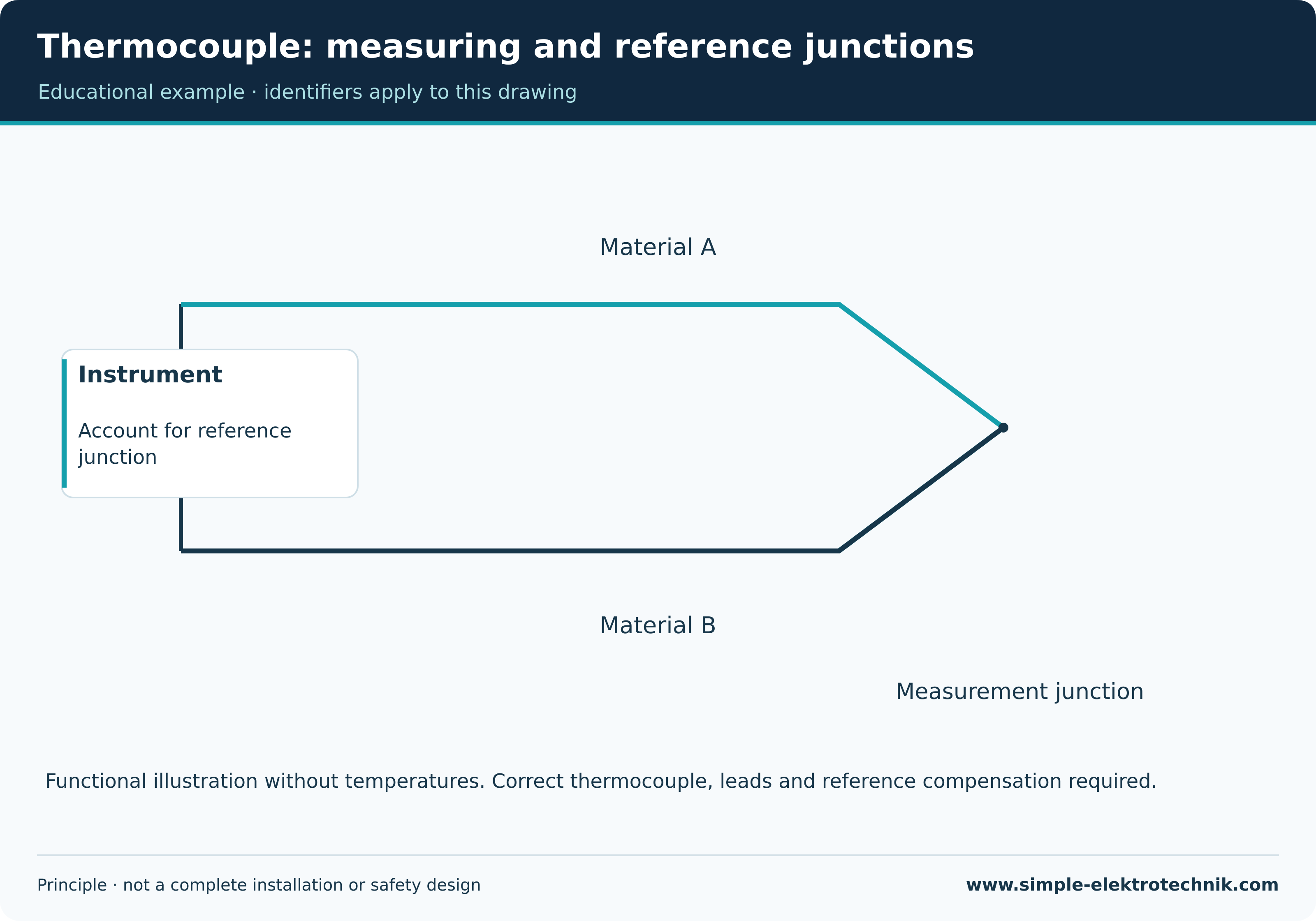
ThermocoupleA thermocouple uses thermoelectric voltage from a suitable combination of different conductor materials to determine temperature.
Measured voltage depends on temperature conditions at the measurement and reference junctions. Material pair, connecting leads and reference-junction treatment need to match the system.
Example
A suitable instrument considers required cold-junction compensation as well as measured voltage.
Important distinction
A thermocouple is not a temperature-dependent resistor such as a Pt100. Voltage alone does not provide a reliable temperature without the appropriate reference.
ThyristorA thyristor is a controllable semiconductor device. A common SCR can be triggered and remains conducting under the relevant current conditions.
Returning to blocking requires the conditions specified by the device and circuit. A normal SCR gate is not simply an arbitrary on-off input.
Example
Thyristor-family devices are used in suitable power controllers and controlled rectifiers.
Important distinction
A thyristor is not a general current limiter. SCRs, triacs and other forms must not be treated as identical without considering their differences.
TransformerA transformer transfers electrical energy through magnetic coupling between designated windings or winding sections.
Ratio, frequency, loading and construction determine intended operation. An autotransformer has common winding sections and differs from a separate-winding design.
Example
A suitable winding arrangement may transform AC voltage to another rating.
Important distinction
Transformer does not automatically mean protective separation or safe extra-low voltage. An ordinary mains transformer is not an arbitrary DC converter either.
TransistorA transistor is a semiconductor device used to control electrical signals or currents.
Bipolar and field-effect transistors differ in construction and drive. At suitable operating points, they can amplify or operate as switches.
Example
A suitable transistor stage may use a small control signal to switch an intended load.
Important distinction
The name alone does not specify permitted voltage or dissipation. Similar-looking packages can have different pin arrangements.
No matching term. Try another spelling or select all topics.