
Motors and drives

A motor connects electrical supply with a mechanical task. Rotating field, torque, slip and starting current describe different parts of that relationship. These terms help interpret nameplates and principle drawings.
Star-delta starting and Dahlander pole changing are different methods. A variable-frequency drive also serves different purposes from a starting-only circuit. Actual windings, terminals and protective settings always need the correct equipment documentation.

How these terms connect
Three-phase systems, motor behaviour and starting or control methods. The short definition supports quick lookup. Open an entry for its example, important distinctions and useful references. Related terms link to further entries in the glossary.
The linked guides explain applications in greater detail. This glossary explains terminology and replaces neither product documentation nor assessment of an actual installation.
Look up a term
11 terms found
D
Dahlander connectionA Dahlander connection changes an induction machine’s pole number through a specially designed winding arrangement, thereby changing its speed step.
It uses a different principle from a starting-only reconnection. Actual winding variant, ratings and switching sequence follow the motor documents.
Example
A suitable Dahlander motor may have two designated speed steps.
Important distinction
An arbitrary star-delta diagram is not a Dahlander connection diagram. Similar terminal counts do not prove identical windings.
I
Induction motorAn induction motor develops torque through interaction between a rotating field and currents induced in its rotor.
In normal motoring operation, the rotor runs at a speed different from the associated synchronous field. Slip describes that difference.
Example
As load increases within the operating range, the required slip changes.
Important distinction
Rated rotor speed is therefore not simply synchronous field speed. Motor type, supply and operating limits must be considered.
M
Motor protectionMotor protection comprises suitable measures against specified impermissible operating stresses.
Depending on the concept, current, temperature or other conditions are monitored. Short-circuit and overload protection may need different devices or functions.
Example
An overload relay may release its associated contactor through a control contact.
Important distinction
A setting does not follow merely from the circuit name. Location, motor rating and manufacturer coordination matter.
R
Rotating magnetic fieldA rotating magnetic field is a magnetic field rotating in space. Suitable multiphase windings can produce it through time-displaced currents.
The principle enables many AC motors. Field direction and speed depend on the supply system and machine construction.
Example
The supply phase sequence can influence field direction in a correspondingly connected machine.
Important distinction
A phase-sequence tester indicates electrical order. Actual mechanical rotation needs additional assessment through a suitable procedure.
S
SlipSlip describes the relative speed difference between the synchronous rotating field and an induction-machine rotor.
For the usual motoring case, s = (ns − n)/ns is used. Load and operating state influence its actual value.
Example
A rotor at 1440 rpm with an assumed synchronous speed of 1500 rpm has a calculated slip of 4%.
Important distinction
Slip is not mechanical belt slippage. Formula and sign relate to the considered machine operating mode.
Star and delta connectionStar and delta are different ways of connecting three load branches in a multiphase system.
In star, branches meet at a common point. In delta, they connect between line conductors. Their branch voltages therefore differ at the same line-to-line voltage.
Example
In an ideal balanced case, each star branch receives ULL/√3, whereas each delta branch receives ULL.
Important distinction
The terms do not specify an arbitrary motor terminal plan. Nameplate and manufacturer documents determine permitted connections.
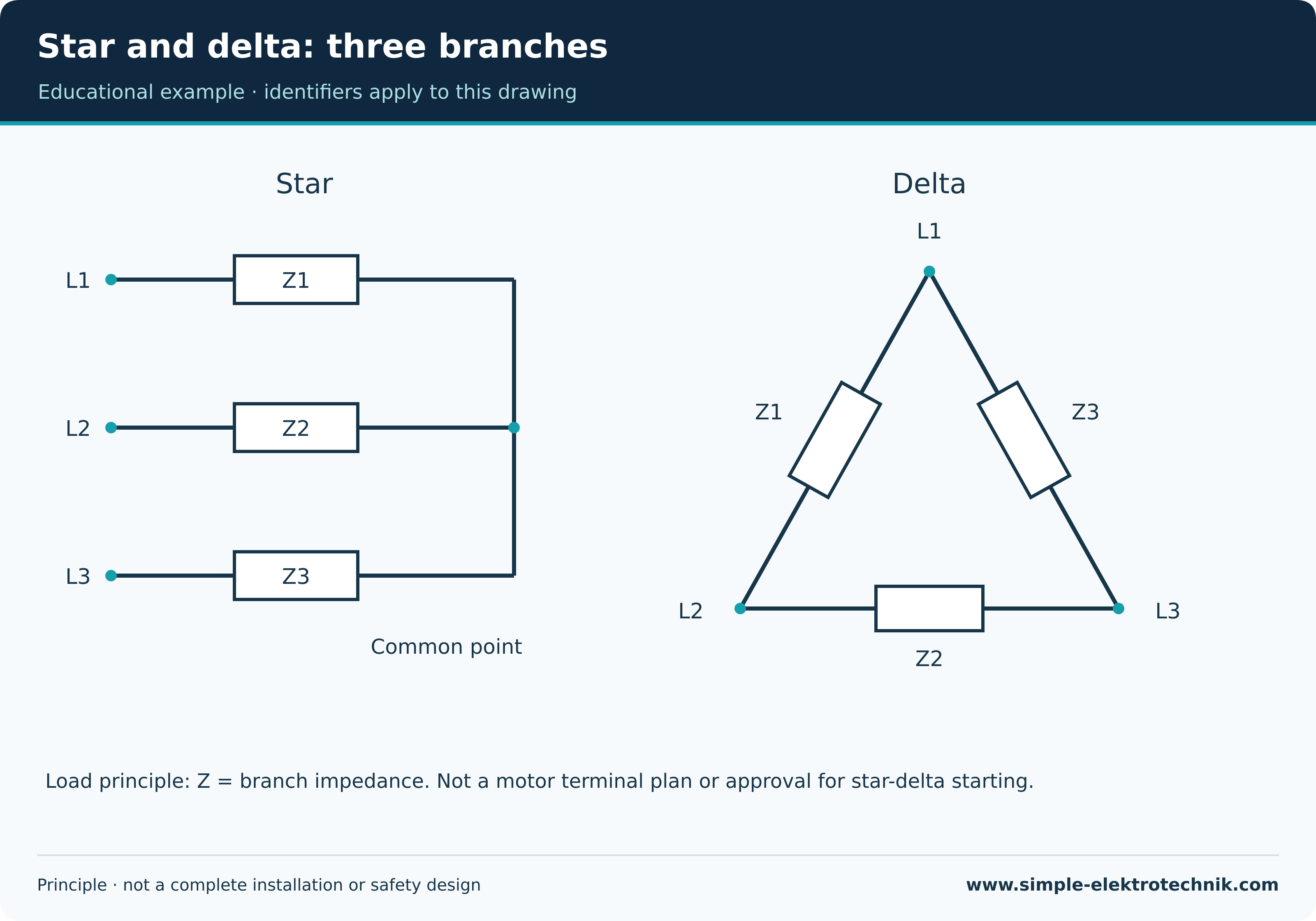
Star-delta startingStar-delta starting starts a suitable motor in star before transferring to its intended delta running connection.
Motor rating, accessible winding ends, load torque and transfer sequence need suitability. Compared with the corresponding direct start, both starting current and available starting torque are reduced.
Example
A suitable starter interlocks against impermissible simultaneous star and delta connection.
Important distinction
It is not suitable for every six-terminal motor. Fixed transfer times or universal overload settings cannot be inferred from the term.
Starting currentStarting current describes current during machine startup. It may differ substantially from normal running current.
Starting method, motor and connected load influence magnitude and duration. Electronic-equipment inrush may arise from different processes and requires separate consideration.
Example
A starter needs to account for load requirements, permitted supply stress and protective coordination.
Important distinction
Brief high current is not automatically a short circuit. Conversely, an excessively long or unsuitable start must not simply be accepted as normal.
T
Three-phase ACA balanced three-phase system has three sinusoidal AC quantities at the same frequency, displaced by 120° from each other.
Line-to-line voltage and voltage to the neutral point are different. An ideal balanced star system has the √3 voltage relationship.
Example
In the stated 230/400 V example, about 230 V is present line to N and about 400 V line to line.
Important distinction
Not every load needs N, and not every motor accepts every connection on that supply. Actual equipment ratings matter.
TorqueTorque describes the turning effect of a force about an axis. Its unit is the newton metre.
For rotation, mechanical power, torque and angular speed are related by P = M · ω. A load’s starting requirement may differ greatly from continuous operation.
Example
A drive must provide the required load torque during the intended acceleration.
Important distinction
High electrical input power alone does not prove suitable starting. Gearing, speed range and load behaviour form part of selection.
V
Variable-frequency driveA variable-frequency drive produces a controlled electrical output supply for its intended drive, with variable frequency and other regulated properties.
It can influence motor speed and operation. Motor suitability, EMC, protective measures, cable routing and manufacturer requirements must be considered.
Example
A suitable drive can adjust speed to the process instead of merely switching fixed steps.
Important distinction
Output waveforms are not simply unchanged mains sine waves. Stored energy may remain relevant after switching off.
No matching term. Try another spelling or select all topics.