
Choosing electrical test instruments

The right instrument safely and traceably answers the actual test question. A multimeter, a two-pole voltage detector and an installation tester may display similar quantities but are not interchangeable tools.
Selection includes the function, location, electrical stress, accessories and handling. The largest printed voltage or finest display resolution is not enough.
Match the instrument to the task

| Instrument | Typical purpose | Important limitation |
|---|---|---|
| Two-pole voltage detector | Voltage checks and appropriate proving-dead tasks | Suitable design and functional checks are required |
| Digital multimeter | Voltage and other supported quantities | Its resistance range is not installation verification |
| Installation tester | Suitable continuity, insulation, loop and RCD functions | Equipment and methods vary between models |
| Current or leakage clamp | Current measurement without opening the conductor | Resolution, AC/DC capability and frequency range must suit |
| Earth tester | Defined earthing test methods | Stakes and return paths depend on the method |
| Equipment tester | Equipment verification under the applicable framework | Not a universal substitute for installation testing |
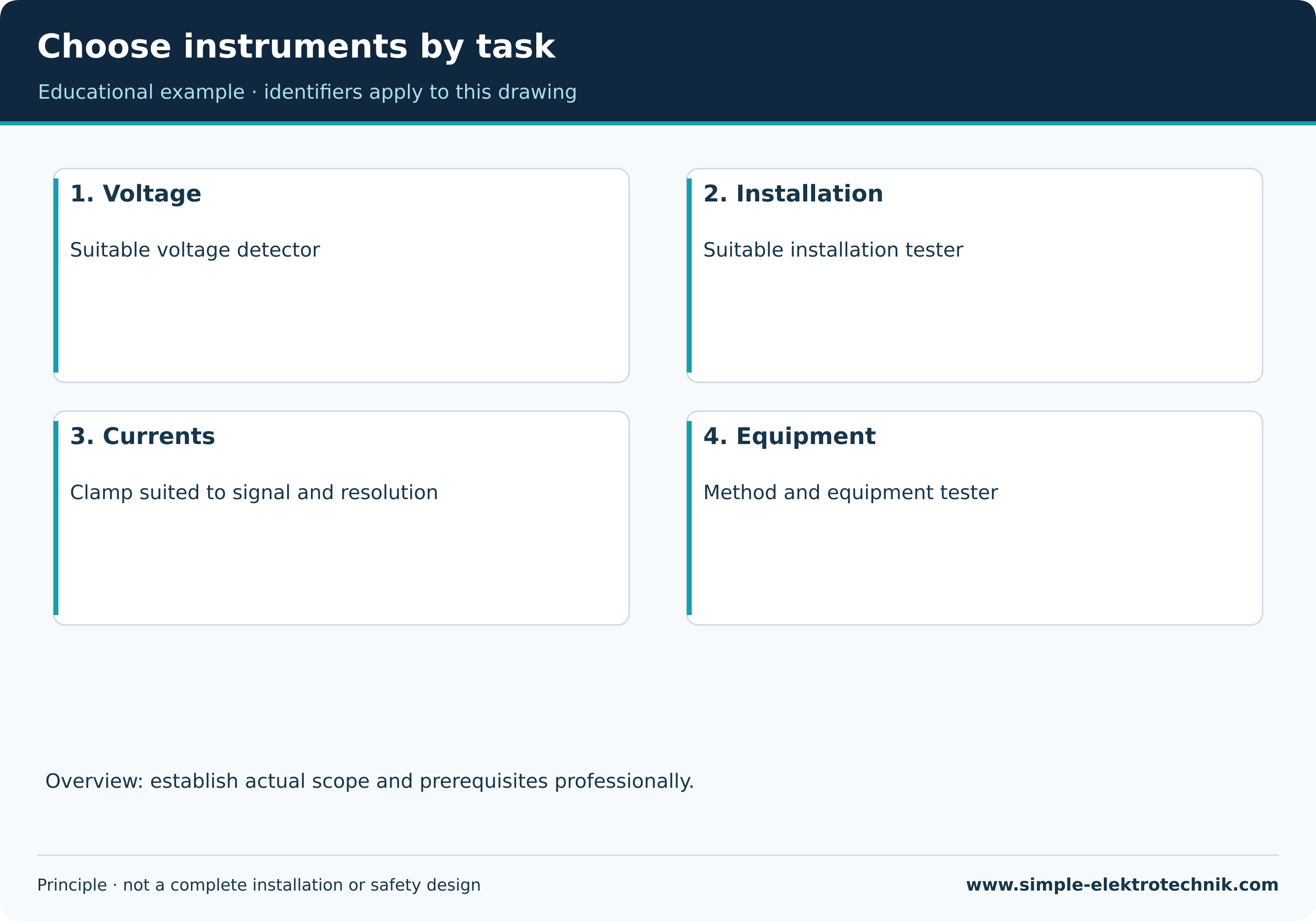
Choose instruments by task
Category and voltage belong together
Measurement categories describe intended electrical environments and transient stresses. Read CAT III together with the voltage rating and actual application. A larger voltage figure without a suitable category does not establish suitability.
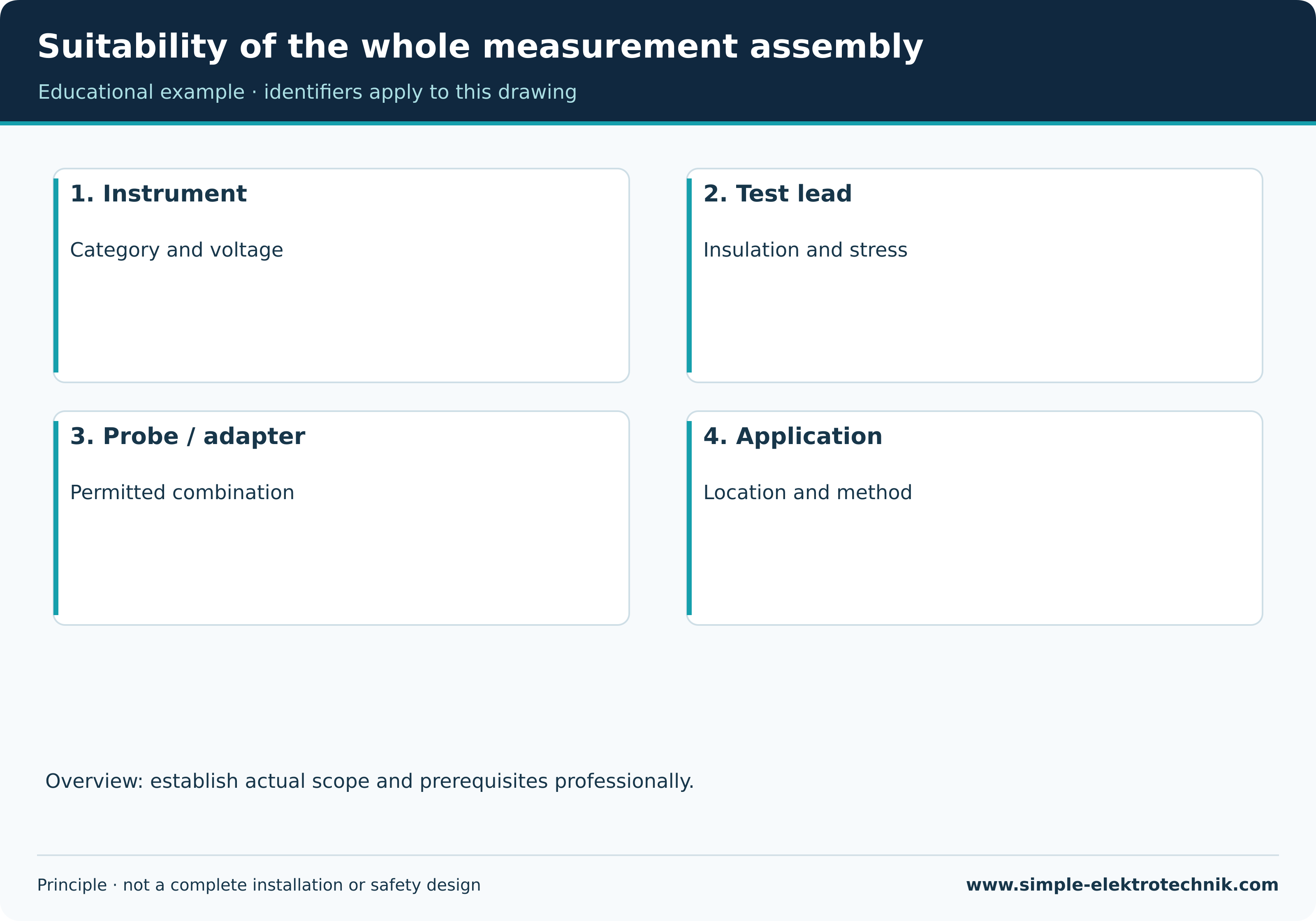
The whole assembly matters: instrument, leads, probes, caps, adapters and any fuses. A lower-rated accessory is not upgraded by an expensive instrument. Manufacturer instructions define permitted combinations and conditions.
A category rating does not authorise the operator or replace protective measures. Suitable equipment can still be used dangerously with the wrong function or handling.
Suitability of the whole measurement assembly
Check before use

Inspect the enclosure, insulation, leads, plugs and probe tips. Check function, readiness and socket selection. A multimeter lead left in a current input is a particular hazard when the next intended task is voltage measurement.
Resistance and continuity functions are used only on suitable isolated objects. Selecting a range does not isolate a supply. Proving dead requires the appropriate method and instrument functional checks.
For low-resistance testing, account for lead resistance according to the instructions. Stored compensation may become wrong after changing leads. The actual arrangement must match the correction.
Accuracy, resolution and suitability
Resolution describes display discrimination. Accuracy describes possible error under specified conditions. Neither proves that the method is appropriate. More decimal places do not validate an unsuitable test.
AC/DC capability, frequency range, waveform and filters affect voltage and current readings. True RMS does not guarantee correct measurement of arbitrary signals outside the instrument specification. A filter can stabilise the display while excluding some signal components.
Instrument control and records
Inspection, functional checks, comparisons and calibration serve different purposes. Necessary measures and intervals depend on use, manufacturer guidance and quality requirements. A calibration certificate does not excuse a lead damaged today.
Instrument identity supports traceable records. Investigate unusual results by checking the setup and, where appropriate, using a suitable reference instrument. Do not select whichever reading happens to pass.
Common questions
Can one inexpensive multimeter do everything?
No. Demonstrable suitability, condition and functions matter. Price or brand alone cannot answer the question either.
Does automatic testing mean automatic assessment?
No. The programme works with the selected settings and connected points. Scope, protective measure and the professional decision remain the examiner's responsibility.
Related guides
Sources and technical context
- Fluke 1672/1673 FC/1674 FC – Users Manual, Rev.4,06/2026
- BENNING DUSPOL expert – Bedienungsanleitung,02/2019
- Fluke 9040/9040UK – Bedienungshandbuch Rev.3,11/2021
- Megger DCM305E – Earth leakage clampmeter
Sources support this explanation. Public standard summaries do not replace the complete standard. Retain national context and equipment conditions.