

Electrical equipment testing: principles and process

Equipment testing assesses the condition, protective measures and operation of an identified item. It differs from verification of the circuit supplying it. A sound socket does not prove that connected equipment is safe.
The reason and equipment type determine the process. Periodic testing, post-repair verification and manufacturer testing are not interchangeable. Medical and welding equipment, for example, can have their own requirements.
Identify the protective concept

Use equipment identity, rating plate, instructions and actual construction together. Do not infer protection class solely from enclosure material. Metal parts can occur in different protective concepts; plastic alone does not establish complete double insulation.
| Protective concept | Implications |
|---|---|
| Class I | Examine intended protective conductor connections and other required properties |
| Class II | Consider double or reinforced insulation; do not invent a protective conductor path |
| Class III | Assess the suitable protective extra-low-voltage supply and equipment together |
A power supply and the equipment it supplies can have different protective concepts. Low output voltage alone does not describe the full measure. Include the agreed accessories, lead and plug in the scope.
Equipment testing by protective concept
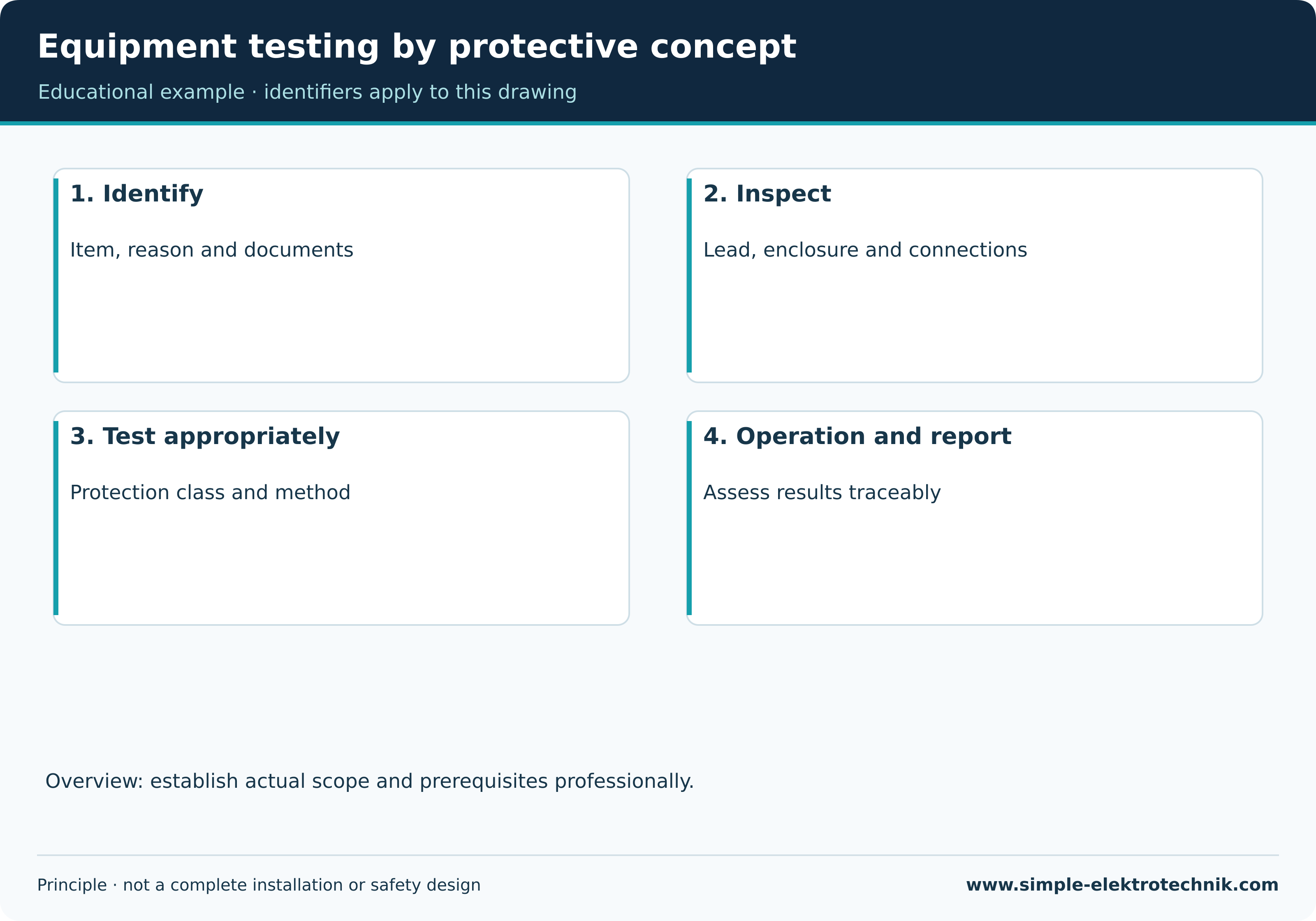
Inspect and prepare
Check the lead, plug, restraint, enclosure, controls and safety markings. Record heating or abrasion, loose parts and unclear earlier modifications. An evident dangerous defect is not a reason to continue blindly through an automatic sequence.
Identify the item and record its condition. Consider motion, heat and stored energy. A motor can start unexpectedly during testing; a heater can be hazardous without visible movement.
Select electrical tests deliberately

Depending on the concept and method, protective conductor resistance, insulation resistance, protective conductor current or touch current can be relevant. They do not measure the same property. Use an alternative method only where appropriate and justified.
Switches and electronics influence what is included. A favourable insulation result on switched-off equipment may not include an internally disconnected heater. Conversely, unsuitable test voltage can damage electronics.
Touch-current measurement uses an appropriate measuring network. Arbitrary direct current connections or a voltage reading on an enclosure are not equivalent. Follow the defined method and instrument instructions.
Functional testing
After the necessary preceding checks, examine intended operation safely. Modes and settings must suit the equipment. Brief energisation cannot assess every function of a complex item.
Depending on the method, different plug orientations may be relevant. Consider them in the plan rather than treating one favourable reading as complete evidence.
Standards and national context
EN 50678 and EN 50699 address post-repair and recurrent verification respectively. Check their national application and additional requirements for the country. German VDE designations and workplace intervals do not automatically apply in Austria or Switzerland.
No universal equipment limits are claimed here. Reason, equipment, method and applicable requirements determine assessment. Manufacturer information is especially important for specialised equipment.
Records and questions
Record equipment identity, reason, methods, results, assessment, defects and required examiner and instrument details. A test label identifies status; it does not replace the associated report.
Is successful operation sufficient?
No. Load current can flow despite an interrupted protective conductor. Operation and protective effectiveness are different questions.
Does every item follow the same sequence?
No. Protective concept, equipment type, connection and reason determine the suitable process.
Related guides
Sources and technical context
Sources support this explanation. Public standard summaries do not replace the complete standard. Retain national context and equipment conditions.