

Understanding electrical verification

Electrical verification asks more than whether power is present. It examines whether construction, protective measures and functions suit the intended use. Inspection and testing need professional evaluation before individual observations become meaningful evidence.
Equipment may operate with a missing protective conductor. A lamp may work despite damaged insulation. Conversely, an unexpected result may come from an unsuitable setup. Understand the question before selecting the instrument function.
Three complementary tasks

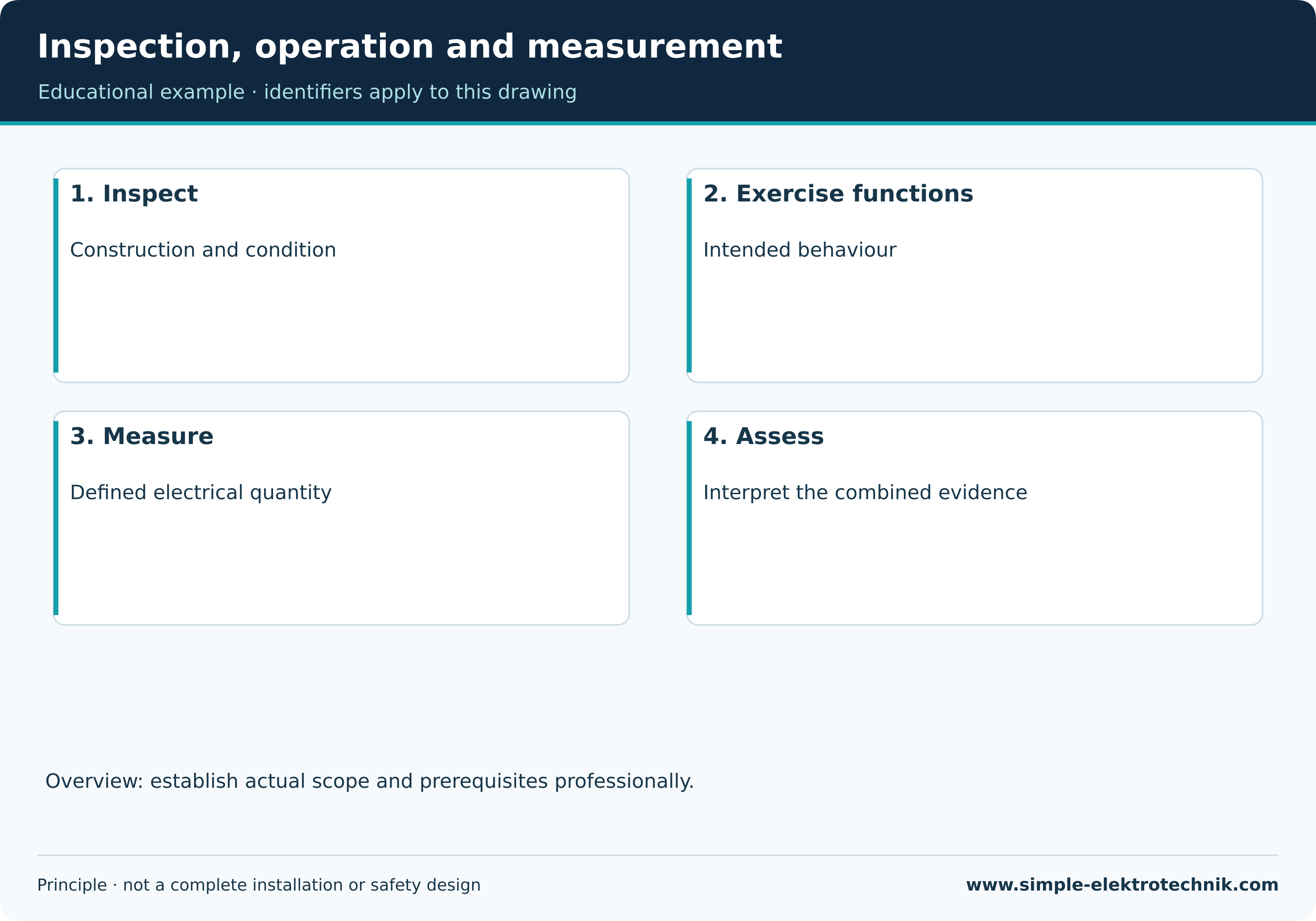
Visual inspection assesses selection, installation, condition and visible defects. Some inspection takes place during construction while future concealed parts remain accessible. It cannot replace necessary measurements, and measurements cannot excuse visible damage.
Functional testing examines behaviour: does a control operate the intended load? Do timing and interlocks work as intended? The application determines the scope. Successful operation is not proof of complete electrical safety.
Measurement determines a physical quantity by a suitable method. Protective conductor resistance, insulation resistance and loop impedance investigate different properties despite their related names. Choose the method for the question.
| Question | Appropriate approach |
|---|---|
| Is an enclosure damaged? | Visual inspection |
| Is the intended protective path continuous? | Suitable continuity or low-resistance testing |
| Are defined conductive parts adequately insulated? | Insulation testing under defined conditions |
| Has the intended disconnection measure been verified? | Assessment of protection and relevant tests |
| Does the control operate as designed? | Functional testing |
Inspection, operation and measurement
Identify the object and reason
A fixed installation and equipment connected to it are different test objects. Testing a socket does not replace testing a machine supplied from it. Equally, verified equipment does not prove the condition of its supply.
Initial verification concerns new and altered installations before intended service. Periodic verification assesses an existing installation in operation. Reason, condition and framework influence scope. Even replacement of a small component can affect a safety-critical connection.
Earthing arrangement and protective measure

TN and TT systems differ in important parts of the fault path. In a simplified TN example, a metallic protective path returns to the earthed source. In TT, the earthing arrangement forms part of the assessment. This comparison does not identify an actual installation's earthing arrangement.
RCDs and overcurrent devices perform different tasks. How a device is relied upon for automatic disconnection must match the protective measure. A favourable figure from another example is not transferable simply because nominal voltage is the same.
Give each result its context
Record the unit, location, method, settings and operating condition with the number. Low resistance is wanted for some purposes, high resistance for others. An isolated display of “0.2” is not useful evidence.
Instrument selection and result evaluation therefore complement the individual measurement guides. Safe preparation and competence matter equally. This website explains principles; it does not confer authorisation to work on mains installations.
Common misunderstandings
Is a green tick a complete verification report?
No. It relates to an instrument setting and the path actually measured. Incorrect identification, omitted checks or visible damage may remain undiscovered.
Must every installation follow exactly the same tests?
No. The object, protective measure, reason, country and special use determine requirements. A clear framework helps but cannot replace an appropriate plan.
Related guides
Sources and technical context
- OVE – OVE E8101: Neufassung2025
- Arbeitsinspektion: kommentierte ESV 2012
- DKE: DIN VDE 0100-600 Kurzdarstellung
Sources support this explanation. Public standard summaries do not replace the complete standard. Retain national context and equipment conditions.