

Functional testing of electrical circuits

Functional testing checks whether a circuit behaves as intended. It connects the design with real operation: which control operates which load, what timing is intended and what happens after an interruption?
Successful operation does not replace verification of protective measures. A circuit can switch correctly while containing a dangerous connection fault.
Turn the intended function into a plan

Describe expected behaviour first. “Works” is too vague. A staircase timer may require checks of starting, timing and its actual retriggering function. A seal-in control involves start, stop and behaviour after supply interruption.
| Circuit | Example behaviours to examine |
|---|---|
| Two-way or intermediate switching | Every control changes the intended lamp state |
| Impulse relay circuit | Suitable button pulses produce the intended transition |
| Timer control | Start, timing mode and model-specific extra functions match |
| Seal-in control | Start, holding path, stop and supply-loss behaviour suit the design |
| Reversing control | Intended interlocks and permitted changeover sequence are considered |
This is not complete machinery verification. Emergency stop, guard interlocks and other safety-related functions require their applicable evidence and any necessary validation.
Functional test: intended and actual
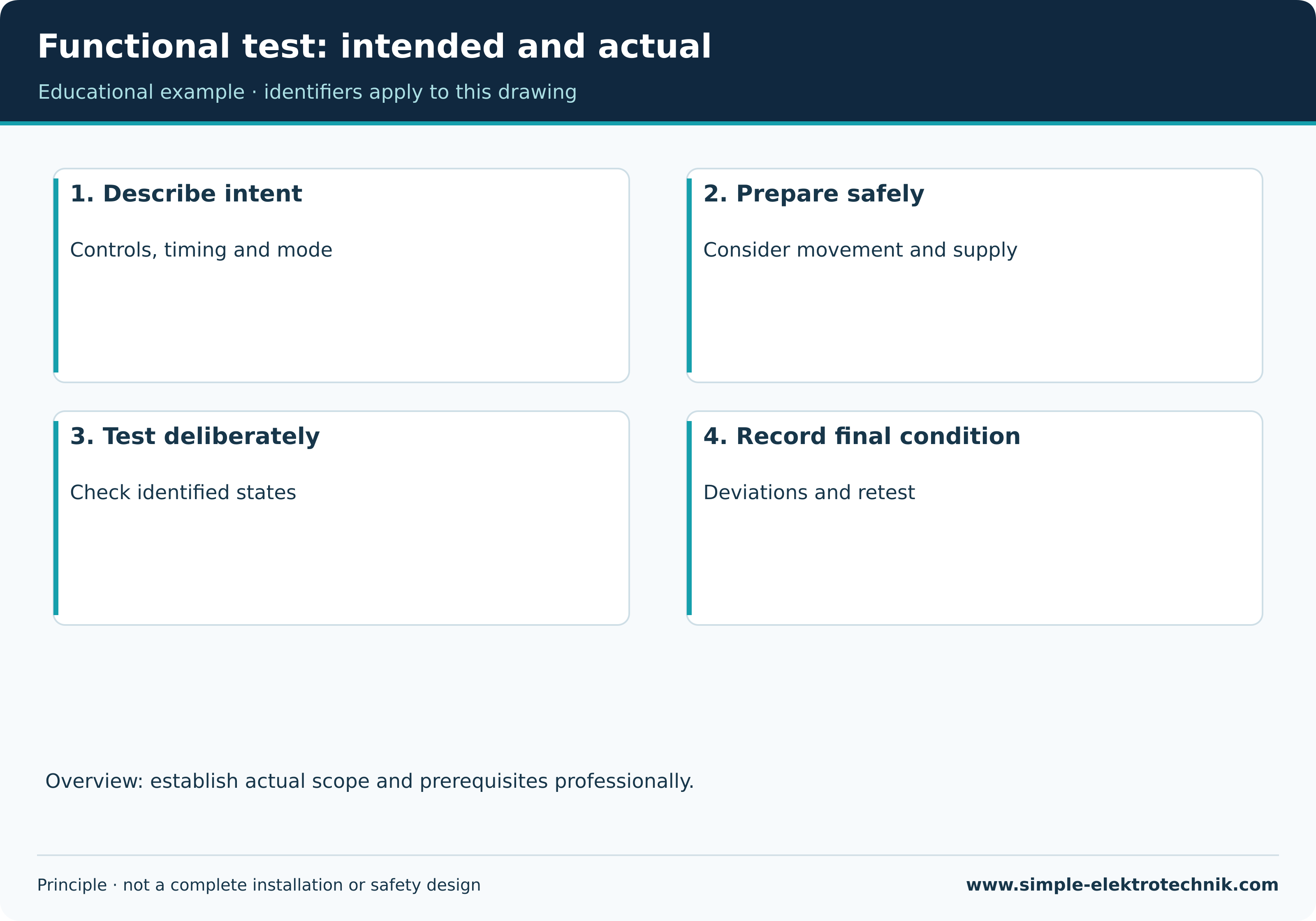
Before supplying the circuit
Complete the checks needed for safe energisation. Restore temporary disconnections and consider covers and protection. Prevent dangerous motion, heat and unexpected starting.
For motors, consider load, direction and rundown. An open contactor does not prove mechanical standstill. Testing cannot consist simply of pressing direction buttons arbitrarily.
Examine operating states deliberately

Check normal start and stop, then other intended states: multiple controls, repeated presses, timing or permitted modes. Use the actual configuration.
Behaviour after a supply interruption deserves attention. Some controls retain states; others restart with a maintained command. The word seal-in does not guarantee prevention of restart. A held start button can also alter behaviour.
Investigate abnormal states only through suitable safe methods. Do not bypass protection indiscriminately. Deliberately causing a short circuit is not an appropriate functional check.
Example: lighting from multiple locations
Identify each control on the actual circuit. Verify that every location operates the intended lamp without unexpected permanent states. For timers, document the behaviour of the actual model.
Where several lighting groups exist, check every assignment. Light coming on somewhere is insufficient. Incorrect labels can be problematic in daily use as well as incorrect wiring.
Results and retesting
Record intended behaviour, tested condition and actual observation. Investigate deviations in a safe state. After correction, reconsider affected electrical and functional checks.
The lighting circuit guides explain the operating principles. Initial verification places functional checks within the complete process.
Common questions
Is a tripped protective device a successful functional test?
Not without context. Unexpected operation is initially a deviation requiring investigation. Deliberate protective verification needs an appropriate method.
Can timing be tested with any short setting?
Only where the equipment and test purpose allow it. Record temporary settings and restore the intended final condition.
Related guides
Sources and technical context
Sources support this explanation. Public standard summaries do not replace the complete standard. Retain national context and equipment conditions.