

MCBs: overload and short-circuit protection

A miniature circuit-breaker, or MCB, disconnects a circuit under overload or short-circuit conditions. It protects the associated wiring against excessive current when correctly selected and installed. Selection therefore starts with the cable and disconnection requirements, not simply the desired appliance power.
An MCB is not an RCD. Overcurrent and residual-current protection are separate functions; an RCBO combines them in one product.
Overload and short circuit
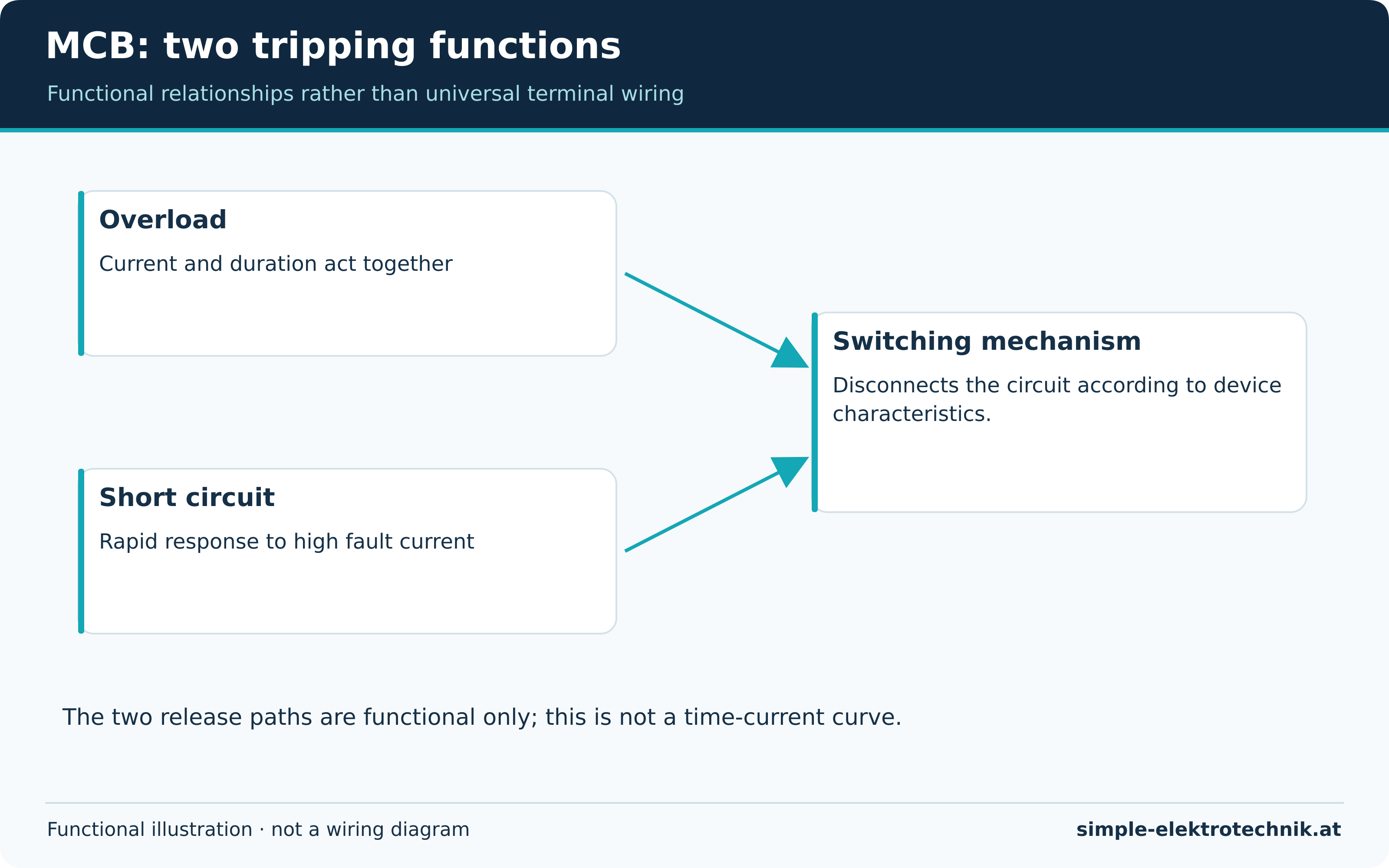
An overload occurs when operating current exceeds what the circuit is designed to carry, for example when several loads together overload a cable. Heating increases. A common thermal-magnetic MCB uses a thermal release whose response also depends on how long the overcurrent persists.
A short circuit is an unintended low-impedance connection between different potentials. Current can rise sharply. A magnetic release responds to sufficiently high current. Actual disconnection depends on fault current, the device characteristic and breaking capacity.
Not every hazardous hot spot causes an MCB to trip. A poor terminal connection can overheat while total current stays below the MCB rating. Suitable, properly made terminations remain essential.
Ratings and selection
| Rating | Purpose |
|---|---|
| Rated current | Match the permissible current-carrying capacity of the protected wiring. |
| Tripping characteristic | Establish time-current behaviour, including magnetic operation. |
| Breaking capacity | Match prospective short-circuit conditions at the installation point. |
| Number of poles | Match the supply and required switching function. |
| Voltage, frequency and temperature | Remain within the permitted operating conditions. |
B and C identify different tripping characteristics. A C device is not inherently stronger or better. It may suit certain loads with higher inrush, but the associated disconnection conditions must also be satisfied.
Cable length, cross-section, installation method, ambient temperature and grouping all affect design. A socket circuit does not imply one universal cable size and protective-device rating. Busbar compatibility, supply arrangements and upstream protection must also follow product instructions.
Working with RCDs and loads
An RCD detects suitable residual currents; an MCB responds to overcurrent. Both functions may be needed for the same circuit. An RCBO combines them in a coordinated product.
Electronic equipment may draw a brief starting current well above its normal operating current. Investigate the load and circuit before changing the protective device. Increasing the current rating simply to avoid occasional tripping can leave wiring inadequately protected.
Selectivity with upstream devices is not established by different ampere ratings alone. Use characteristics and the manufacturer's coordination information. It is not safe to promise that only the smallest breaker will operate in every fault.
Responding to a trip
A trip indicates a condition requiring assessment. Where safe, unplug portable loads and stop using damaged, wet or unusually hot equipment. This does not require opening a distribution board.
If the device trips again after an appropriate reset attempt, seek competent investigation. Do not hold the handle in place or bypass the device. Repeatedly closing onto a fault can stress the installation.
Assessment includes inspection and suitable electrical testing. Loop-impedance testing may contribute to checking disconnection conditions, depending on the protective measure. A working appliance does not establish those conditions.
Common questions
Why does a small overcurrent not cause an immediate trip?
Overload protection follows a time-current characteristic. Rated current is not a single instantaneous trip threshold. Use the actual characteristic and operating conditions for assessment.
Can a B MCB simply be replaced with C?
That changes the protective arrangement. The cable, load and disconnection conditions need professional reassessment; it is not a general solution to inrush problems.
Does switching the MCB off make work safe?
Not automatically. Correct circuit identification, other sources, prevention of reconnection and proving dead remain part of establishing a safe working condition.
Sources and documentation
More equipment guides: Equipment overview