

Interpreting results and electrical test reports

A test report explains what was verified, how it was examined and how the evidence was assessed. It is more than favourable numbers. Limitations, defects and clear circuit or equipment identification matter too.
A number without context can be impossible to assess. “0.35 Ω” means different things for different methods and paths. Here it is only an illustration of a unit, not an acceptance limit or real measurement.
Five linked elements

| Element | Purpose |
|---|---|
| Object and location | Which circuit, item and connection were included? |
| Method and settings | What was examined, with which programme and conditions? |
| Result and unit | Which physical quantity was displayed? |
| Assessment basis | Which requirement applies to this case? |
| Outcome and action | Pass, defect, unresolved or untested; what follows? |
The protective measure and associated device can be essential to interpretation. A loop result without identifying the disconnection measure relied upon is incomplete.
Read the teaching report
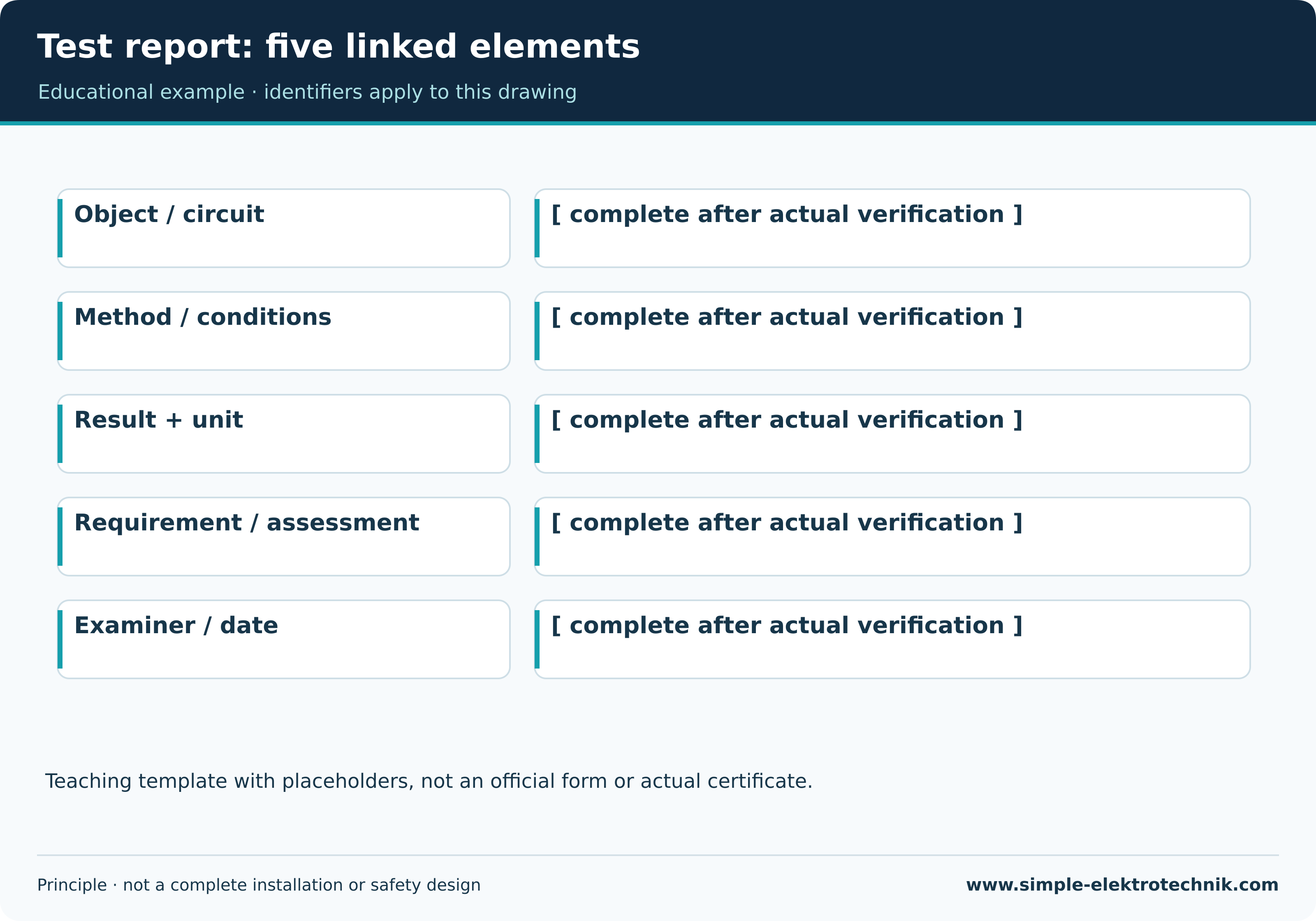
The illustrations are original teaching templates with placeholders. They are not official forms or completed safety certificates. They explain the relationship between the circuit schedule, location and assessment.
The heading identifies the installation, reason, date and responsible people. Scope states whether, for example, a whole new board or one extension was covered. Drawings and identification should represent the same final condition.
Results need their method and conditions. Insulation resistance requires the actual test voltage, for example. An RCD record needs the device type, programme and corresponding results. A tick alone cannot replace this information.
Test report: five linked elements
Untested is not passed

An empty field might mean inapplicable, inaccessible, forgotten or pending. Distinguish those states. Never replace an untested part by copying a neighbouring result.
If a test cannot be performed, clarify why and what that means. A limitation affecting the entire conclusion should not disappear in a small footnote. Permitted use depends on the actual evidence and applicable requirements.
Describe defects precisely
Identify the location, affected part, observation and consequence. “Bad RCD” is too vague. A useful record identifies the device, selected programme and deviation without inventing an unconfirmed cause.
Following correction, repeat and identify the necessary tests. Preserve a traceable history of the original result. Changing a figure without identifying retesting obscures what occurred.
Comparisons and uncertainty
Earlier values help only where conditions are comparable. Instrument, leads, temperature, moisture and connected loads can explain changes. A better-looking number does not automatically mean a better installation.
For results near an applicable limit, consider instrument and method conditions. More decimal places do not remove uncertainty. Arbitrary rounding cannot make a borderline result acceptable.
Records and national context
Mandatory particulars and retention depend on the legal framework and application. Austrian workplace requirements, German reports and Swiss safety certificates are not interchangeable. This guide therefore uses an explanatory template, not a promise of one universally legally valid form.
Is a signed report automatically correct?
No. A signature cannot replace appropriate scope and correct verification. It must relate to work actually performed and assessed.
Is a photograph of the display sufficient?
It may support a record. Without location, method, conditions and assessment it is generally incomplete.
Related guides
Sources and technical context
- Arbeitsinspektion: kommentierte ESV 2012
- DKE: DIN VDE 0100-600 Kurzdarstellung
- ESTI: Erstprüfung, Schlusskontrolle und Sicherheitsnachweis
Sources support this explanation. Public standard summaries do not replace the complete standard. Retain national context and equipment conditions.