

Visual inspection of electrical installations

Visual inspection examines whether an installation appears suitably selected, erected and maintained. It starts during construction and is completed for the finished condition. Connections concealed later cannot simply be examined at the end.
An intact appearance is not complete proof of safety. Equally, favourable measurements cannot excuse visible damage. Inspection and measurement complement one another.
Follow a systematic route

A useful route runs from documentation and supply through the board to wiring and outlets. Use the actual circuit schedule. Labels on covers and drawings must correspond to the installation.
Examination takes place under suitable safe conditions. Opening an enclosure can expose hazards. Checking connections is not an instruction to pull or tighten live parts.
| Area | Typical questions |
|---|---|
| Enclosures and covers | Intact, properly secured and suitable for use? |
| Cable entries | Insulation protected, openings suitable and necessary restraint provided? |
| Conductors and terminals | Correct type, size and occupancy under manufacturer instructions? |
| Protective conductors and bonding | Intended connections traceable and identified? |
| Protective devices | Consistent with design, application and labels? |
| Environment | Moisture, dust, temperature and mechanical stress considered? |
Inspection from board to outlet
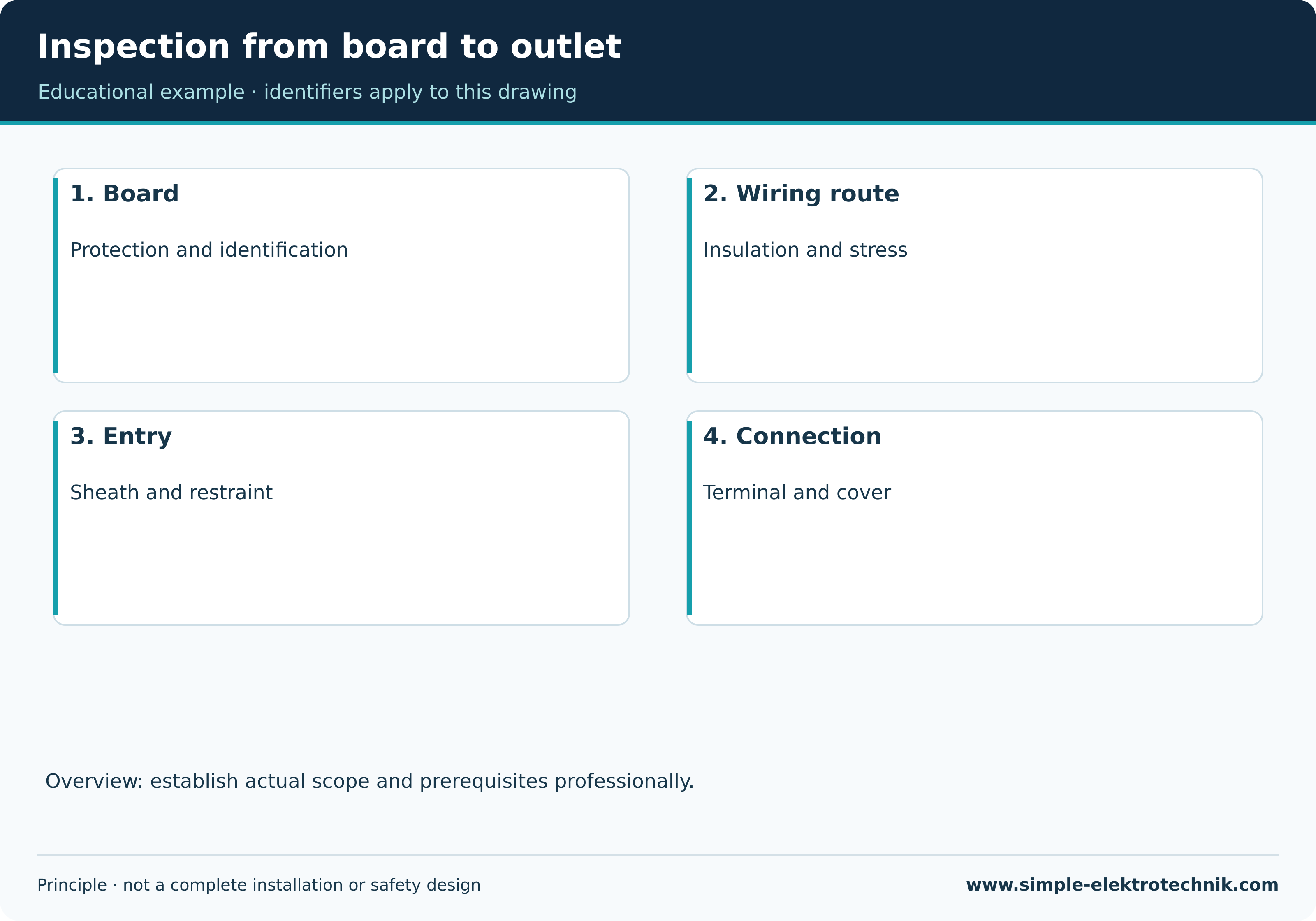
Connections and insulation
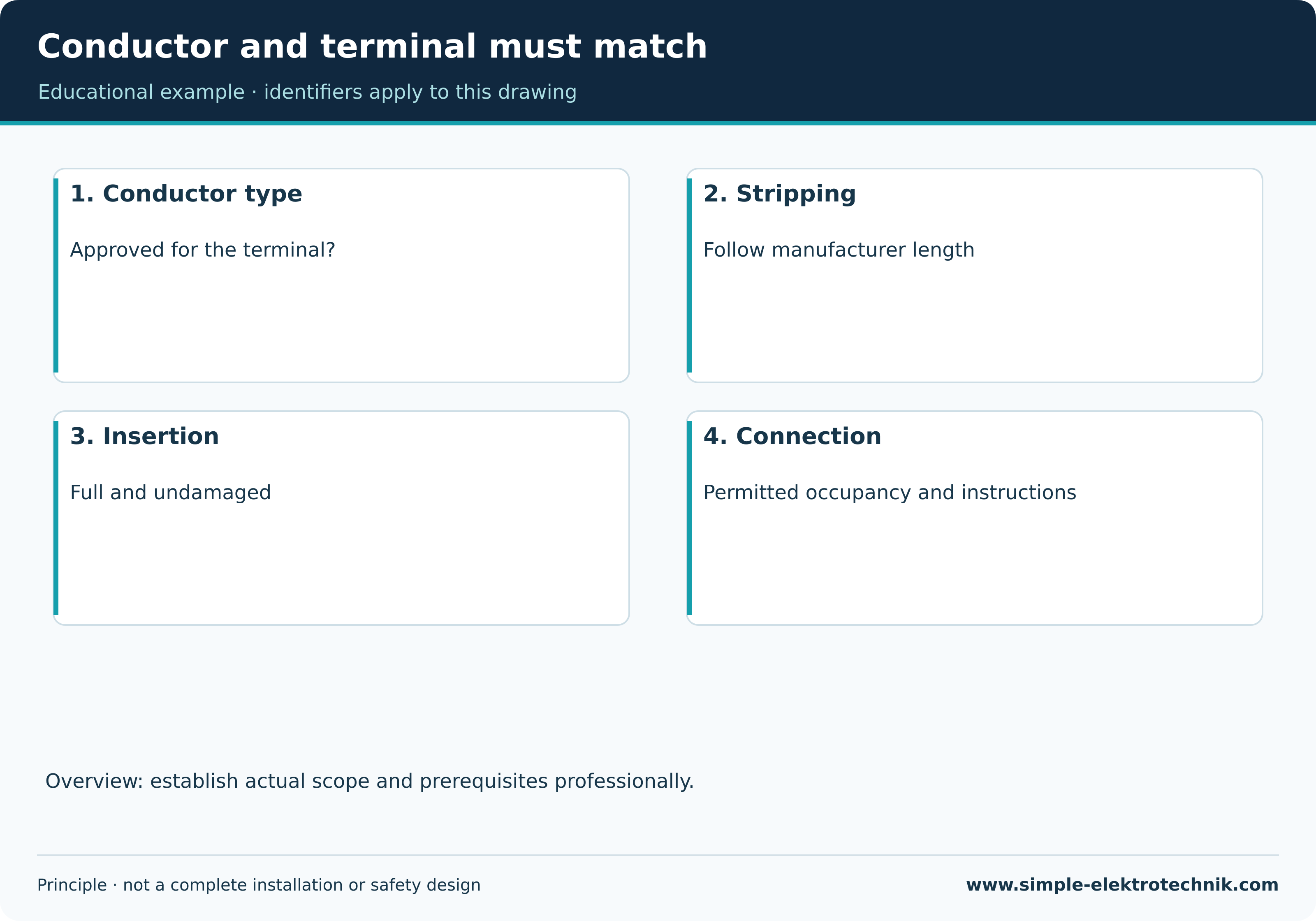
Excessive stripping can leave exposed conductor outside a terminal. Insufficient preparation can prevent full insertion. Dimensions and permitted conductor types are terminal-specific. One stripping length cannot suit every product.
Multiple conductors may share a terminal only where it is designed for them. A ferrule does not automatically make an arbitrary combination acceptable. For screw terminals, follow manufacturer requirements including specified torque where applicable.
Crushed insulation, sheath damage and unsuitable bends deserve attention. Later insulation testing does not replace inspection of these defects. A fault may only develop with movement, heat or moisture.
Conductor and terminal must match
Protection and identification

Colour helps identification but does not establish actual function. Reliable verification is particularly important with older or altered wiring. A green-and-yellow conductor is not a spare core available for other purposes.
Protective connections must suit the equipment and protective concept. A metal enclosure alone does not establish protection class. Nor does a two-pin plug prove the complete protective construction without further information.
Concealed parts and existing installations
Record relevant checks before boxes or linings are closed. Photographs can support records when clearly identified. They cannot replace examination or electrical evidence.
Inaccessible parts and missing documentation in existing installations must be addressed explicitly. An unknown route is not presented as verified. The examiner determines necessary further investigation and limitations.
Turn observations into useful records
A defect entry identifies the location, equipment and observation. “Bad electrics” says little. “Damaged sheath at entry to box D4; core insulation exposed” is traceable without inventing a cause.
Correction is followed by the necessary retest. Remaking a connection can also require repeated electrical tests. The initial verification guide connects these stages.
Common questions
Can an installation be approved from a photograph?
No. A picture may reveal visible concerns but cannot establish conductor paths, hidden connections and all electrical properties.
Is old construction automatically defective?
Not simply because of age. Condition, design, alterations and applicable requirements need assessment. A blanket statement that old work is always acceptable would be equally wrong.
Related guides
Sources and technical context
Sources support this explanation. Public standard summaries do not replace the complete standard. Retain national context and equipment conditions.