
Electrical glossary: terms from A to Z

What does a term mean, what does an abbreviation stand for, and what is it commonly confused with? Find clear explanations from installation, protection, testing, lighting, drives and smart homes.
Use the search, jump to a letter with A–Z or choose a subject area. Open a term for examples, illustrations and further context.
Explore by subject

Electrical quantities and fundamentals
Voltage, current, power and relationships within a circuit.
Explore terms →
Conductors, cables and connections
Conductor functions, cable construction and correctly made connections.
Explore terms →
Protection and electrical safety
Distinguish protective concepts, protective devices and safe working.
Explore terms →
Switching, control and circuit diagrams
Contacts, controls and the language of circuit diagrams.
Explore terms →
Inspection and testing
Measured quantities, test methods and the limits of an individual reading.
Explore terms →
Lighting and light technology
Lighting specifications, LED supplies and differences in dimming.
Explore terms →
Motors and drives
Three-phase systems, motor behaviour and starting or control methods.
Explore terms →
Smart home and communications
Device roles, networks and what the different standards do.
Explore terms →
Electronics and components
Components, signals and basic electronic functions.
Explore terms →Look up a term
161 terms found
A
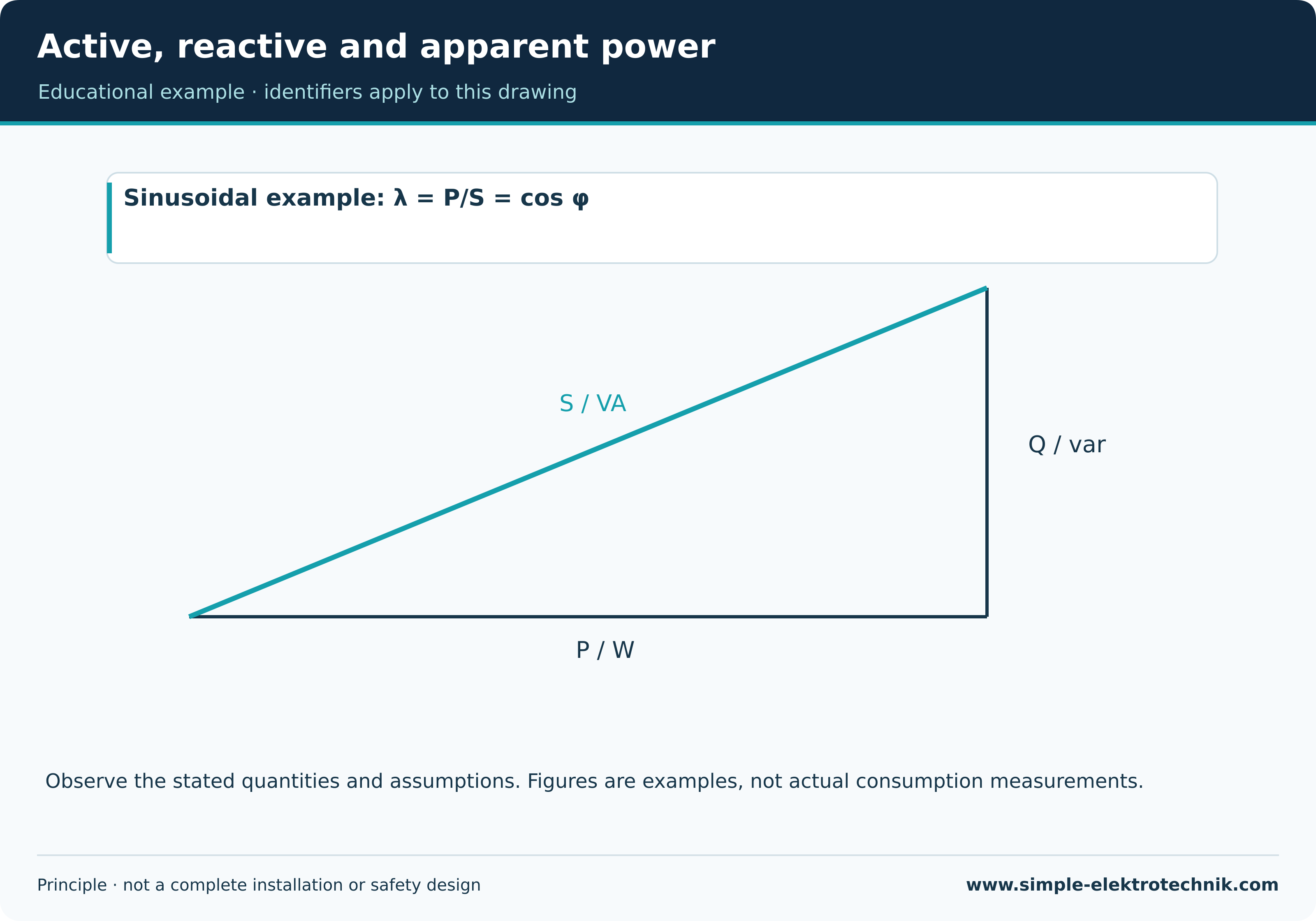
Active, reactive and apparent powerActive power is the average rate of energy conversion. Apparent power is the product of RMS voltage and current; reactive power describes the corresponding exchange component in the sinusoidal case.
The quantities are expressed in W, VA and var. For sinusoidal waveforms, their relationship can be shown in a power triangle. For distorted waveforms, that simple picture does not cover every power decomposition.
Example
An inductive load may require more current for the same active power than a load with a power factor close to one.
Important distinction
Reactive power is not itself an efficiency loss. The associated current can nevertheless increase loading of conductors and equipment.
ActuatorAn actuator converts a control signal into an intended physical action such as switching, dimming or movement.
The load and communication sides have different requirements. Feedback, failure behaviour and manual operation should suit the use concept.
Example
A suitable heating actuator changes a valve state, while a switching actuator controls an intended circuit.
Important distinction
An app button does not prove safe load isolation. An actuator is not automatically suitable for every motor or LED load.
Additional protectionAdditional protection supplements the intended fundamental protective measures in specified applications.
A suitable RCD can form part of this concept. The additional measure required depends on application, national requirements and actual protective design.
Example
For particular circuits, an RCD is used in addition to the other required protective measures.
Important distinction
Additional protection does not permit omission of basic protection, a required PE or correct construction. The measures serve different functions.
Alternating currentAlternating current changes direction. A sinusoid is an important waveform, but not the only possible one.
Sinusoidal voltage is commonly specified by its RMS value. The relationship between RMS and peak depends on waveform. For a sine wave, the factor is √2.
Example
230 V RMS for an ideal sine wave corresponds mathematically to a peak of about 325 V.
Important distinction
A zero crossing does not permit contact. A changing waveform does not replace safe isolation and verification of absence of voltage.
AmplifierAn amplifier changes a signal quantity using an additional energy supply and suitable circuitry.
Voltage, current and power gain are different properties. Input range, output load and frequency response limit actual operation.
Example
A small sensor signal can be conditioned suitably for a following measurement stage.
Important distinction
Amplification creates no free energy and does not automatically remove noise. A switching stage serves different tasks from a linear signal amplifier.
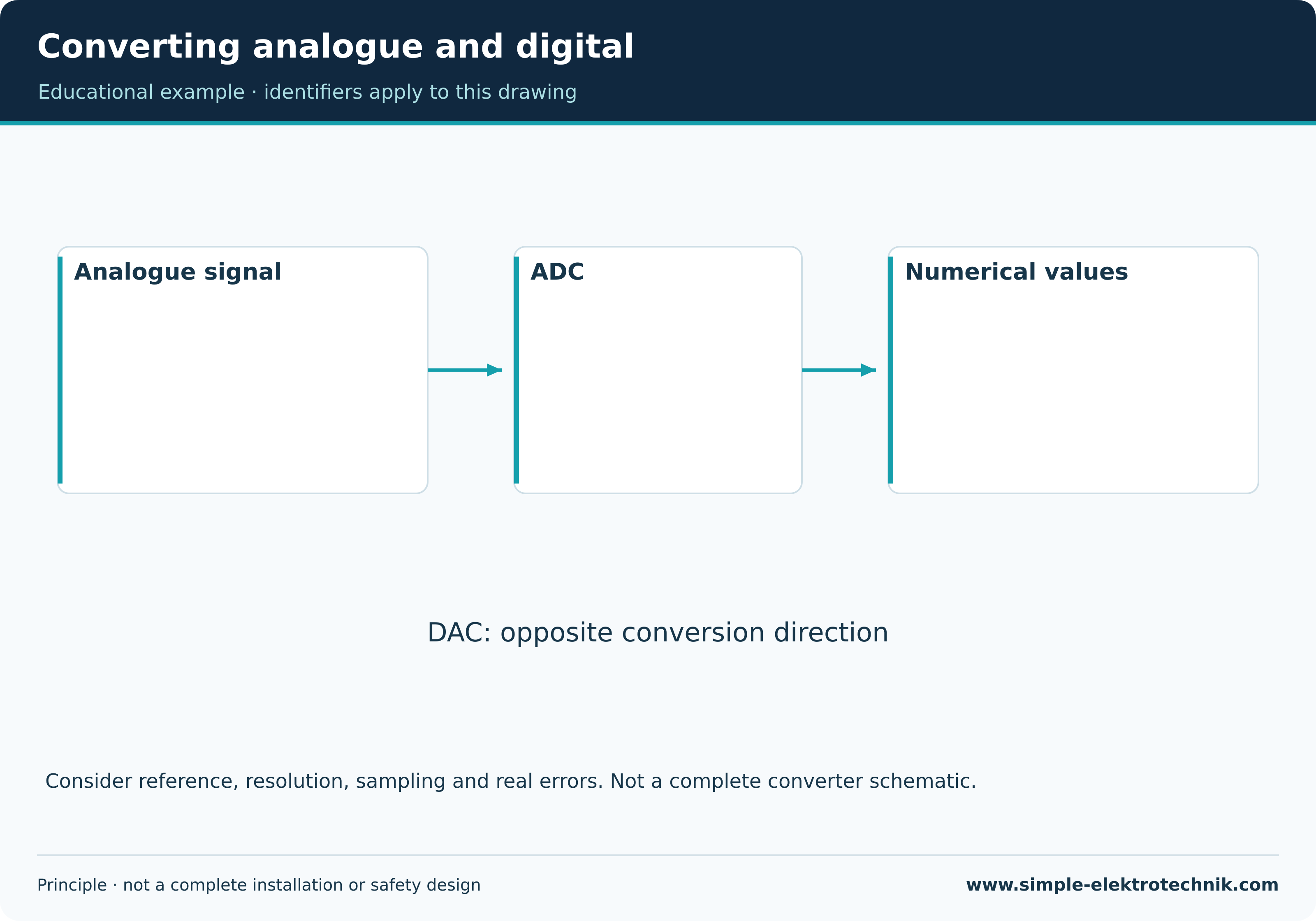
Analogue-to-digital converter (ADC)An ADC assigns digital numerical values to an analogue input using its intended conversion method.
Input range, resolution, sampling, reference and real errors influence the result. A high bit count alone does not establish matching measurement accuracy.
Example
An instrument may digitise a conditioned sensor voltage and calculate a reading.
Important distinction
Digitisation does not create real information beyond the suitable input and sampling range. It does not replace safe input circuitry.
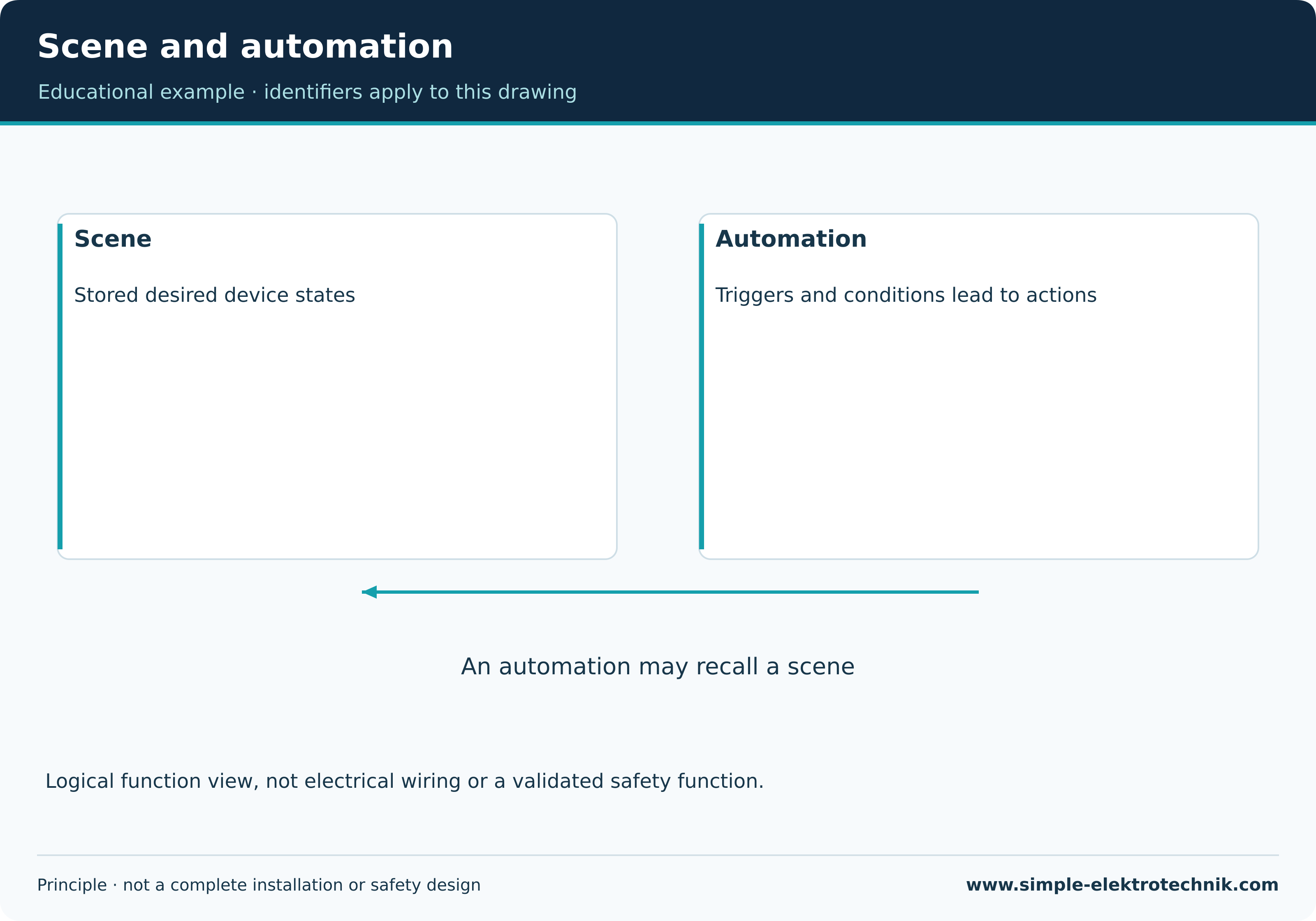
AutomationAn automation links defined triggers and conditions to intended actions.
Triggers, state checks, timing and failure behaviour should be understandable. Manual controls and automatic rules should not conflict unpredictably.
Example
A motion event may recall a lighting scene only when sufficiently dark.
Important distinction
More rules do not automatically make better control. An ordinary smart-home automation is not a validated machine safety function either.
B
Basic protectionBasic protection protects against electric shock under normal, fault-free conditions. Hazardous live parts should not be accessible.
Suitable insulation, barriers or enclosures can provide this function. Their suitability depends on construction, environment and intended use.
Example
The core insulation of an intact suitable cable prevents direct contact with conducting material.
Important distinction
Basic protection alone does not describe the complete concept under an insulation fault. Fault protection or an appropriate enhanced measure is also needed.
Bridge circuitA bridge circuit has multiple branches with a considered cross-connection. Its actual purpose depends on the circuit.
Measurement bridges may compare component ratios. Other bridge arrangements perform rectification or controlled load operation.
Example
A Wheatstone bridge can express a resistance change as a differential signal.
Important distinction
Not every bridge is a measurement bridge. Rectifier bridges and H-bridges must not be described as having identical functions.
Bus systemA bus is a communication system through which compatible participants exchange data under defined rules.
Physical transmission, addressing and communication depend on the system. Shared communication does not automatically imply arbitrary shared power supply.
Example
A building bus may carry control commands from sensors to suitable actuators.
Important distinction
Similar terminals or cables do not prove protocol compatibility. Bus rules, supply and isolation must follow the actual system.
C
Cable and wiring conductorCables and wiring conductors provide electrical connections in different forms. Precise terminology depends on product and standards context.
Selection depends on actual construction, conductors, insulation, environment and manufacturer approval. An everyday name does not replace these details.
Example
An individual insulated wiring conductor and a sheathed multicore installation cable have different construction and application conditions.
Important distinction
The word cable alone does not establish burial suitability, UV resistance or current capacity. The actual type matters.
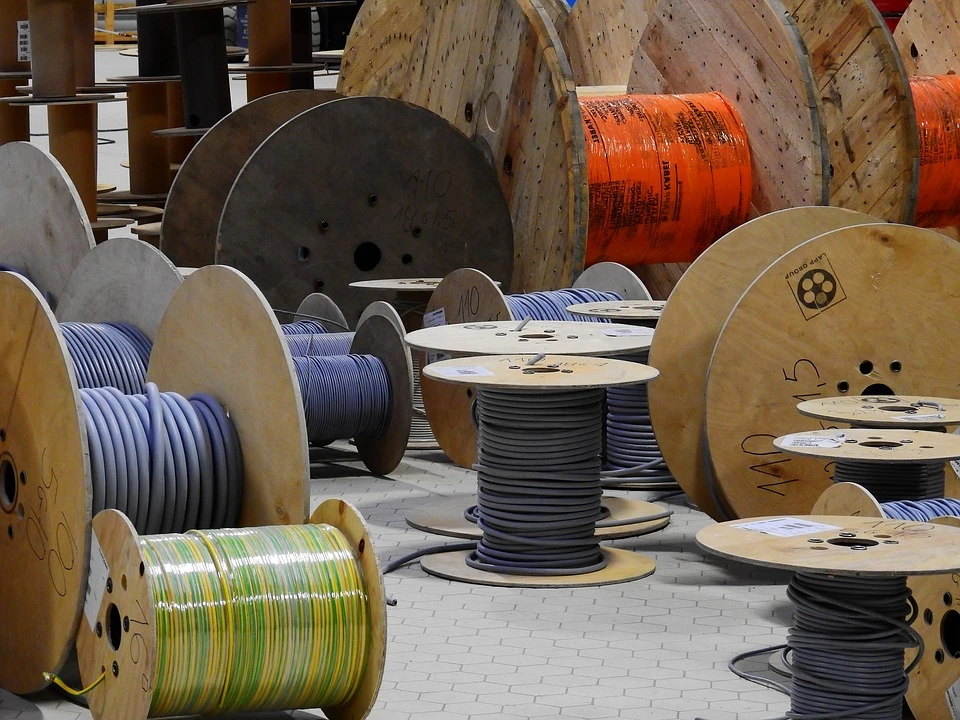
Cable sheathThe sheath is an outer covering of a cable. It serves different functions from each core’s individual insulation.
Material and construction can affect mechanical protection and suitability for environments. These properties depend on the product.
Example
At an entry, the sheath must be positioned as required by the system so that sealing and any strain relief work correctly.
Important distinction
An intact sheath does not prove intact internal core insulation. A cable gland does not automatically provide every required strain-relief function.
CapacitanceIn the simple linear case, capacitance is the ratio of stored charge to the associated voltage: C = Q/U.
Its unit is the farad. Construction and dielectric affect real capacitor properties; stored energy is a separate derived quantity.
Example
At the same applied voltage, a larger ideal capacitance stores more charge.
Important distinction
Farads do not express voltage rating. A matching capacitance value does not automatically make a capacitor suitable for a supply.
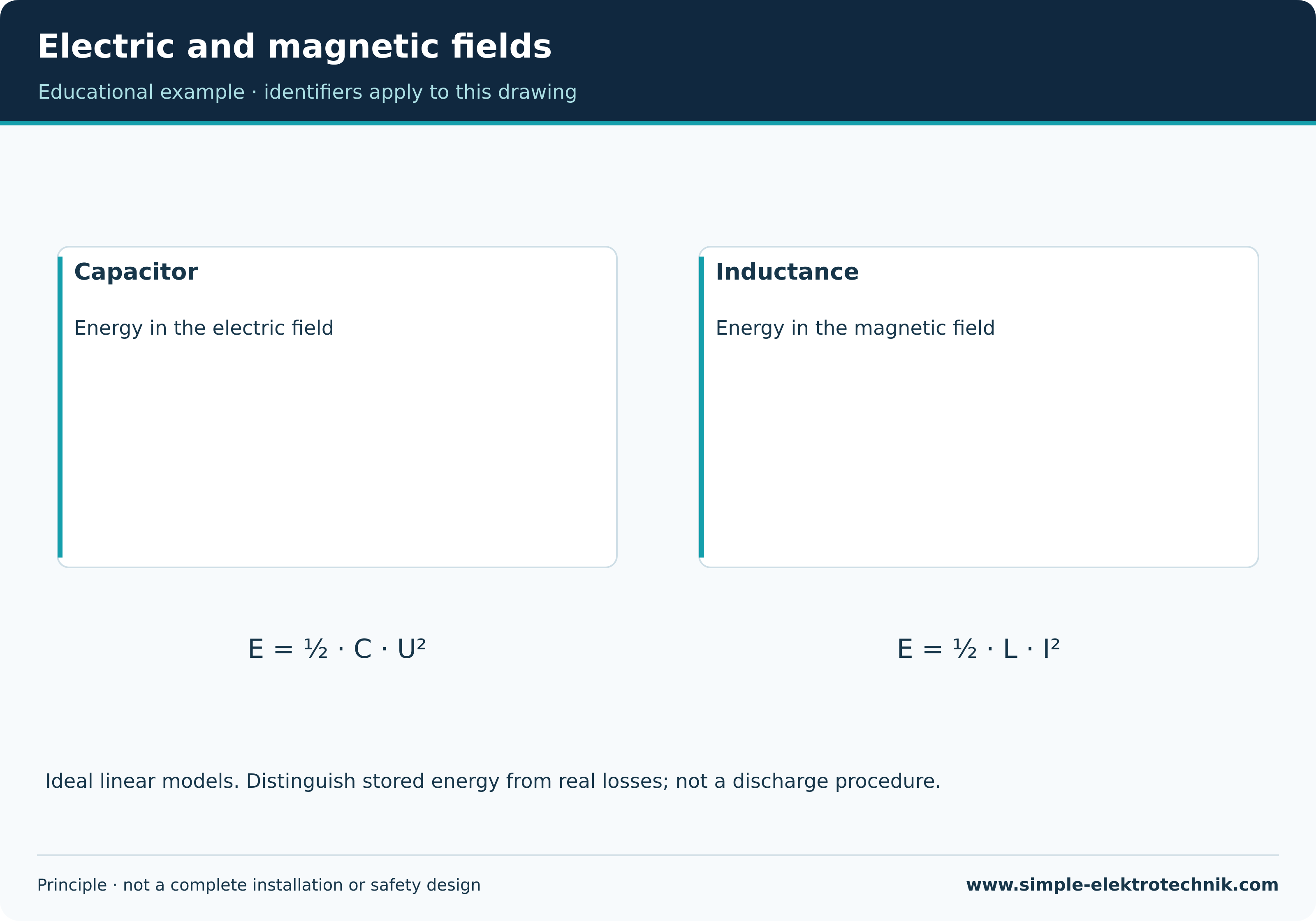
CapacitorA capacitor has capacitance and can store energy in an electric field.
Its behaviour depends on capacitance, voltage, construction and frequency. Real components have additional losses and limits.
Example
A suitable capacitor may reduce voltage variation in a supply.
Important distinction
Switched-off equipment may retain stored energy. Voltage rating and any polarity must not be guessed from case size.
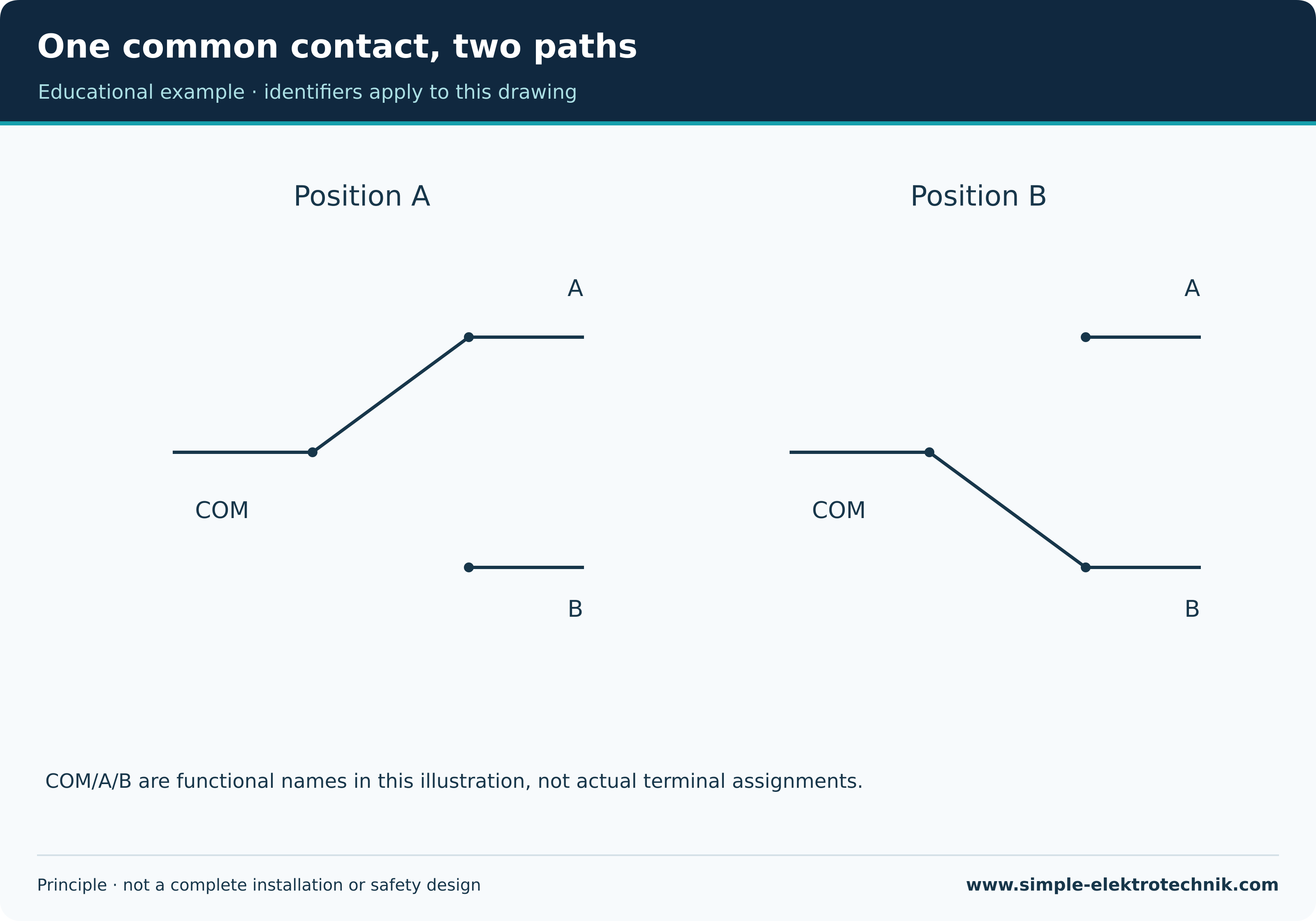
Changeover contactA changeover contact connects a common contact to one of two other contacts depending on its position.
Actual terminal markings and transfer behaviour depend on the device. The common contact cannot be inferred solely from its physical position.
Example
Two suitable changeover switches can form part of a lighting circuit operated from two locations.
Important distinction
A changeover is not the same as two independently operated NO contacts. An arbitrary terminal must not be assumed to be neutral.
Circuit analysisCircuit analysis examines currents, voltages and behaviour of an electrical circuit model.
Component models, sources and boundary conditions need definition. Ohm’s law, Kirchhoff’s laws and time- or frequency-dependent models provide different tools.
Example
An ideal resistor network can be calculated using node and loop relationships.
Important distinction
A mathematically consistent diagram does not prove a suitable real installation. Component ratings, protection and construction are additional matters.
Circuit diagramA circuit diagram represents components and their electrical relationships using symbols and connecting lines.
A schematic explains different relationships from a scaled assembly drawing. The representation, device identification and depicted state must be understood.
Example
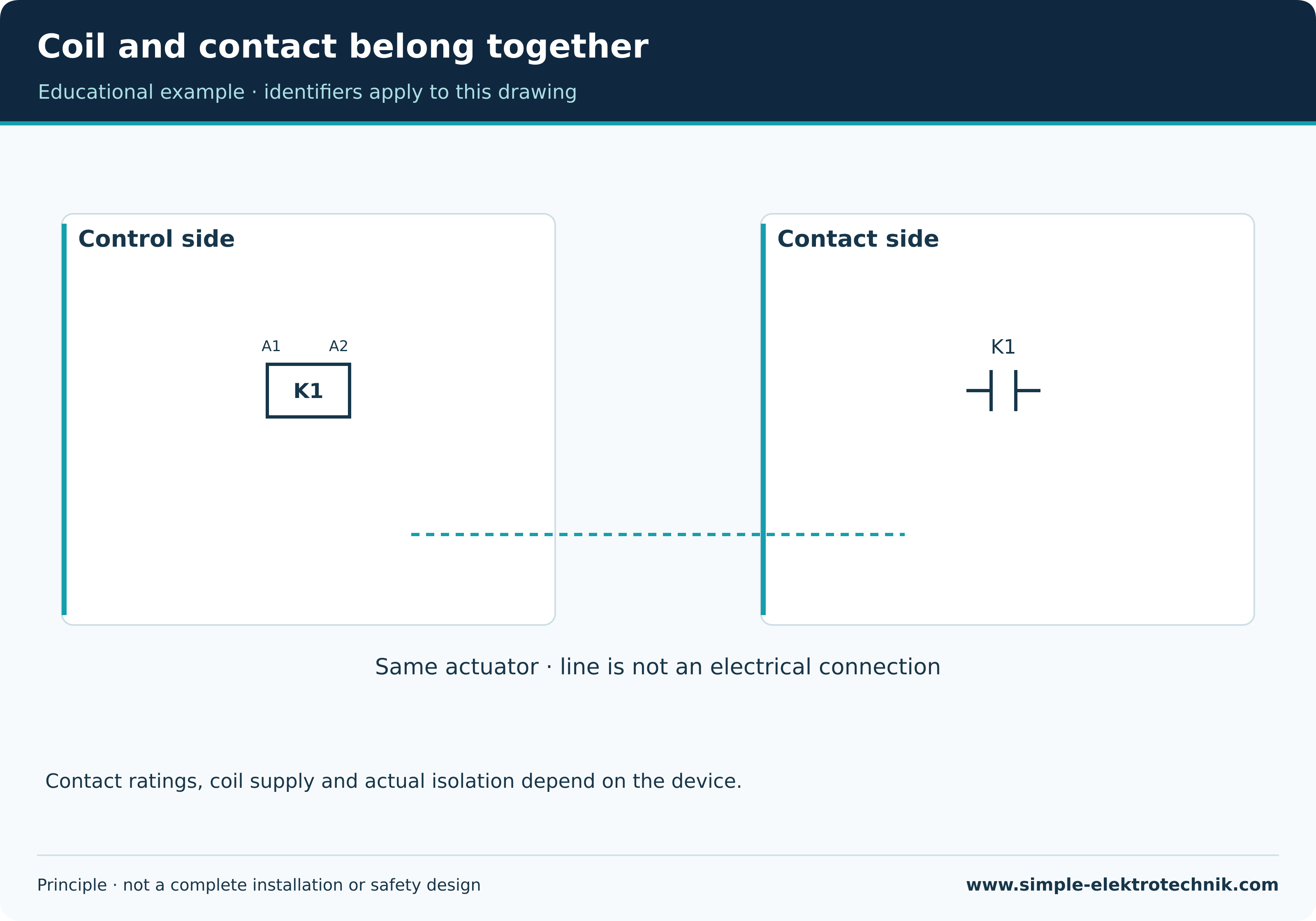
A control drawing may show a coil and its associated contacts in different positions even though they belong to one device.
Important distinction
A symbol’s position does not establish a universal physical terminal position. A principle illustration does not replace actual device documentation.
Circuit symbolA circuit symbol is an agreed graphical representation of an electrical component or function.
Its meaning follows from the drawing convention and context. Additional markings can identify the device, function and terminal relationship.
Example
NC and NO symbols distinguish the specified normal states of contacts.
Important distinction
An invented protection-class symbol can mislead. Established markings must not be replaced with decorative variants having a different meaning.
CoilA coil consists of one or more conductor turns. Current produces a magnetic field within it.
Current changes produce induced voltage in the relevant relationship. A core can influence behaviour but is not essential to every coil.
Example
A relay coil produces the magnetic action for its intended mechanical actuation.
Important distinction
Conductor resistance, inductance and real losses are different properties. Switching off a coil can cause particular voltage stresses.
Colour renderingColour rendering describes how illumination affects perceived object colours compared with a specified reference.
Metrics such as Ra or CRI summarise particular assessment methods. A single number does not capture every colour property or application.
Example
For workplace lighting, colour temperature and colour rendering may matter separately.
Important distinction
The same kelvin rating does not mean identical colour rendering. A high score also does not prove suitable glare control or illuminance.
Colour temperatureColour temperature or correlated colour temperature describes an aspect of the perceived colour of light. It is expressed in kelvins.
For many white sources, a lower value appears warmer and a higher value cooler. Real LED spectra are described using correlated colour temperature.
Example
Two white luminaires can have similar CCT yet render object colours differently.
Important distinction
Kelvins here do not express enclosure temperature or brightness. Colour rendering, luminous flux and chromaticity are additional properties.
Conductor cross-sectional areaConductor cross-sectional area describes the area of conducting material through a conductor. Square millimetres are commonly used.
It is not the outside diameter of an insulated core. Permissible current also depends on installation method, environment, grouping and protection.
Example
Two insulated conductors that appear equally thick can have different conductor areas and materials.
Important distinction
A single mm² value does not determine a universal protective-device rating. Selection requires the full operating and installation conditions.
Connecting terminalA connecting terminal provides an intended electrical and mechanical connection between conductors.
Permitted conductor types, sizes, quantities, stripping and operating methods depend on the product. Screw and spring principles may have different requirements.
Example
A transparent area may allow an additional conductor-position check but does not replace complete connection verification.
Important distinction
Similar housings do not establish identical approval. Two conductors must not share an opening merely because they fit.
Constant-current supplyA constant-current supply regulates output current to an intended value within its operating limits.
Required output voltage follows from the suitable connected load while the permitted range is respected. Load quantity and connection must match the driver.
Example
A suitably designed LED module can operate from a matching constant-current driver.
Important distinction
CC does not allow any arbitrary load. An unsuitable current can damage LEDs despite a seemingly suitable wattage.
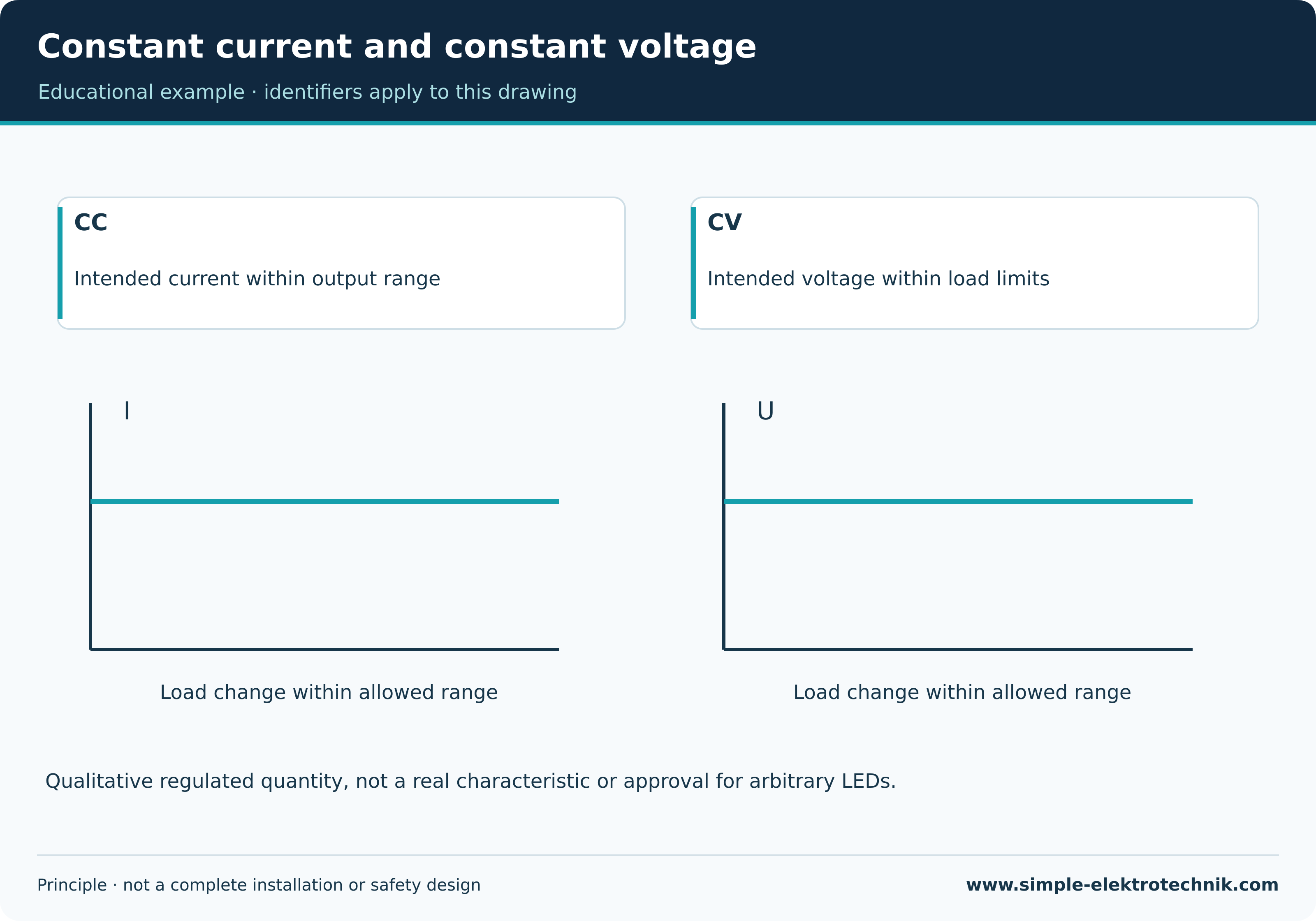
Constant-voltage supplyA constant-voltage supply regulates output voltage to its intended value within specified conditions.
Actual current depends on the suitable connected load. Current limit, power and load behaviour must suit the supply.
Example
An LED strip designed for a specified DC voltage may require a suitable CV supply.
Important distinction
A supply with higher available current does not automatically force that maximum through every load. Correct voltage and protection remain essential.
ContactorA contactor is a suitably rated remotely operated switching device, commonly used for electrical loads.
Main contacts switch the intended load; auxiliary contacts may perform control functions. Coil rating, utilisation category and load type need suitable selection.
Example
A motor contactor can be controlled through start and stop buttons in a suitable control circuit.
Important distinction
A contactor does not automatically replace overload or short-circuit protection. Its off state is not a general proof of safe isolation either.
Control circuitA control circuit handles the intended commands, permissives and feedback of a circuit.
It may contain pushbuttons, contacts, coils and electronic controllers. Supply voltage and protection must match the actual construction.
Example
Start and stop pushbuttons and a holding contact may together form the intended contactor-coil path.
Important distinction
Control circuit does not automatically mean extra-low voltage or safe touch conditions. Its supply must be expressly considered during safe working.
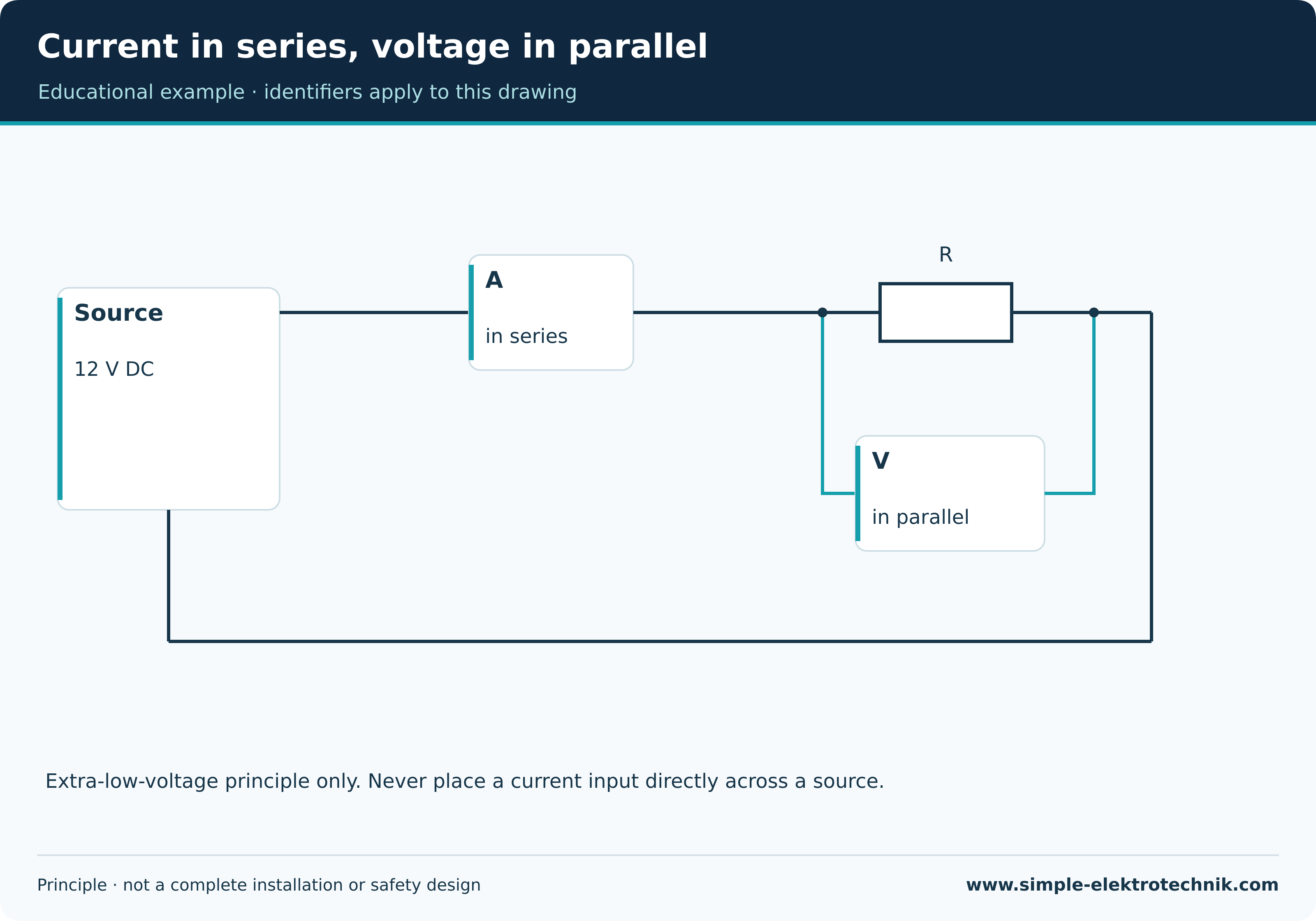
Current measurementCurrent measurement determines current in a defined conductor or group using a suitable method.
An instrument inserted into a circuit and a current clamp have different conditions. With a clamp, the conductors enclosed together are decisive.
Example
When a suitable clamp encloses outgoing and returning conductors together, their load-current effects may cancel in the sensing principle.
Important distinction
A current input must not be placed across a source like a voltmeter. Clamp type, conductor group and desired quantity must be clear.
D
Dahlander connectionA Dahlander connection changes an induction machine’s pole number through a specially designed winding arrangement, thereby changing its speed step.
It uses a different principle from a starting-only reconnection. Actual winding variant, ratings and switching sequence follow the motor documents.
Example
A suitable Dahlander motor may have two designated speed steps.
Important distinction
An arbitrary star-delta diagram is not a Dahlander connection diagram. Similar terminal counts do not prove identical windings.
Digital-to-analogue converter (DAC)A DAC produces an associated analogue output quantity from digital input values.
Reference, output circuitry, resolution and timing determine its properties. A following amplifier or filter may perform additional functions.
Example
A controller may use a suitable DAC to produce an analogue command voltage from a digital setpoint.
Important distinction
A DAC output is not automatically a power output for a motor. Load capability and signal range must be known.
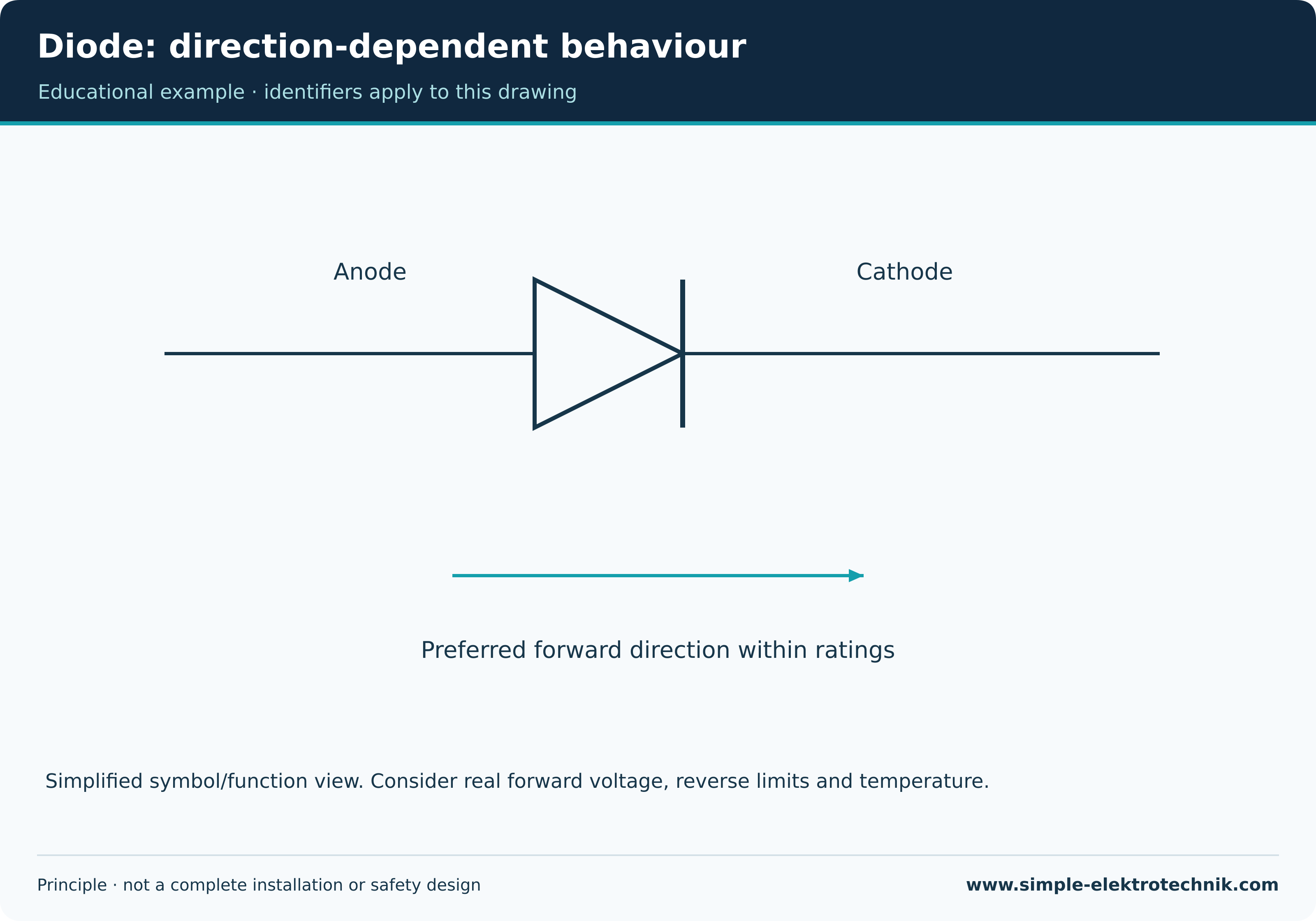
DiodeA semiconductor diode has direction-dependent electrical behaviour. Within its intended operating range, it conducts mainly forward and blocks in reverse.
Forward voltage, permitted current, reverse voltage and temperature are real component properties. Special diodes intentionally use additional effects.
Example
A rectifier may use suitable diodes to rectify AC quantities.
Important distinction
A diode is not an ideal one-way conductor at arbitrary voltage. LEDs, Zener and rectifier diodes are not interchangeable without checking.
Direct currentDirect current maintains the same direction. Its magnitude need not be constant in every case.
An ideal DC voltage source has fixed polarity and constant voltage. Real sources can vary; a pulsating rectified current is therefore distinct from ideal constant DC.
Example
A battery supplies suitable equipment with a defined polarity. Electronics may produce other voltages from it.
Important distinction
An AC contact rating is not automatically a DC approval. Low DC voltage is not harmless regardless of source and environment.
Disconnecting suppliesDisconnecting supplies means separating the relevant installation or work area from the applicable electrical sources.
The work area and possible additional sources must be known. Securing against reconnection and verifying absence of voltage are separate further steps.
Example
PV, storage, UPS or separately supplied control circuits may need consideration alongside the normal supply.
Important distinction
An off command from an app, pushbutton or control does not prove safe isolation. Operational and isolating functions are different.
E
EarthingEarthing is an electrical connection to earth. Depending on its design, it can serve protective or functional purposes.
Electrodes, earthing conductors and designated connection points form the actual arrangement. Soil is not an ideal uniform zero-potential reference everywhere.
Example
An earthed source point and an earthed equipment enclosure may be connected through different paths depending on the system.
Important distinction
Earthed does not automatically mean dead. An earth connection alone is not complete protection against electric shock.
Earthing arrangementAn earthing arrangement describes, among other things, the source’s earth relationship and protective connections of exposed conductive parts.
TN, TT and IT identify different arrangements. S and C distinguish separate or combined protective and neutral functions.
Example
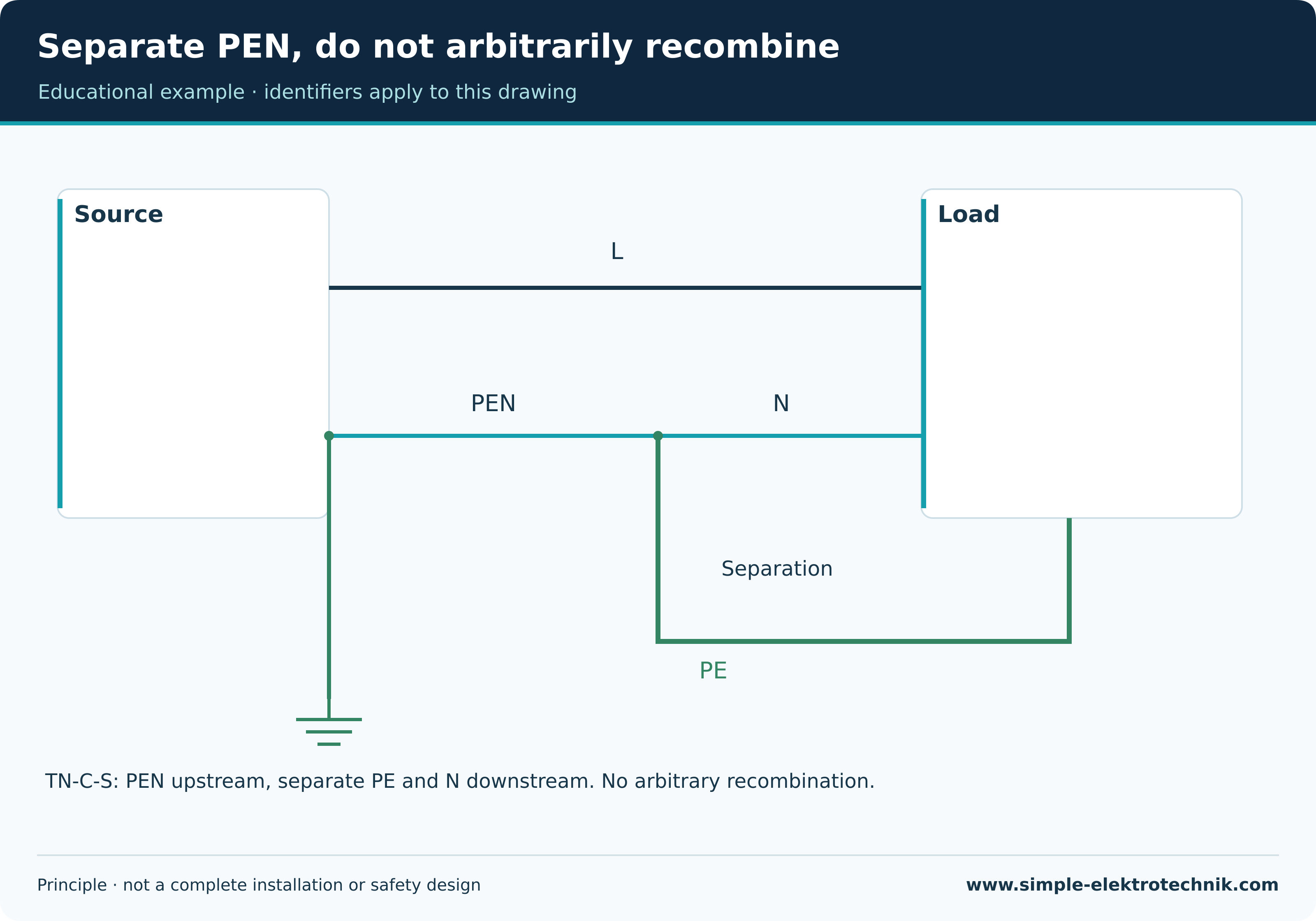
In TN-C-S, a combined PEN section is followed by a section with separate PE and N functions.
Important distinction
A conductor colour or simple socket tester cannot reliably establish the earthing arrangement. It influences required protective and verification assessment.
EfficiencyEfficiency describes the ratio of useful output power to input power.
The difference may appear as heat or other real losses. What counts as useful output must match the equipment and the specified operating point.
Example
A motor can absorb electrical power and deliver a smaller mechanical power at its shaft.
Important distinction
Efficiency, power factor and a product energy class are not interchangeable specifications. Efficiency also often changes with load.
Electric and magnetic fieldsElectric and magnetic fields describe electrical and magnetic effects in space.
Charges and time-dependent processes are associated with these fields. A current path’s magnetic field depends on current and geometry, among other factors.
Example
The arrangement of outgoing and returning conductors can affect the external field of a connection.
Important distinction
The term field alone supports no general claim about health effects or limits. Frequency, strength, exposure and appropriate technical evidence are needed.
Electric chargeElectric charge is a physical quantity describing electrical interactions. Its unit is the coulomb.
Current describes how much charge passes a point per unit time. For constant current, the charge transferred is Q = I · t. Charge and electrical energy are different quantities.
Example
A constant current of 1 A transfers 1 C of charge in one second.
Important distinction
Q is also used for reactive power in another context. The unit and context therefore need to be considered.
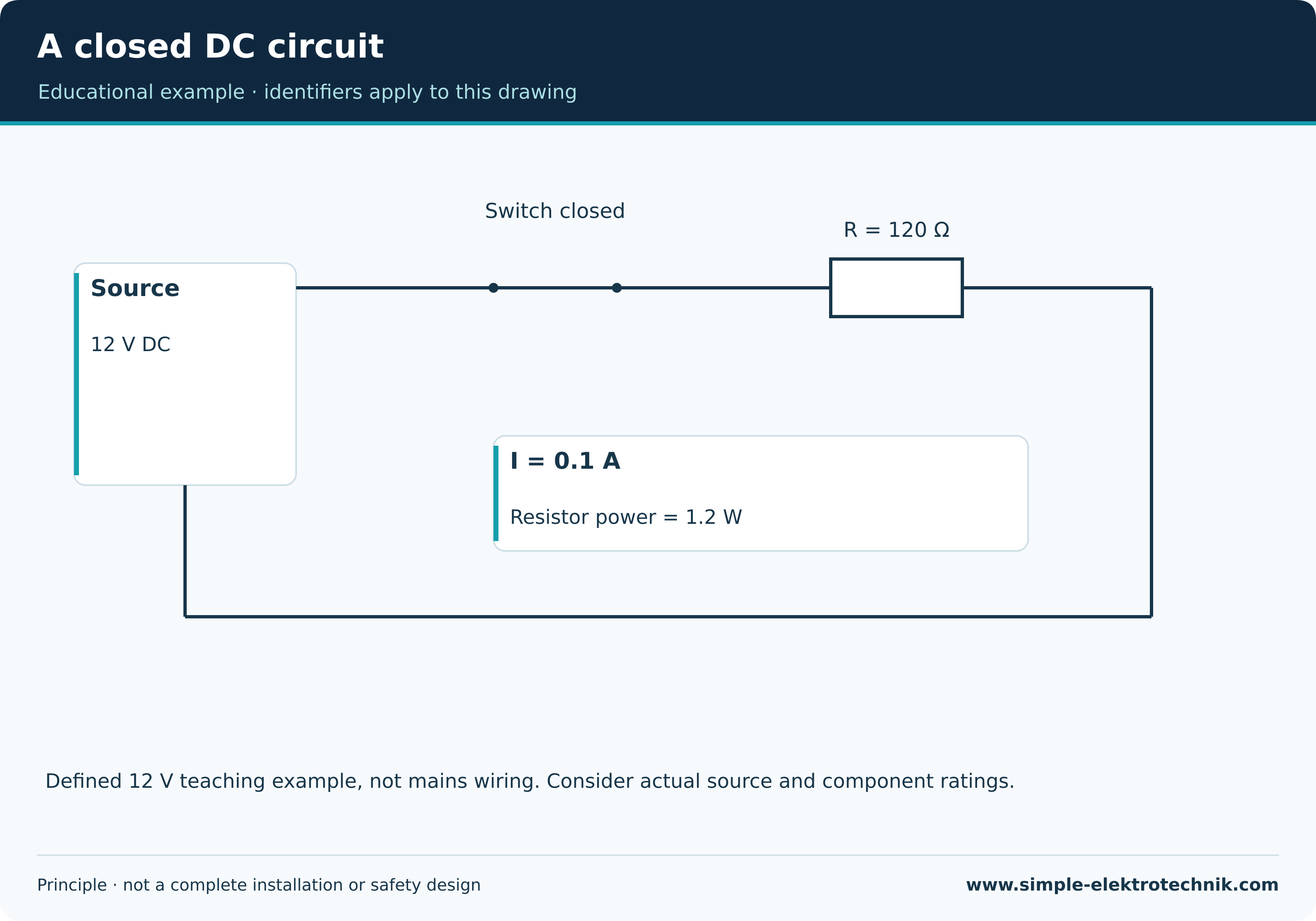
Electric circuitAn electric circuit is an arrangement of connections and components. A closed conducting path allows steady current from a suitable source.
A simple DC circuit has a source, outward path, load and return path. Actual installations may have branches, protective devices and additional sources.
Example
An open switch can interrupt load current while voltage remains across its contacts.
Important distinction
A circuit is not safe merely because a load does not work. Faults and alternative supplies require separate consideration.
Electric currentElectric current describes the rate of transport of electric charge. Its unit is the ampere.
Conventional current follows the direction of positive charge movement. In metals, electrons move in the opposite direction. A load does not simply use up charge.
Example
In an unbranched series circuit, the same current passes through each component if no additional branches exist.
Important distinction
Amperes do not express an amount of energy. The danger of a current depends on factors including its path, duration and contact conditions.
Electrical continuityElectrical continuity describes an existing electrical connection along a defined test path.
The suitable test method and assessment depend on the task. Test leads, contact points and parallel conducting paths may affect the result.
Example
A protective-conductor test examines the intended protective path between defined points.
Important distinction
A continuity beep from an arbitrary multimeter does not automatically prove required protective-conductor quality. A parallel path can conceal a break.
ElectromagnetAn electromagnet produces its magnetic field through current in a designated coil.
A suitable core can influence and concentrate the field. Magnetic and thermal design determine intended operation.
Example
An electromechanical relay uses magnetic action to operate contacts.
Important distinction
A core is not essential to every electromagnet. A coil must not be connected to a supply merely on the basis of physical size.
Electromagnetic compatibilityEMC is the ability to operate as intended in an electromagnetic environment without causing unacceptable disturbance to other equipment.
Emissions and immunity are different aspects. Equipment, cables, installation and environment interact.
Example
Cable routing and specified screen connections may form part of a drive manufacturer’s requirements.
Important distinction
One filter or metal enclosure does not prove complete EMC suitability. Improvised screen connections can conflict with other requirements.
Emergency stopEmergency stop is an intended emergency function for stopping hazardous motion or processes within the machine concept.
Actuation, evaluation and stopping need suitability for the actual risk assessment. Resetting must not cause an unintended restart.
Example
A conspicuous actuator may form part of the function but is not itself a complete safety concept.
Important distinction
Emergency stop and emergency switching off are different tasks. An ordinary stop button or red actuator is not a general proof of function.
EnergyElectrical energy describes the amount of energy transferred or converted. Common units are the joule and kilowatt-hour.
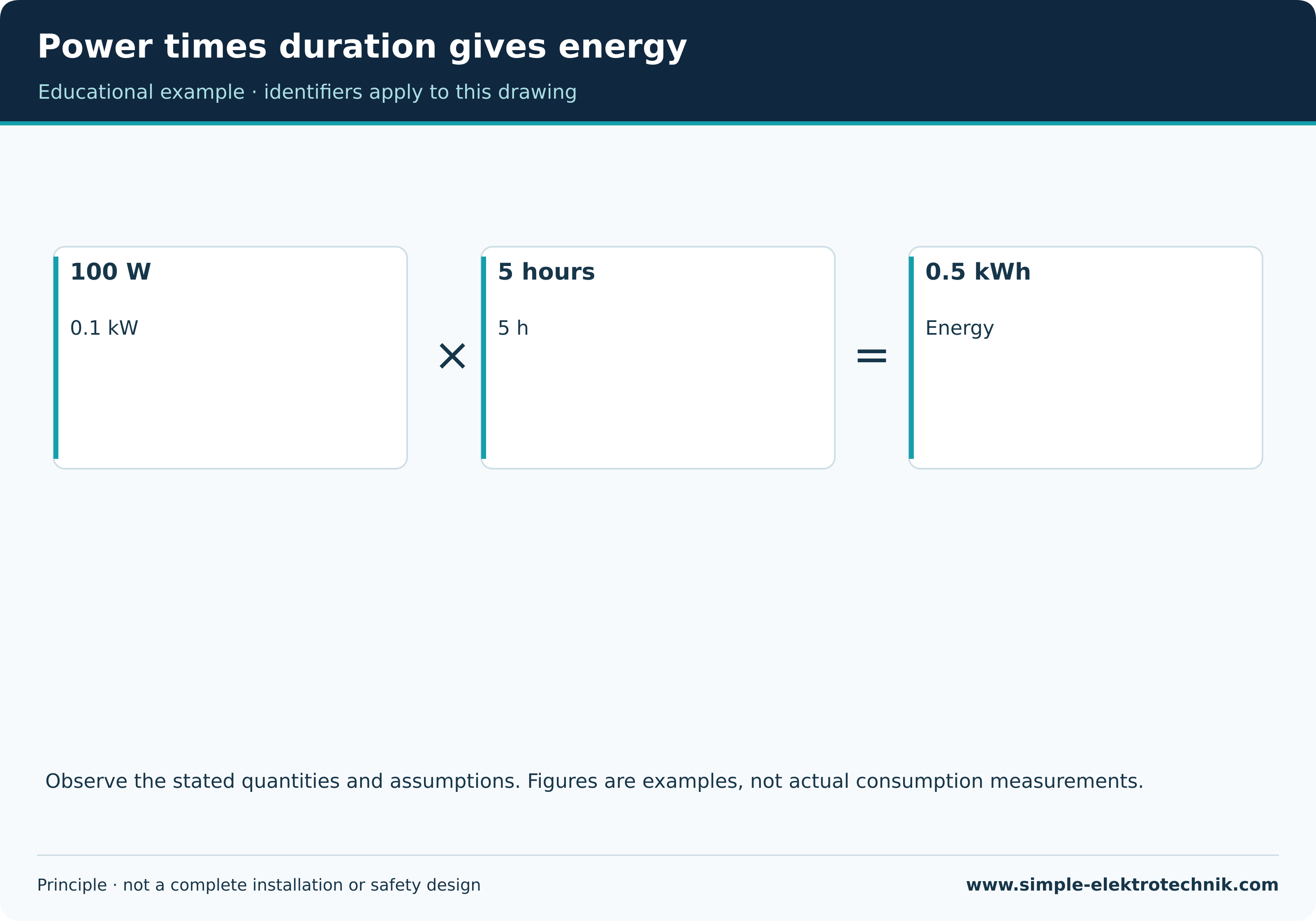
For constant power, E = P · t. With varying power, its time history is taken into account. A kilowatt-hour combines power and operating time; it is not a type of electric current.
Example
100 W for five hours gives 0.1 kW × 5 h = 0.5 kWh.
Important distinction
A power-supply rating does not automatically describe its continuous energy consumption. Load, losses and operating duration matter.
EthernetEthernet describes a family of local data-link technologies, commonly carried over suitable copper or optical-fibre links.
Connector type, cabling category, transmission variant and equipment must match. IP can operate above Ethernet and is not the same thing.
Example
A suitable switch connects multiple Ethernet participants within the intended network structure.
Important distinction
An RJ45-like connector does not prove every Ethernet or PoE approval. Other systems may use similar connectors.
F
Fault protectionFault protection protects against electric shock under specified fault conditions, such as an insulation fault.
An intended combination of protective connections and disconnection may limit hazardous conditions. Other protective concepts may use double or reinforced insulation.
Example
If a fault energises a correctly connected Class I enclosure, the designed protective system must achieve its required effect.
Important distinction
A connected green-and-yellow conductor alone does not prove this effect. Protective path, device and installation need coordination and verification.
Fault-loop impedanceFault-loop impedance describes the impedance of a considered closed fault path, including the relevant supply and return paths.
Its result depends on earthing arrangement, method and protective concept. Under suitable assumptions, prospective fault current can be derived.
Example
A simplified TN fault loop includes source, line conductor and intended metallic protective return.
Important distinction
A loop measurement is not an isolated earth-electrode test. A TN example cannot simply be transferred to TT or IT.
FeedbackFeedback returns part of a system’s output to an input.
Sign, gain and timing determine whether desired behaviour is stabilised or oscillation may be produced. The complete loop matters.
Example
Suitable negative feedback helps establish an amplifier’s intended transfer ratio.
Important distinction
Negative feedback is not automatically stable under arbitrary conditions. Delays and phase shifts can alter loop behaviour.
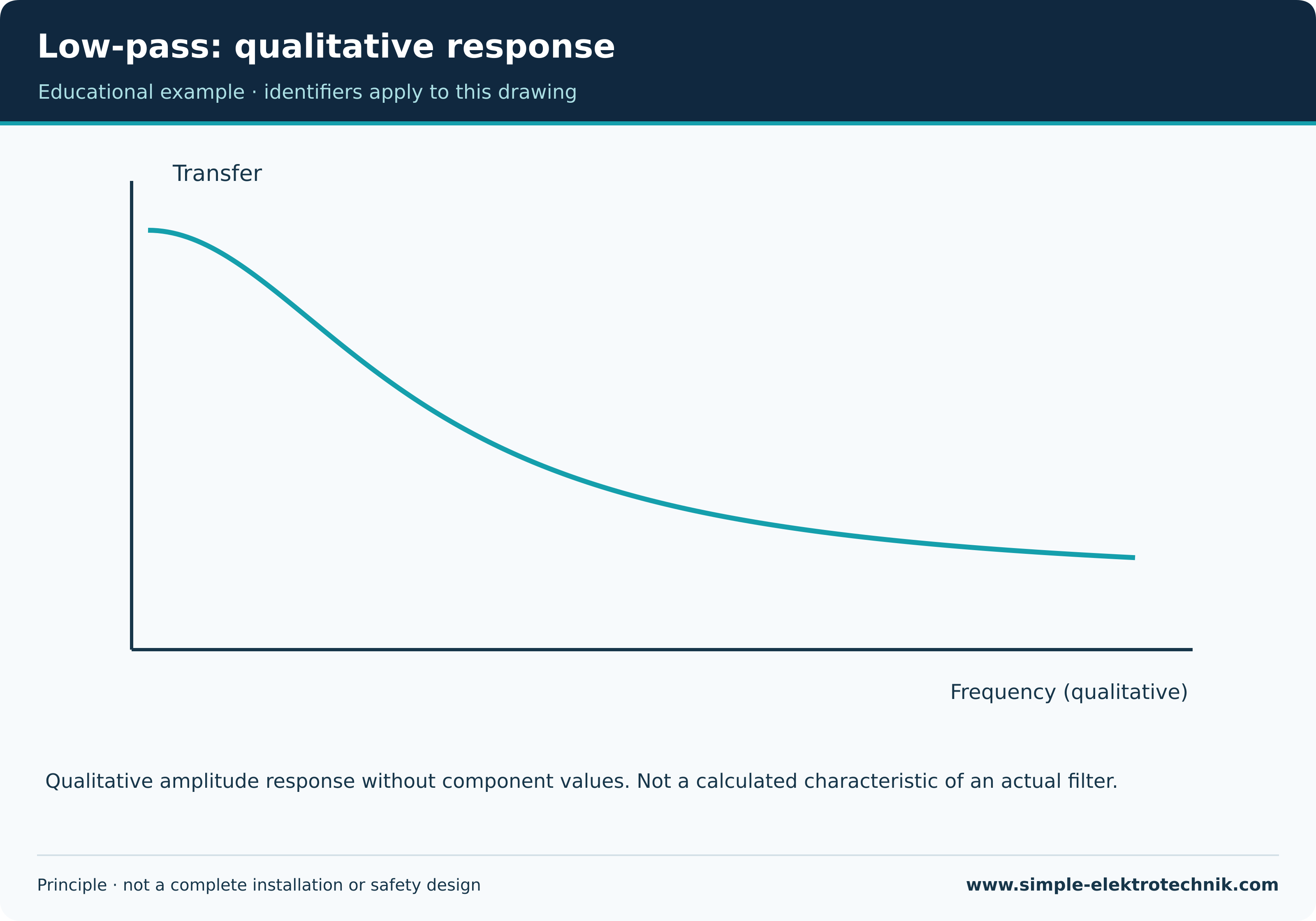
FilterA filter modifies a signal according to frequency or other specified properties.
Analogue and digital methods can attenuate or favour different ranges. Actual frequency response includes transitions and possible phase changes.
Example
A low-pass filter can attenuate fast signal components relative to slower ones.
Important distinction
A filter does not automatically eliminate every disturbance completely. Desired signal, interference spectrum and waveform effects need joint consideration.
Flicker and temporal light modulationTemporal light modulation is variation of light output over time. Depending on waveform and observation, it can produce flicker or other visual effects.
Supply, driver and dimming method affect the waveform. Switching frequency alone does not describe every property or the complete visual effect.
Example
An unsuitable dimmer-driver combination may show visible brightness fluctuations at particular settings.
Important distinction
A smartphone camera image is not a general standards-based flicker measurement. The recording process can introduce additional bands or effects.
FrequencyFrequency is the number of periods of a periodic process per unit time. Its unit is the hertz.
For a sine wave, one period includes a complete positive and negative cycle. Period T and frequency are related by f = 1/T.
Example
A hypothetical 50 Hz oscillation repeats every 0.02 s. This illustrates the relationship mathematically.
Important distinction
Frequency is not voltage magnitude. The same RMS voltage at a different frequency can still impose different equipment conditions.
Frequency responseFrequency response describes how a system transfers sinusoidal inputs at different frequencies in magnitude and phase.
Measurement or model conditions must be known. The response may show gain, attenuation, resonance and phase change.
Example
A filter has a different transfer ratio in its transition region than in its intended passband.
Important distinction
One cutoff frequency does not describe complete time and transfer behaviour. Loading can also alter actual response.
FuseA fuse interrupts a circuit by melting an intended element under sufficient overcurrent.
Current rating, construction, utilisation category, time-current behaviour and breaking capacity inform selection. Not every small exceedance of rated current causes immediate operation.
Example
A suitable fuse link may provide short-circuit protection within a coordinated equipment combination.
Important distinction
A fuse must not be bypassed or replaced by an arbitrary higher rating. Fault cause and correct coordination must be established.
G
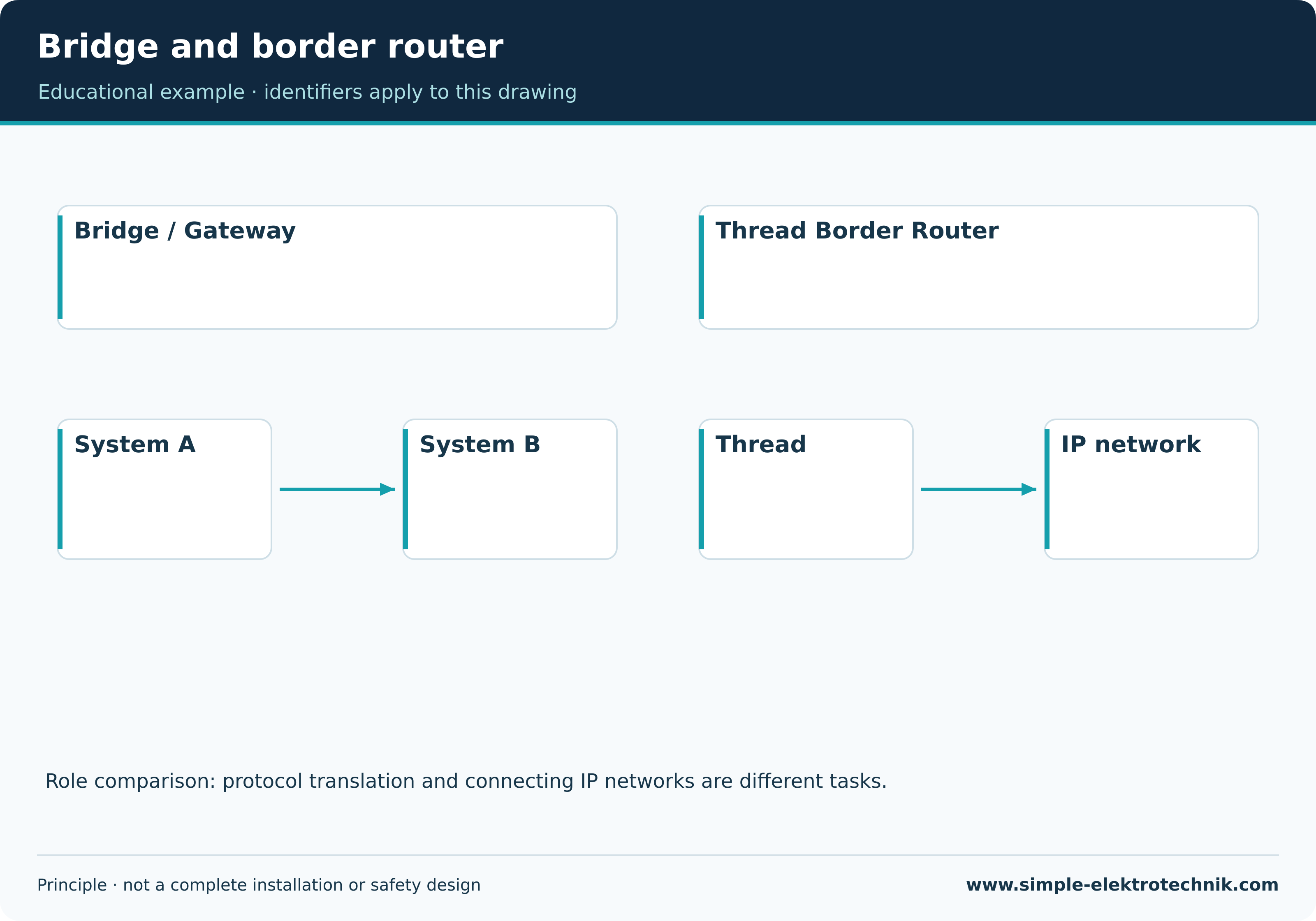
Gateway and bridgeGateway and bridge describe connection roles between networks or systems. Their precise function depends on product and context.
Application-protocol translation is different from merely forwarding network packets. A hub may combine several roles.
Example
A suitable Matter bridge may expose particular devices from another system to Matter.
Important distinction
The terms do not guarantee general compatibility. A Thread Border Router does not thereby translate arbitrary Zigbee devices into Matter.
H
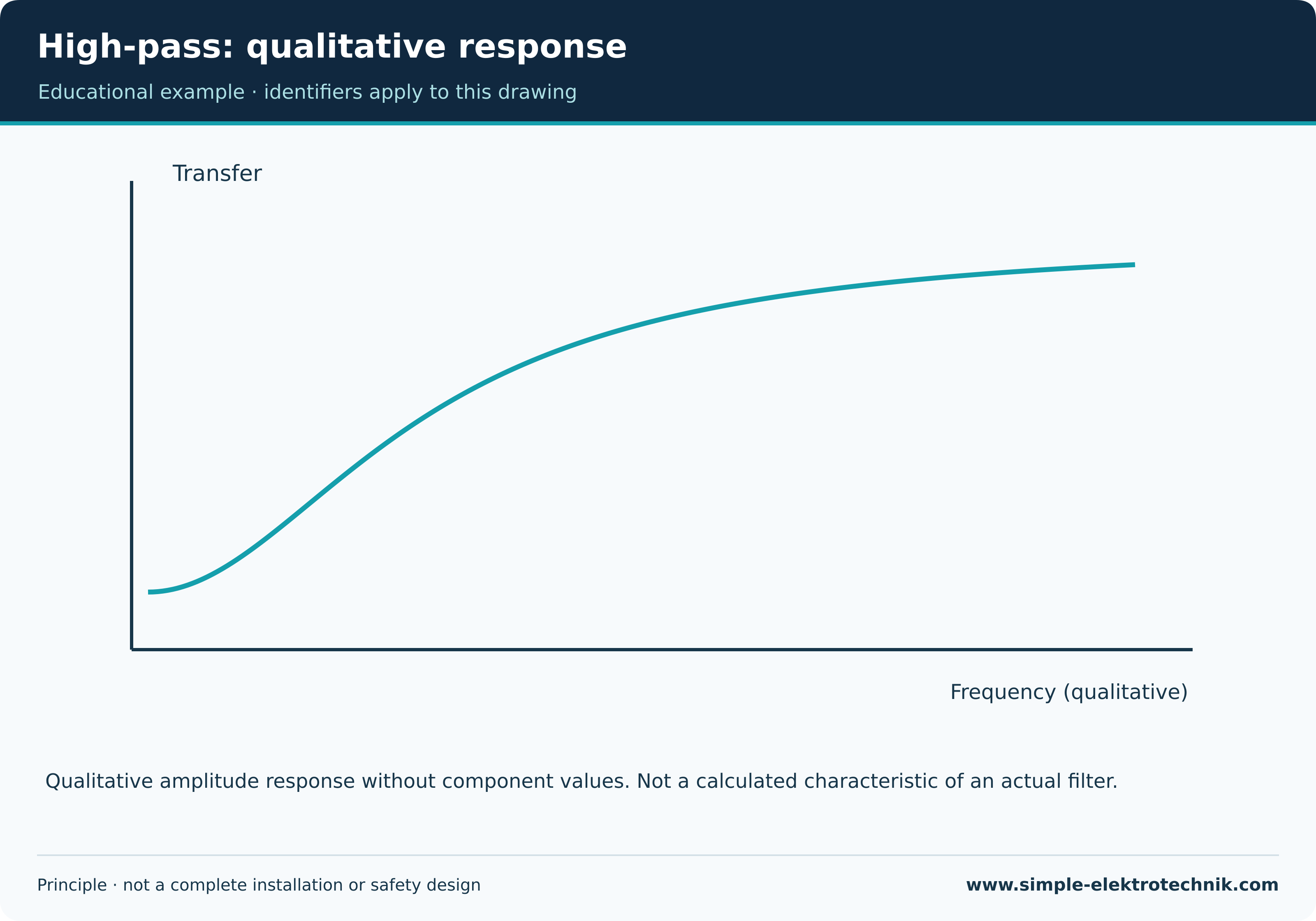
High-pass filterA high-pass filter favours higher frequencies over lower ones within its intended range.
Transition region, component values and loading affect actual response. The circuit may reduce low-frequency or constant signal components.
Example
Suitable signal coupling may keep a DC component out of a following stage.
Important distinction
This does not imply arbitrary galvanic or protective isolation. Signal filtering and electrical protection are different functions.
HysteresisHysteresis means a system’s state depends on the preceding history of its input.
In a switching device, this may produce different on and off thresholds. It can avoid repeated switching from small fluctuations around one threshold.
Example
A temperature controller may switch on below a lower threshold and off above a higher one.
Important distinction
Hysteresis is not simply a time delay. A device may have both properties separately.
I
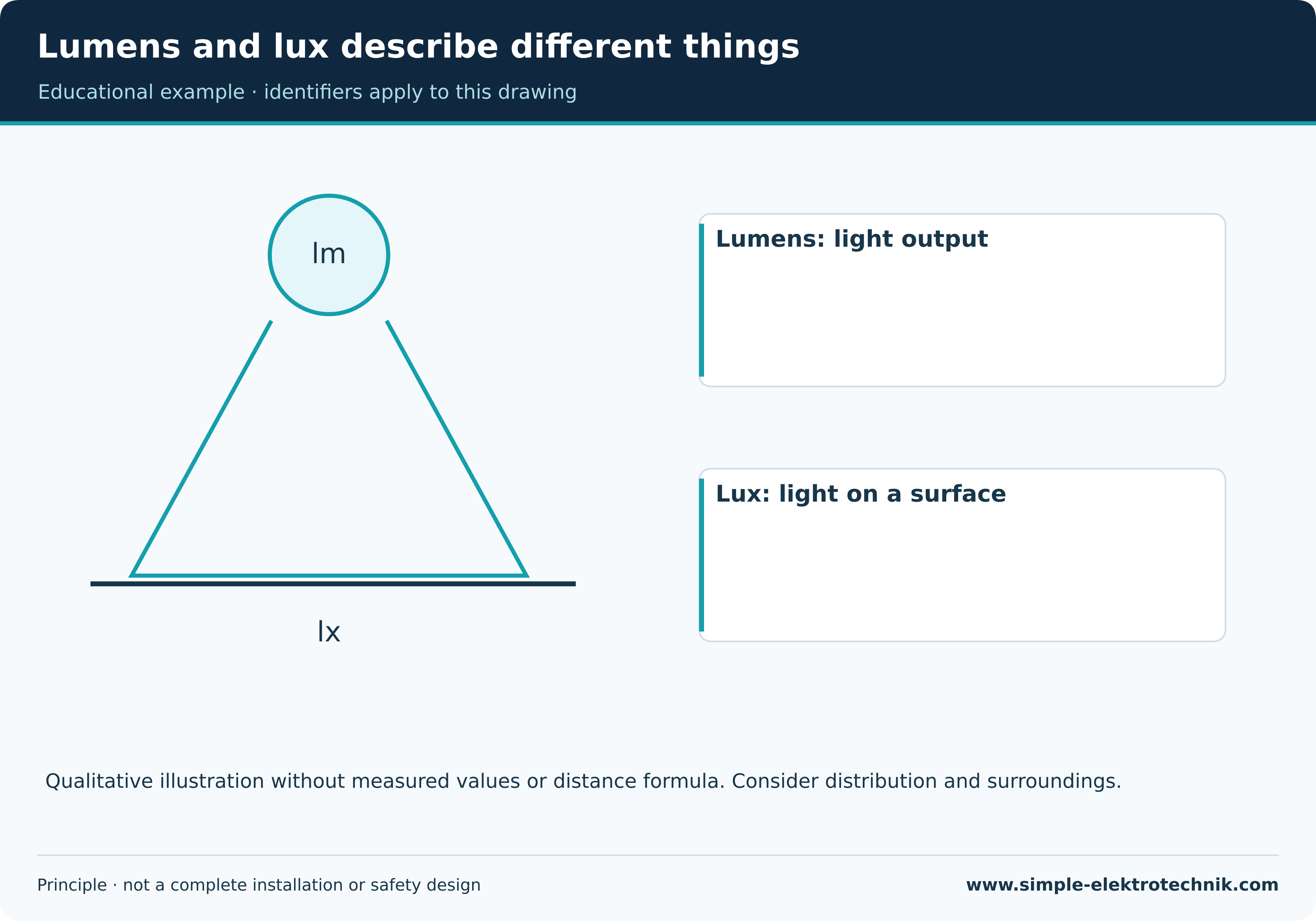
IlluminanceIlluminance describes incident luminous flux per unit area. Its unit is the lux.
One lux corresponds to one lumen per square metre in the relevant assessment. Illuminance concerns the illuminated location, not just the light source.
Example
If the same light output is spread over a larger area, average illuminance falls in a simplified uniform example.
Important distinction
One point reading does not automatically describe uniformity, glare or the complete quality of a lighting installation.
ImpedanceFor sinusoidal AC quantities, impedance is the complex ratio of voltage to current. Its unit is the ohm.
It includes resistive and reactive components and their phase relationship. Frequency and operating conditions may affect its value.
Example
A real path with inductive properties can behave differently under AC from a simple DC assessment.
Important distinction
Impedance and ohmic resistance are not universally interchangeable. A magnitude without frequency and context does not describe every property.
InductanceInductance describes the relationship between electric current and magnetic flux linkage. Its unit is the henry.
In a simple linear model, a changing current produces induced voltage according to its rate of change. Geometry, core and operating state can affect real behaviour.
Example
A choke uses inductive properties, for example to influence current waveform.
Important distinction
Inductance is not ohmic resistance. An ideal inductive element stores energy, while real windings also have losses.
Induction motorAn induction motor develops torque through interaction between a rotating field and currents induced in its rotor.
In normal motoring operation, the rotor runs at a speed different from the associated synchronous field. Slip describes that difference.
Example
As load increases within the operating range, the required slip changes.
Important distinction
Rated rotor speed is therefore not simply synchronous field speed. Motor type, supply and operating limits must be considered.
Initial verificationInitial verification examines a new or appropriately altered electrical installation before its intended commissioning under applicable requirements.
Inspection, functional testing, measurement, assessment and recording belong together. The scope and interfaces of an alteration need clear definition.
Example
A new circuit is considered together with its required connections and effects on the existing supply.
Important distinction
A successful functional check or one reading does not replace required complete initial verification. Country and test object must not change unnoticed.
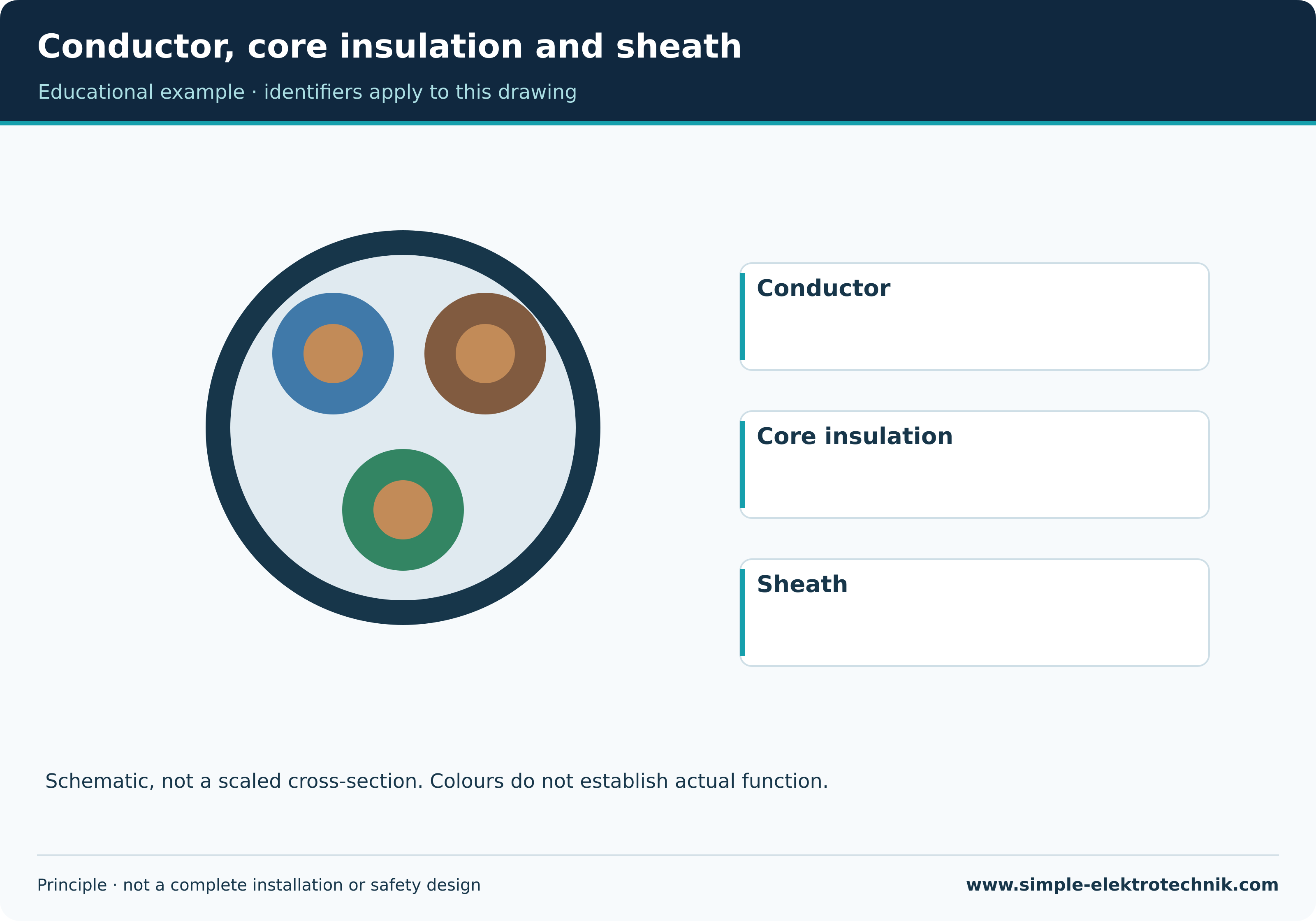
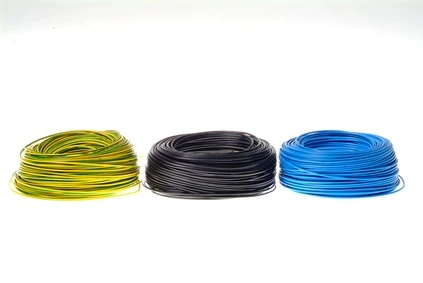
Insulated coreIn the usual cable context, an insulated core consists of a conductor and its individual insulation.
Several cores may sit within a common cable together with other construction elements. Conductor material, construction and insulation determine different properties.
Example
When a multicore cable’s overall sheath is removed, its individually insulated cores remain visible.
Important distinction
Removing the sheath and stripping a core are different operations. Damaged core insulation is not merely cosmetic.
Insulation resistanceInsulation resistance describes the electrical resistance across a considered insulation path between defined points.
Measurement uses a suitable test procedure under specified conditions. Connected electronics, surge protection and other components may require special preparation.
Example
A result is recorded with the test object, measurement points, test voltage and assessment.
Important distinction
A favourable value for one conductor pair does not prove every other insulation path. An RCD test button is not an insulation measurement.
InterlockingInterlocking prevents specified impermissible combinations of circuit or machine states.
It can be electrical, mechanical or implemented by a suitable control concept. Its function also needs assessment under the considered fault conditions.
Example
In reversing contactor control, the impermissible simultaneous energisation of both direction paths must be prevented.
Important distinction
A software condition alone is not a general safety demonstration. Required interlocking methods and stopping conditions depend on the actual application.
IP addressAn IP address provides addressing within an IP network. IPv4 and IPv6 use different address formats.
Address, network range and routing affect reachability. A local address is not automatically reachable from the internet.
Example
A device may have a home-network address yet fail to connect to an external service.
Important distinction
IP in networking means Internet Protocol. IP in an enclosure protection rating describes a completely different matter.
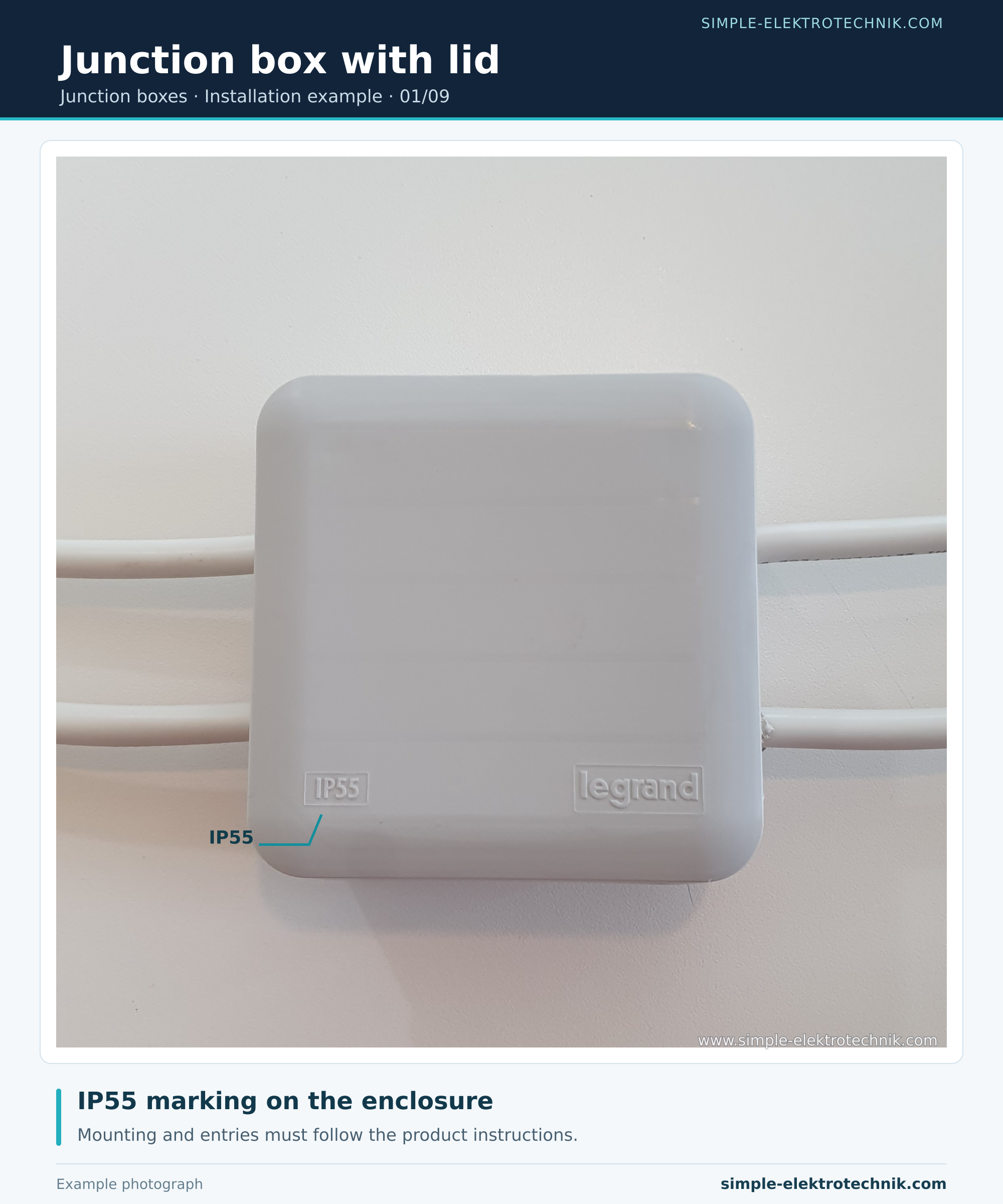
IP ratingAn IP rating describes specified enclosure protection against access, solid foreign objects and water.
The first numeral concerns access or solids; the second concerns water. Conditions such as mounted, closed or mated form part of product assessment.
Example
In IP44, the two numerals are read separately rather than as the number forty-four.
Important distinction
A higher second numeral does not automatically cover every other water exposure. IP also does not establish UV resistance, chemical suitability or electrical protection class.
J
Junction boxA junction box contains electrical connections and protects them according to its intended construction.
Box, cover, entries, seals, cables and terminals form a system. Space and accessibility must suit the actual installation.
Example
Outdoor installation requires a suitable combination of enclosure, entries and mounting condition.
Important distinction
Neat wiring is helpful but is not a safety demonstration on its own. Required electrical verification remains necessary.
K
Kirchhoff’s lawsKirchhoff’s laws describe fundamental relationships between node currents and loop voltages in a suitable circuit model.
The signed current sum at a node is zero. Around a closed loop, the algebraic voltage sum is also zero in the appropriate model. Reference directions and signs must be consistent.
Example
If 0.2 A divides into two equal branches, each carries 0.1 A in the ideal example.
Important distinction
Circuit analysis can require component models and additional relationships. A simple DC model does not automatically describe all electromagnetic behaviour.
KNXKNX is a standardised building-automation system with defined communication and device functions.
It can use different designated transmission media. Design, parameterisation, supply and device association form part of the actual installation.
Example
A suitable KNX sensor can send commands to correspondingly configured actuators.
Important distinction
KNX is not one app or an arbitrary two-wire connection. Changes can require knowledge of configuration and protective requirements.
L
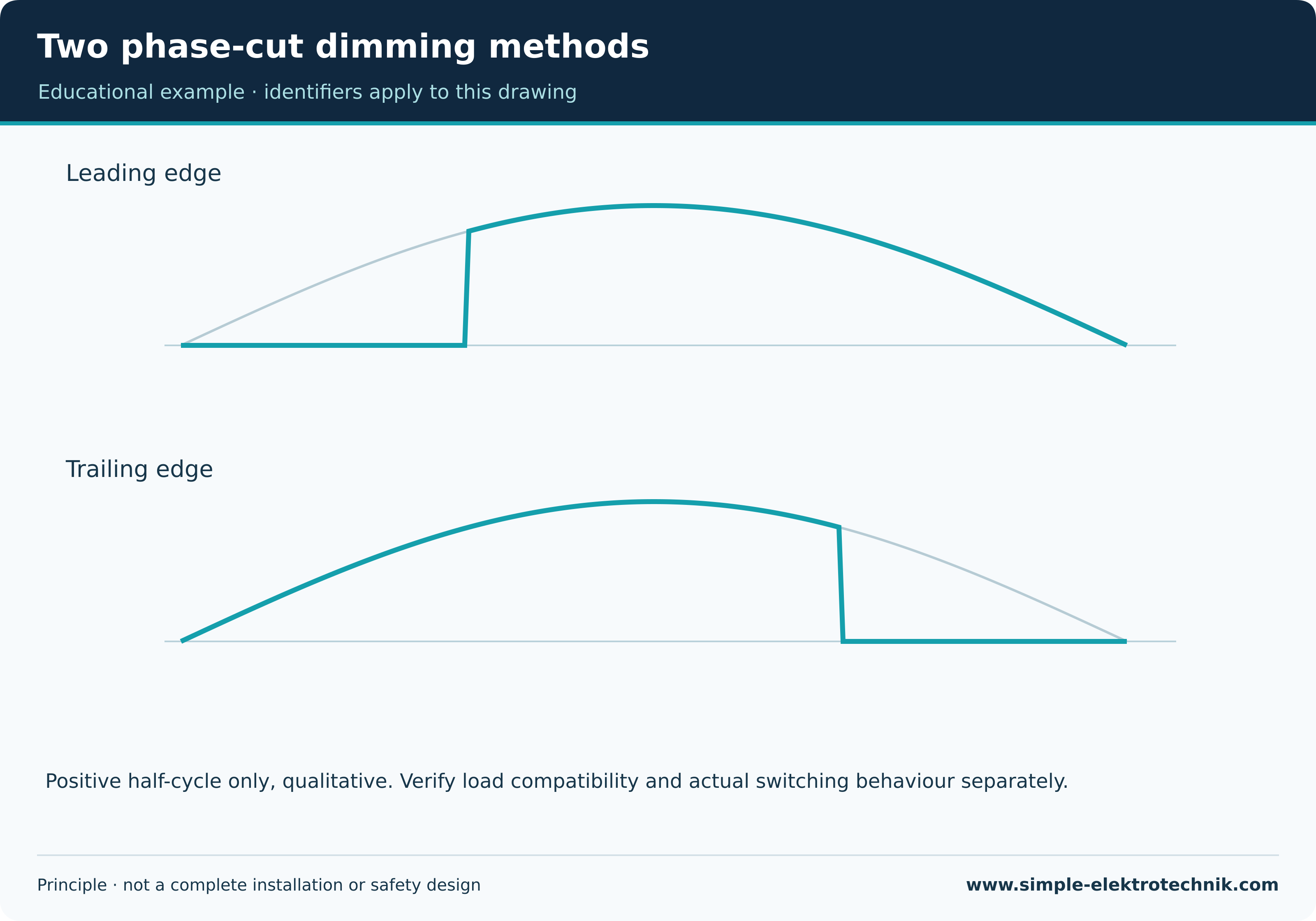
Leading-edge and trailing-edge dimmingThese dimming methods alter the effective waveform of an AC half-cycle by switching portions of it.
Leading-edge dimming delays conduction at the start of a half-cycle. Trailing-edge dimming turns conduction off before its end. Electronic loads must support the particular method.
Example
A dimmable LED supply may be approved only for particular dimmer types and load ranges.
Important distinction
Suitability does not follow from LED wattage alone. Minimum load, starting behaviour and manufacturer compatibility may matter.
LEDAn LED is a semiconductor diode that emits light under suitable operation.
It needs a supply and current limiting or regulation suited to its characteristics. A complete LED lamp may already contain that electronics.
Example
An LED module for constant-current operation and a strip for a specified constant voltage need different supply concepts.
Important distinction
A bare LED is not an arbitrary load to connect directly to a voltage source. Dimmability depends on the complete equipment combination.
LED driverAn LED driver provides operating conditions suitable for its intended LEDs.
Important specifications include output mode, voltage or current range, power, isolation and control method. Driver and LED module need to match.
Example
A constant-current driver regulates its intended current within its specified output-voltage range.
Important distinction
A dimmable marking does not automatically identify the correct dimming method. A low output voltage also does not prove every required protective separation.
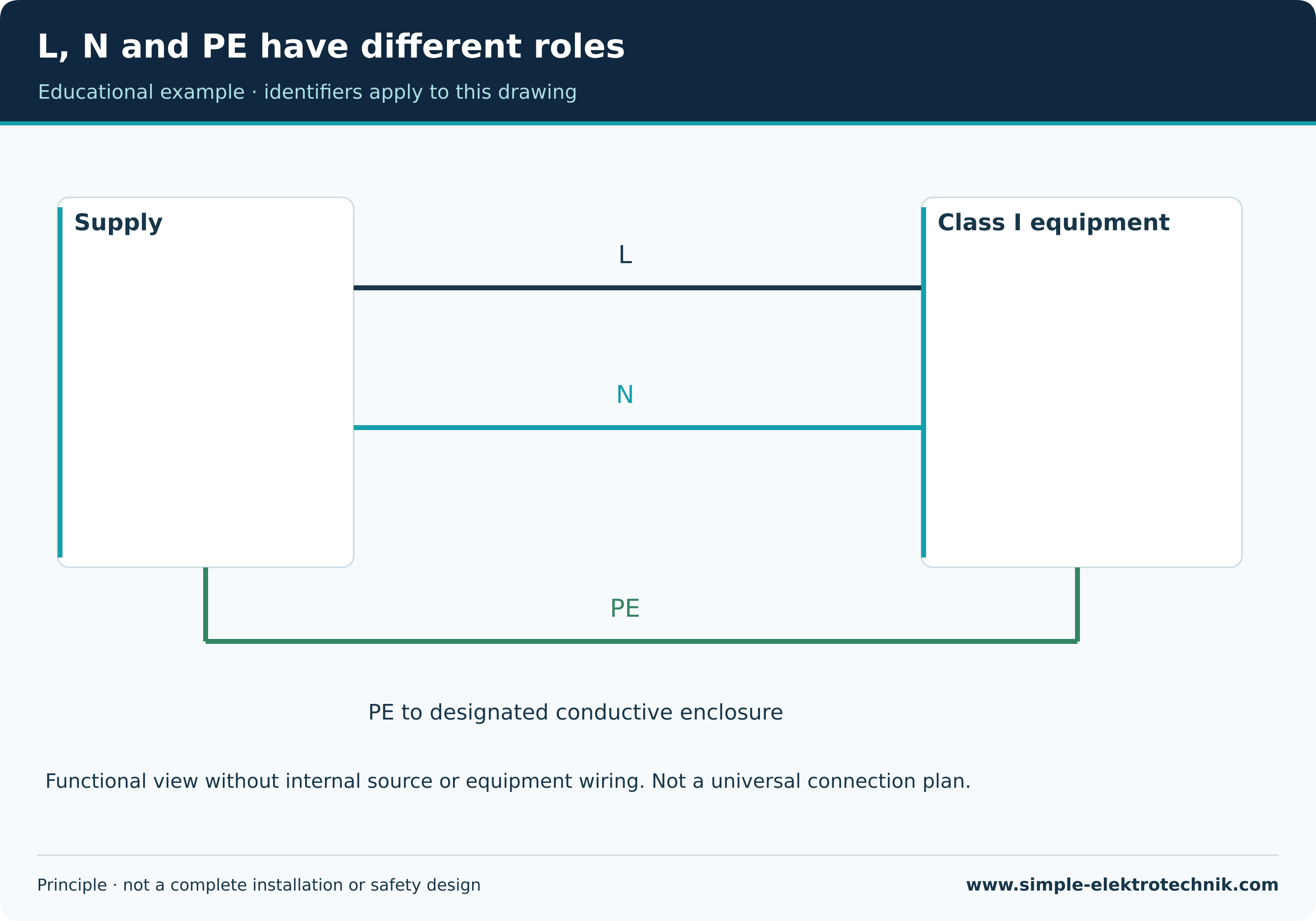
Line conductorA line conductor is a live conductor other than a neutral or midpoint conductor. L or L1, L2 and L3 are common designations in AC installations.
A hazardous voltage can exist relative to another conductor or earth. The actual voltage depends on the supply and earthing arrangement.
Example
A single-phase lamp may be supplied between line and neutral when the equipment and circuit are designed accordingly.
Important distinction
Insulation colour alone does not prove conductor function. The everyday term phase also needs distinguishing from phase angle and phase sequence.
Local control and cloud servicesLocal control processes intended functions within the local system. Cloud functions additionally use external services.
Which functions work without internet needs verification for the actual combination. Operation, automations, remote access and setup may have different dependencies.
Example
A local lighting rule may continue while a cloud-based voice function fails during an internet outage.
Important distinction
A radio standard alone does not guarantee complete offline operation or privacy. Integration, accounts and platform functions also matter.
Low-pass filterA low-pass filter favours lower frequencies over higher ones within its intended range.
Cutoff, order and actual circuitry determine the transition. Outside an idealised model, attenuation is not a hard all-or-nothing boundary.
Example
A suitable filter can reduce particular fast components of a measured signal before further processing.
Important distinction
Filtering may also delay changes or alter useful information. A steadier displayed number does not therefore prove better accuracy.
Luminous fluxLuminous flux is optical power weighted according to a specified visual response. Its unit is the lumen.
It helps compare emitted light. Electrical input in watts describes energy use and is not a direct brightness specification.
Example
Two lamps with the same wattage can emit different luminous flux.
Important distinction
Lumens alone do not show how well a work surface is illuminated. Distribution, distance and surroundings also matter.
M
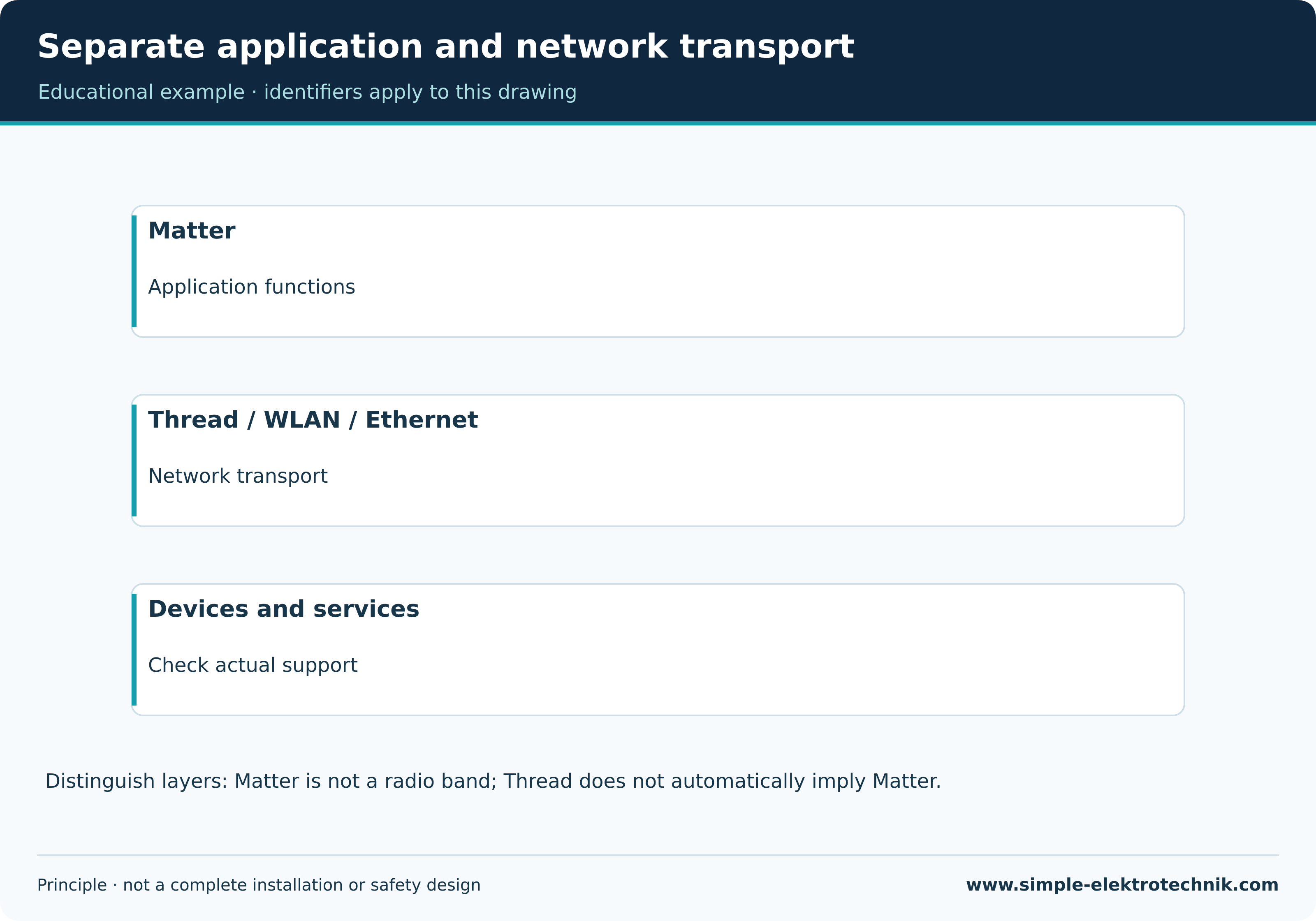
MatterMatter is an IP-based application protocol for interoperable functions between compatible smart-home devices and systems.
It can use suitable transports such as Thread, Wi-Fi and Ethernet. Actual available functions depend on equipment, supported features and participating systems.
Example
A suitable device may join a supporting ecosystem without every manufacturer-specific extra function necessarily appearing there.
Important distinction
Matter is not a radio band and is not the same as Thread. A Matter mark does not promise every imaginable function in every app.
Measurement categoryMeasurement category identifies instrument suitability for specified stresses within an electrical supply environment.
Category and associated voltage rating must be considered together. Leads, accessories and actual conditions also form part of selection.
Example
An instrument used in distribution needs the appropriate combination of category and voltage rating.
Important distinction
The highest marked voltage alone does not establish a suitable location of use. A CAT marking also does not prove every required measurement function.
Measurement uncertaintyMeasurement uncertainty describes uncertainty associated with a measurement result on the available information.
Instrument, method, contacts, environment and other influences may contribute. Calibration determines relationships to references; it does not automatically mean adjustment.
Example
A result near a decision limit needs assessment using the intended decision process and its uncertainties.
Important distinction
Many decimal places do not prove equivalent accuracy. A calibration certificate does not replace pre-use function and condition checks.
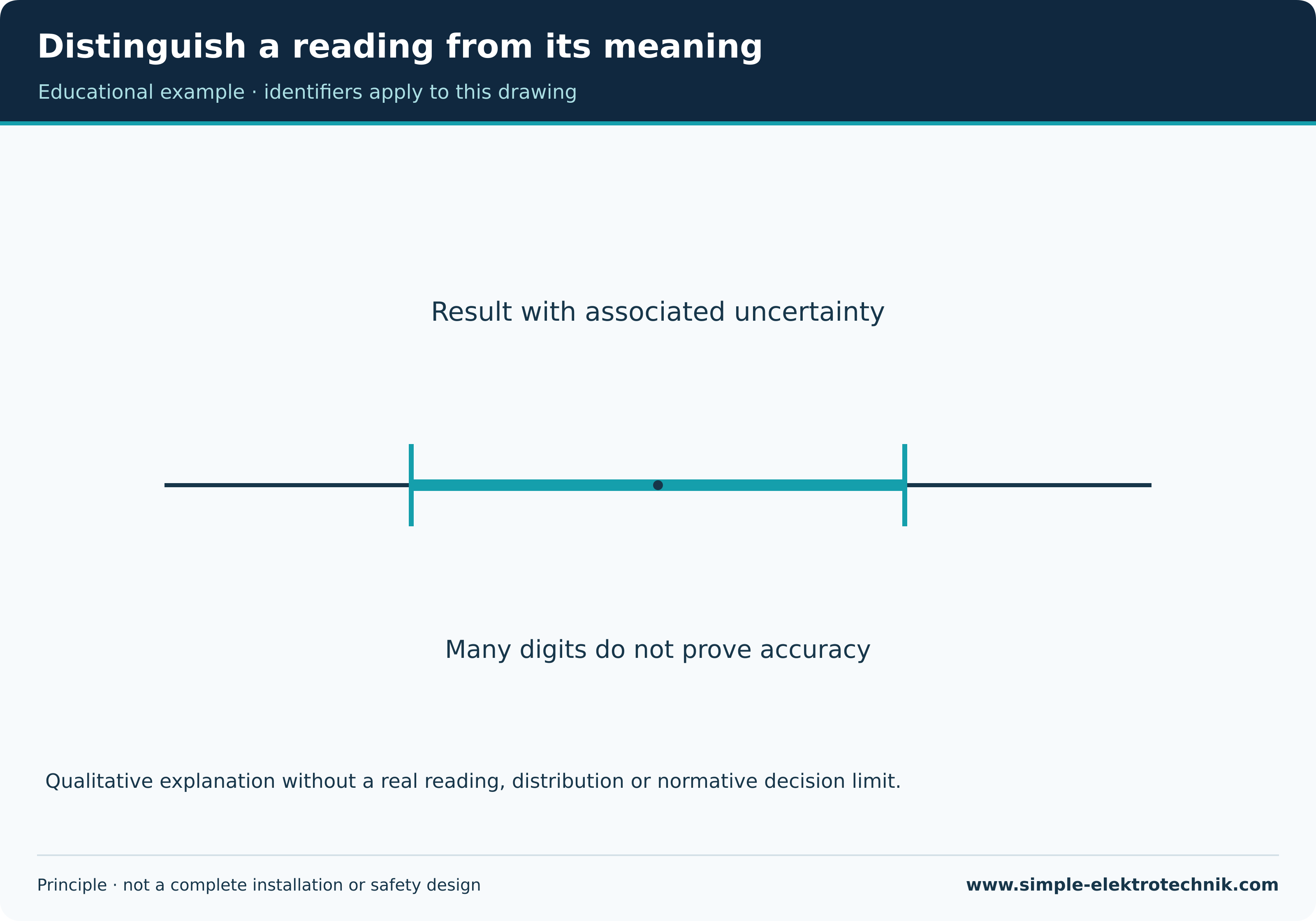
Mesh networkIn a mesh network, suitable participants can forward data through other participants.
Which devices forward traffic and which act only as end devices depend on system and role. Radio quality and suitable paths remain important.
Example
A powered suitable router may provide additional communication paths for a wireless network.
Important distinction
More devices do not automatically improve every network. A battery sensor is not a router merely because it participates.
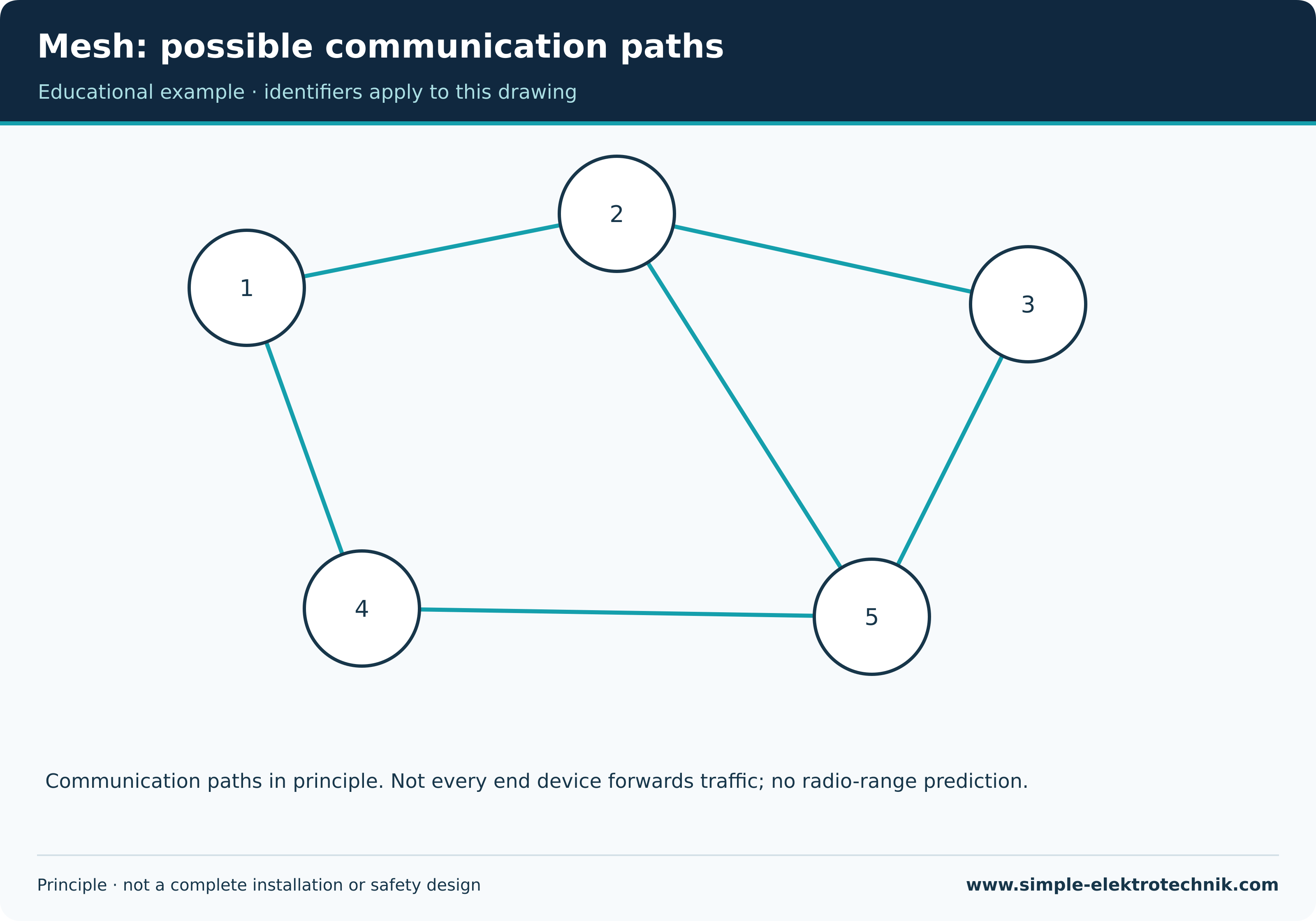
Miniature circuit-breakerAn MCB is an overcurrent protective device for its intended application.
It has a defined time-current behaviour. Common designs respond to sustained overload and sufficiently high short-circuit current through different mechanisms.
Example
Selection considers the conductor, installation conditions, load and the required disconnection verification.
Important distinction
A characteristic letter alone does not establish suitability. A higher current rating may overload an existing conductor.
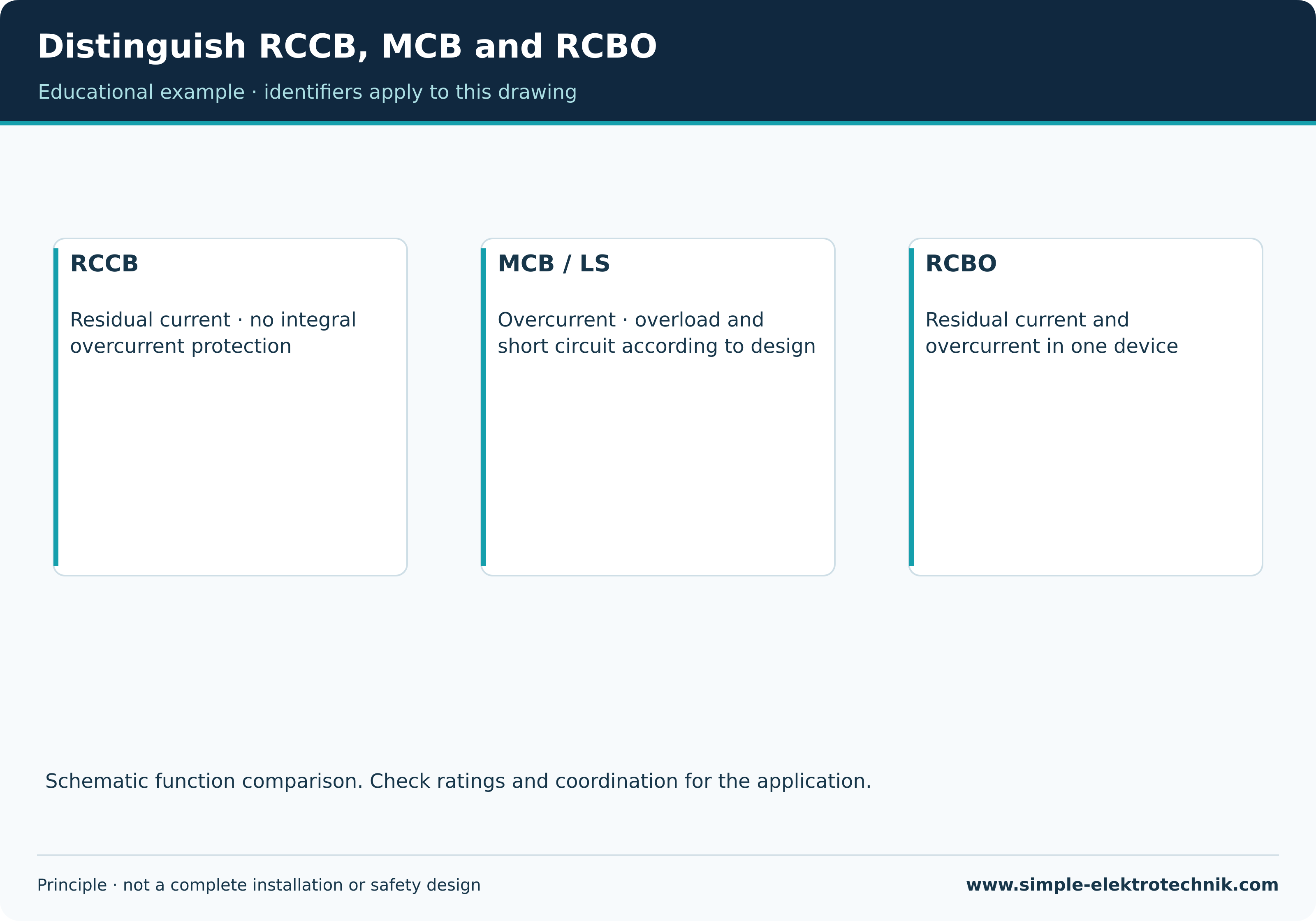
Motor protectionMotor protection comprises suitable measures against specified impermissible operating stresses.
Depending on the concept, current, temperature or other conditions are monitored. Short-circuit and overload protection may need different devices or functions.
Example
An overload relay may release its associated contactor through a control contact.
Important distinction
A setting does not follow merely from the circuit name. Location, motor rating and manufacturer coordination matter.
N
NetworkNetwork is context-dependent. An electrical network connects components; a data network connects communicating participants.
Series and parallel arrangements may be parts of an electrical network. Smart-home discussion more often concerns addressing, transmission and communication roles.
Example
Troubleshooting a data network examines different relationships from resistance calculation in an electrical network.
Important distinction
Similar terminology must not blur the level of discussion. Supply, protection and data communication need separate understanding.
Neutral conductorA neutral conductor is connected to the neutral point of the supply system and may contribute to transmission of electrical energy.
It belongs to the live conductor system and can carry load current. Its potential and loading cannot be inferred merely from blue insulation.
Example
Unbalanced single-phase loads in a three-phase system can produce current in the common neutral.
Important distinction
N is not a protective conductor and is not inherently harmless. Historical German Nullleiter terminology must not obscure the distinction between N and PEN.
NoiseNoise describes irregular signal components that can overlay the desired signal in transmission or measurement.
Sources may lie within a component or its environment. Noise, deliberate periodic interference and systematic measurement error are not identical in every assessment.
Example
A very small sensor signal may be difficult to resolve relative to unwanted components.
Important distinction
A filter may also alter useful information. Reduced visible variation alone does not prove a correct result.
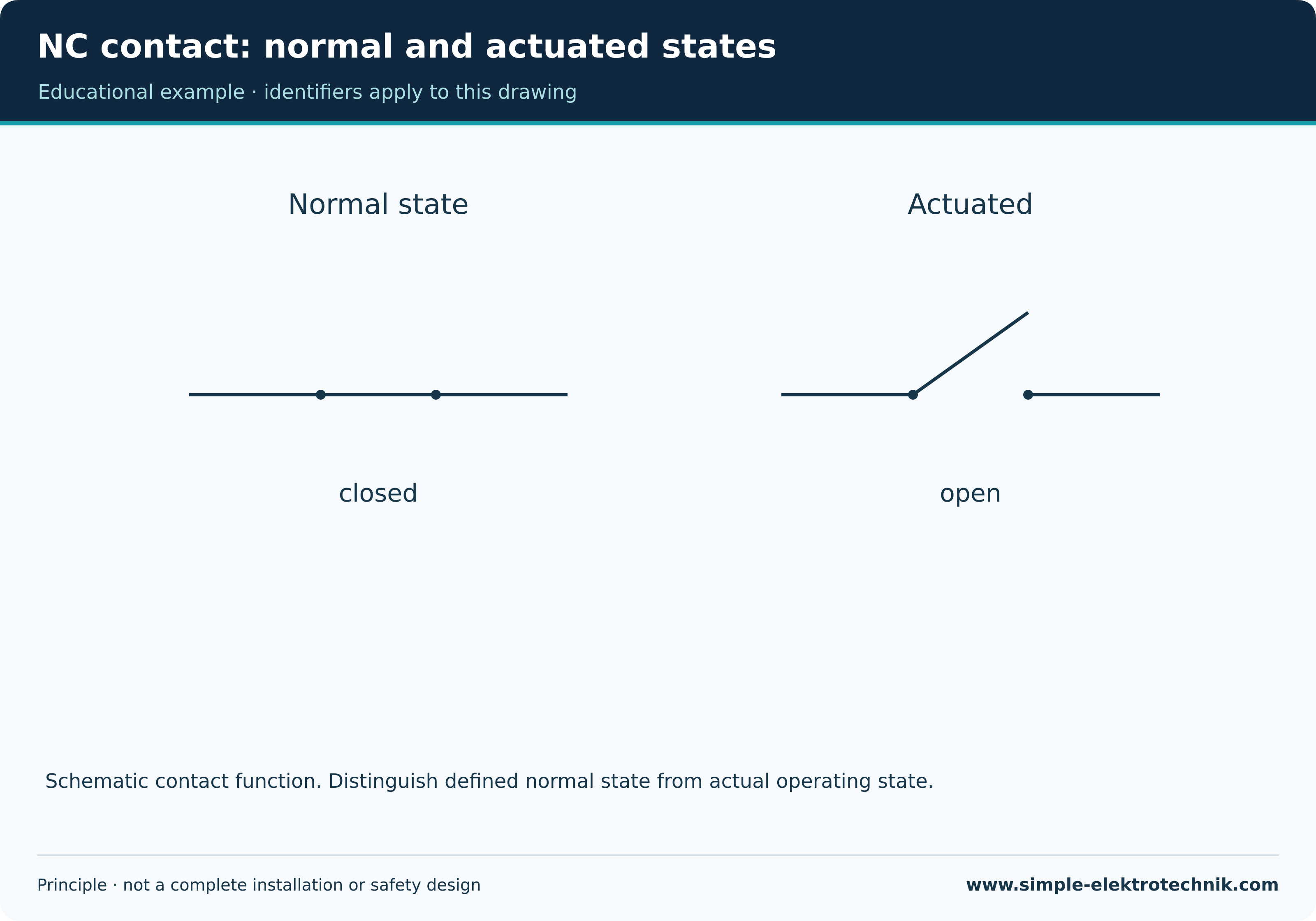
Normally closed contactA normally closed contact is closed in the specified unactuated normal state and opens when actuated.
Determine contact function from its symbol and device documentation. Terminal numbers can help but do not replace identification of the actual device.
Example
An ordinary stop pushbutton may use an intended NC contact to interrupt the control-current path.
Important distinction
An NC contact in a stop path does not alone provide a validated emergency stop. Safety functions require a complete suitable concept.
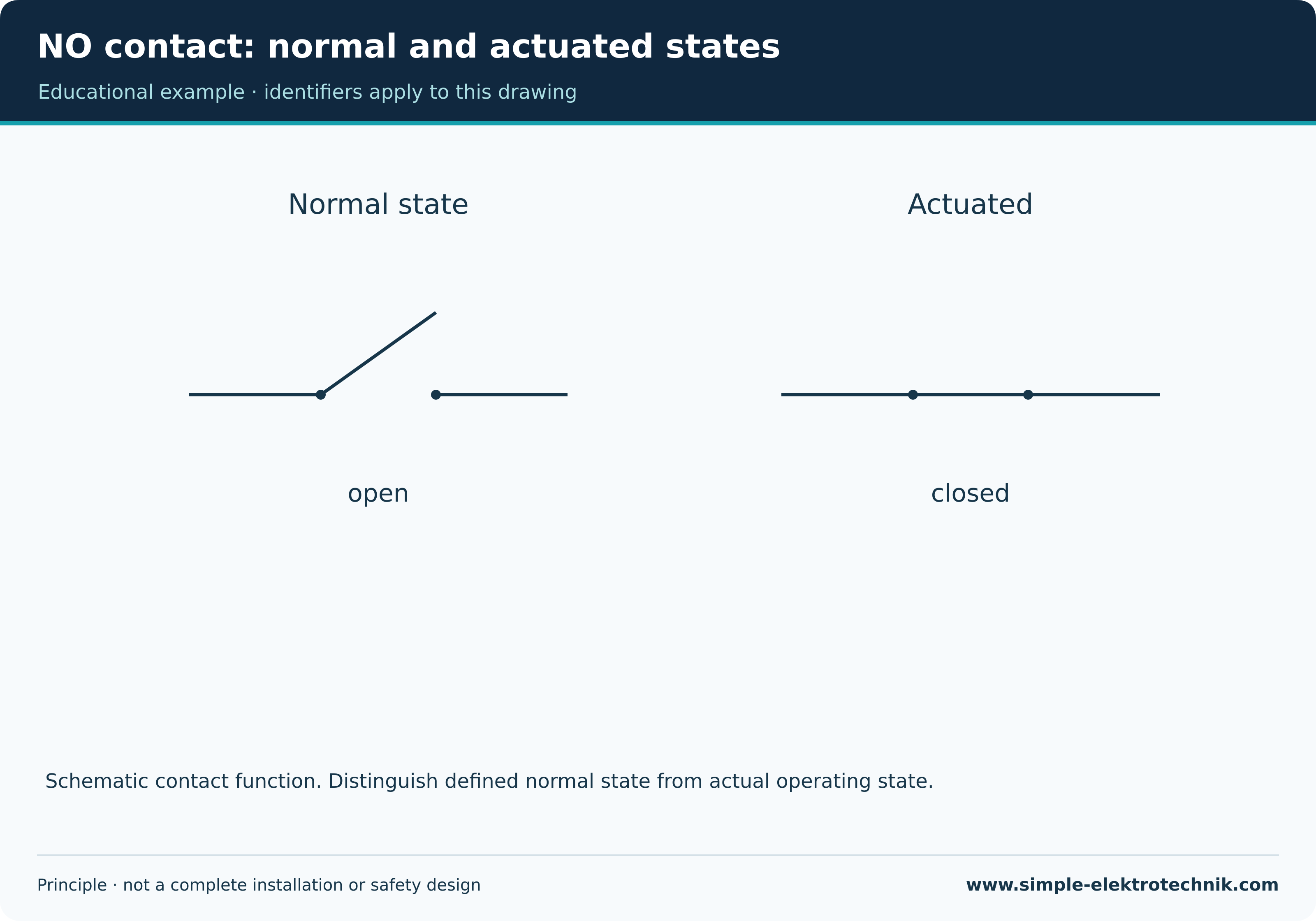
Normally open contactA normally open contact is open in the specified unactuated normal state and closes when actuated.
The symbol refers to that defined state. For relays and contactors, association with the actuator matters; switch drawing conventions also need consideration.
Example
A start pushbutton with an NO contact can close a control-current path when pressed.
Important distinction
NO does not describe an arbitrary present operating state. Distinguish the circuit’s normal-state convention from the actual device state.
O
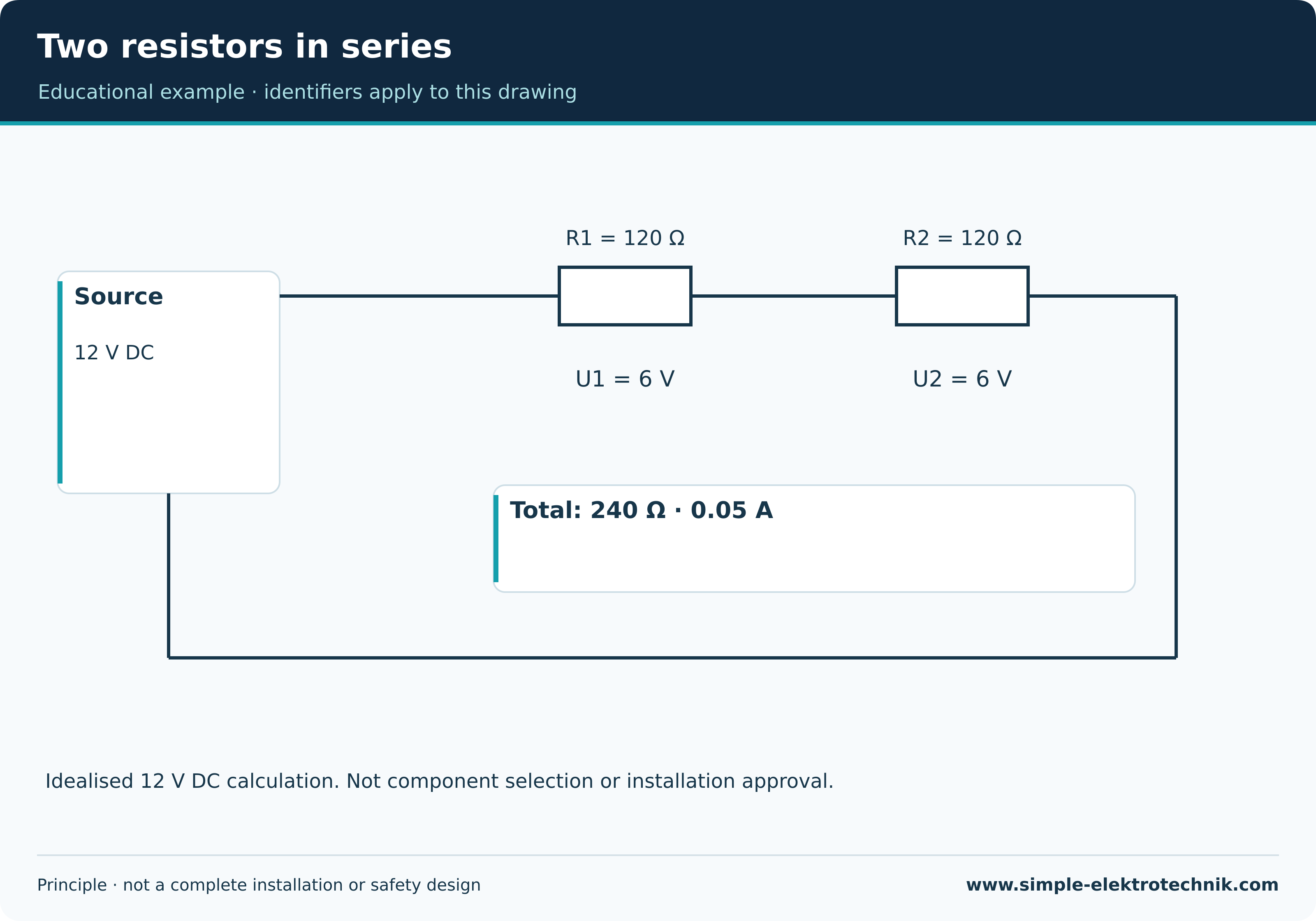
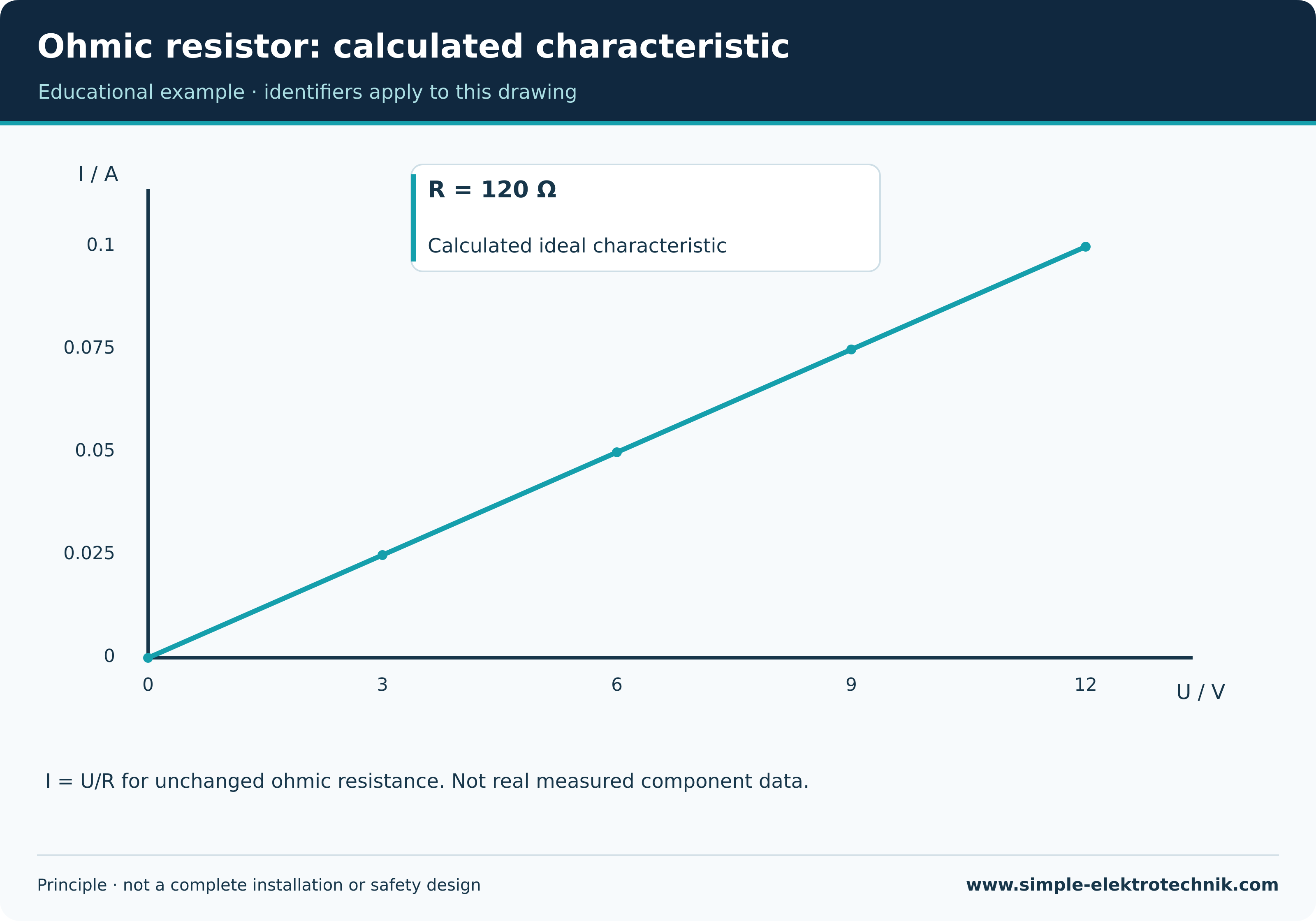
Ohm’s lawOhm’s law describes proportionality between voltage and current in an ohmic resistor under unchanged conditions.
The relationship U = R · I can be rearranged for the required quantity. It describes a suitable model and is not a complete design rule for electrical installations.
Example
Two 120 Ω resistors in series give 240 Ω. Across 12 V, this idealised example carries 0.05 A.
Important distinction
One U/I ratio does not establish ohmic behaviour over a wider range. An incandescent lamp changes resistance as it heats.
Operating timeOperating time describes the interval between a specified triggering event and the device’s intended response.
The start and end points depend on the test procedure. Device operating time and the complete required disconnection time of a protective concept need careful association.
Example
In RCD testing, current waveform, operating conditions and the corresponding time result are assessed together.
Important distinction
A single millisecond value without device type and test conditions cannot support a reliable pass/fail judgement. Do not assume a universal time limit.
Operational amplifierAn operational amplifier is an electronic amplifier building block with differential inputs that can perform many signal functions in a suitable external circuit.
Feedback and surrounding circuitry determine functions such as gain or filtering. Supply, input range, output range and dynamic limits must be respected.
Example
A suitable op-amp can condition a sensor signal for subsequent digitisation.
Important distinction
The ideal op-amp model has limits. An arbitrary op-amp is not automatically suitable as a comparator or power driver.
Optical fibreAn optical fibre guides light to transmit information or perform other intended optical tasks.
A cable may contain multiple fibres and additional protection or strength members. Fibre type, connectors, bend radius and optical equipment need to match.
Example
A suitable fibre link may connect two Ethernet devices through matching optical interfaces.
Important distinction
A fibre and a complete cable are different. Do not look into unknown optical connectors; potentially invisible optical radiation requires care.
OscillationAn oscillation is a variation about a state that repeats after a defined time in the periodic case.
Amplitude, frequency and phase describe different properties of a suitable periodic waveform. Not every oscillation is sinusoidal or undamped.
Example
A sinusoidal AC quantity can be plotted over one complete period.
Important distinction
A single brief pulse is not automatically periodic oscillation. Visual regularity also does not replace quantitative measurement.
OscillatorAn oscillator produces a repeating signal waveform from a suitable energy supply.
Frequency, waveform, stability and startup depend on construction and components. An oscillator may provide analogue or digital waveforms.
Example
A clock oscillator supplies a timing reference for suitable electronic functions.
Important distinction
An oscillation is not automatically desirable. Feedback can also cause unintended instability in an amplifier.
Overcurrent protectionOvercurrent protection limits the consequences of current above the intended conditions for conductors or equipment.
Overload and short circuit impose different stresses. Suitable devices must perform the required tasks according to their design and coordination.
Example
Fuses, MCBs and other coordinated devices can form part of the protection concept.
Important distinction
A protective relay may request disconnection without interrupting the main current itself. An RCCB has no integrated overcurrent protection.
OverloadAn overload occurs when an otherwise intact circuit or item of equipment is loaded beyond its permitted conditions.
Excessive current can cause unacceptable heating over time. Permissible loading depends on construction, environment and operating conditions.
Example
Several simultaneous loads may overload an extension lead without a short circuit being present.
Important distinction
A protective device needs suitable selection. A higher current rating does not fix insufficient conductor capacity.
P
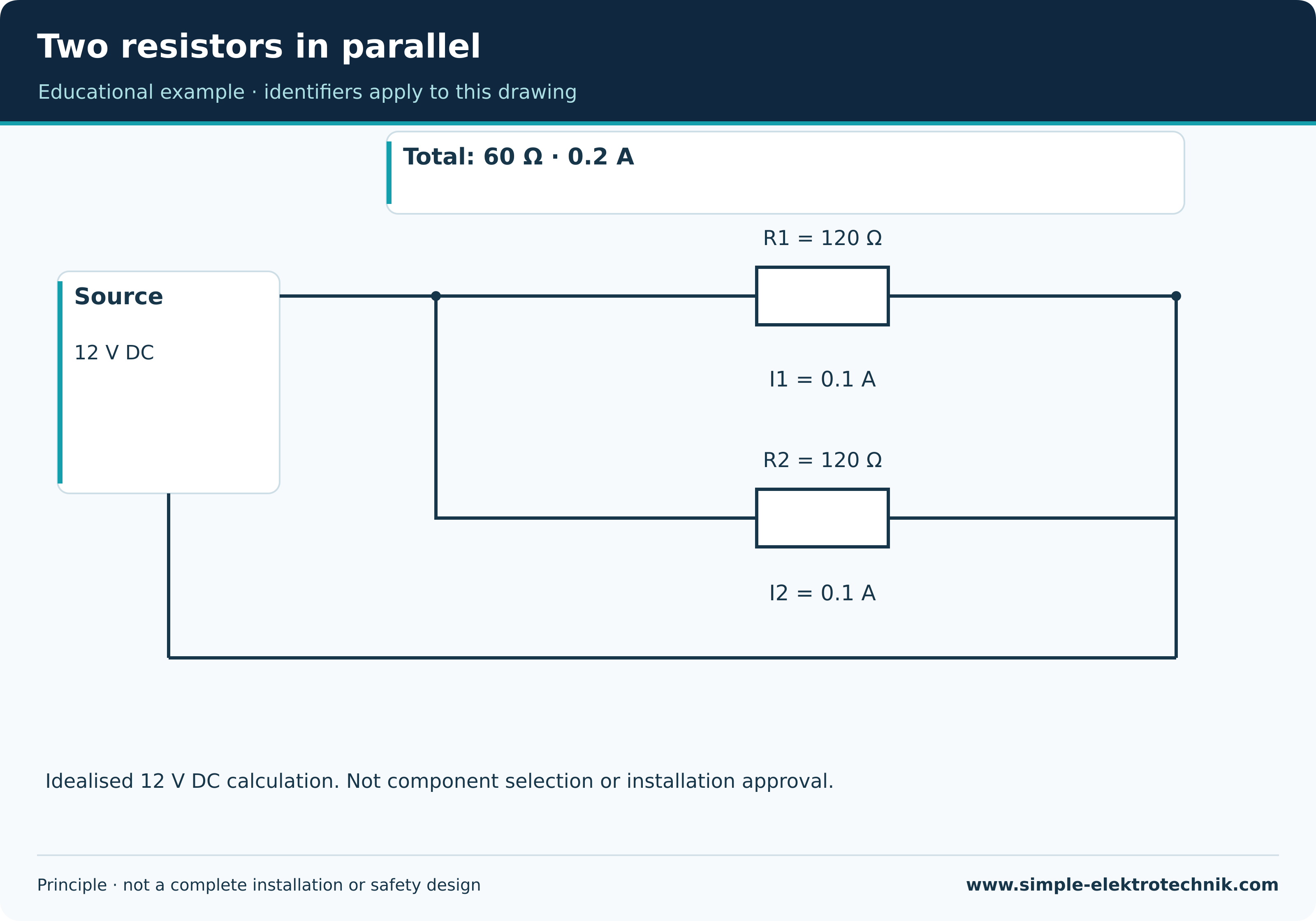
Parallel connectionIn a parallel connection, multiple branches are connected across the same two nodes. Those branches have the same voltage.
Total current is made up of the branch currents. For ideal resistors, equivalent resistance is lower than the smallest individual branch resistance.
Example
Two 120 Ω resistors in parallel across 12 V each carry 0.1 A; the source supplies 0.2 A in total.
Important distinction
Connecting arbitrary sources in parallel is not a general application of this rule. Sources must be suitable and properly coordinated.
PEN conductorA PEN conductor combines protective conductor and neutral conductor functions in one designated conductor.
The combination belongs to particular system sections and is subject to specific requirements. An interruption can affect both protection and the load return path.
Example
In a TN-C-S arrangement, a PEN section is followed by a designated separation into PE and N.
Important distinction
This does not permit arbitrary N–PE links. After the intended separation, the functions must not be arbitrarily recombined.
Phase control and phase lockingPhase control can mean adjustment of phase or its tracking within a control loop, depending on context.
A phase-locked loop compares suitable signals and adjusts an oscillator to achieve the intended relationship. Construction and control behaviour determine function.
Example
A PLL may establish a clock or frequency relationship in suitable communication equipment.
Important distinction
The expression is not an unambiguous synonym for leading-edge lamp dimming. Always state the intended quantity and method.
Phase displacementPhase displacement describes the relative timing of periodic quantities. It is often expressed as an angle.
At the same frequency, a time shift can be related to one complete period. In sinusoidal AC, current may for example be displaced relative to voltage.
Example
An ideal resistive load has sinusoidal voltage and current in phase. Ideal reactive elements behave differently.
Important distinction
The everyday use of phase to mean a line conductor is different. Phase displacement is not a measured proof of installation safety.
Phase-sequence testA phase-sequence test examines the phase order at a defined point in a suitable multiphase system.
Connection, suitability and interpretation follow the instrument instructions. The indication describes the electrical order, not directly every mechanical machine motion.
Example
A motor may need a separate rotation check despite the expected phase sequence because of its actual connection.
Important distinction
A clockwise phase sequence is not complete installation verification. Conductors must not be swapped experimentally without a safe professional procedure.
PowerPower describes the rate at which energy is transferred or converted. Its unit is the watt.
Instantaneous power is p(t) = u(t) · i(t). For DC quantities, P = U · I can be used. Power control adjusts delivered or absorbed power through a suitable method.
Example
A lamp operating at a constant 100 W uses 0.5 kWh of electrical energy in five hours.
Important distinction
Watts are not an amount of consumption. AC requires distinctions between active, reactive and apparent power; U · I is not always active power.
Power and low-current systemsPower and low-current systems are broad terms whose meanings depend on technical and legal context.
Everyday usage often distinguishes energy supply from information transmission. This is not a universal voltage boundary or a statement of permission to perform work.
Example
A data cable carries information; suitable systems may also supply device power over it.
Important distinction
Low-current does not automatically mean safe to touch or fire-safe. Voltage, available energy and actual protective measures matter.
Power circuitThe power circuit carries the electrical energy intended for the load within a switching arrangement.
Conductors, main contacts and protective devices are selected for actual requirements. The control may have separate ratings and supplies.
Example
In a motor starter, the load supply passes through the intended main contacts to the motor.
Important distinction
An off control circuit does not prove a dead power circuit. Conversely, separately supplied control sections may remain live.
Power factorPower factor is the ratio of active power P to apparent power S. It is often denoted by λ.
Only for sinusoidal waveforms does the magnitude of power factor equal the magnitude of cos φ. Nonlinear loads may also distort current, making that simple equivalence unsuitable.
Example
An LED supply may draw a different current waveform from an ideal resistor. Its technical documentation therefore matters.
Important distinction
A high power factor does not establish high efficiency. The two specifications describe different properties.
Power lossPower loss is the part of input power not delivered as intended useful output.
Real losses may produce heating in conductors, semiconductors, magnetic materials or dielectrics. The assessment boundary must be clear.
Example
A power transistor may require suitable heat removal despite its small package.
Important distinction
Ideal inductors and capacitors consume no average active power; real devices have additional losses. Reactive power is therefore not simply power loss.
Power regulationPower regulation controls a power quantity using an intended setpoint and feedback.
Open-loop power control may operate without that feedback. Methods and limits depend on load, source and desired behaviour.
Example
Temperature control may vary heater power to move a measured temperature towards a setpoint.
Important distinction
Not every dimmer position regulates actual output power. Distinguish open-loop control, regulation and the quantity being regulated.
Power transistorA power transistor is designed for an intended power application such as switching or regulating suitable loads.
Voltage, current, switching losses, cooling and safe operating area need joint consideration. Drive and protection are parts of the circuit.
Example
An inverter may use suitable power semiconductors to create an intended output waveform.
Important distinction
A high datasheet current rating does not apply regardless of temperature or operating conditions. Similar packages do not allow arbitrary substitution.
Protection classProtection classes identify fundamental equipment construction concepts for protection against electric shock.
Class I includes an intended protective conductor connection. Class II uses double or reinforced insulation. Class III requires suitable extra-low-voltage protective construction and supply.
Example
The double-square symbol identifies Class II. A metal enclosure alone does not establish Class I.
Important distinction
The classes are not a safety ranking. Protection class, IP rating and CE marking describe different matters.
Protective conductorA protective conductor is provided for protection, for example to connect designated exposed conductive parts to the protective system.
Its connection forms part of the protective concept. Suitable construction and the required verification establish whether it is effective.
Example
A designated conductive enclosure of Class I equipment is connected to the protective conductor system.
Important distinction
PE must not be used as an ordinary load neutral. An RCD does not replace a PE required by the protective concept.
Protective conductor verificationProtective conductor verification examines the intended protective connection and its required properties using a suitable method.
Test points and intended path must be clear. Parallel paths can produce a favourable result even when the intended connection is broken.
Example
A visible enclosure screw is not assumed to be a suitable test point without establishing its actual electrical function.
Important distinction
This is different from earth-electrode or insulation testing. One favourable result does not automatically certify the whole installation.
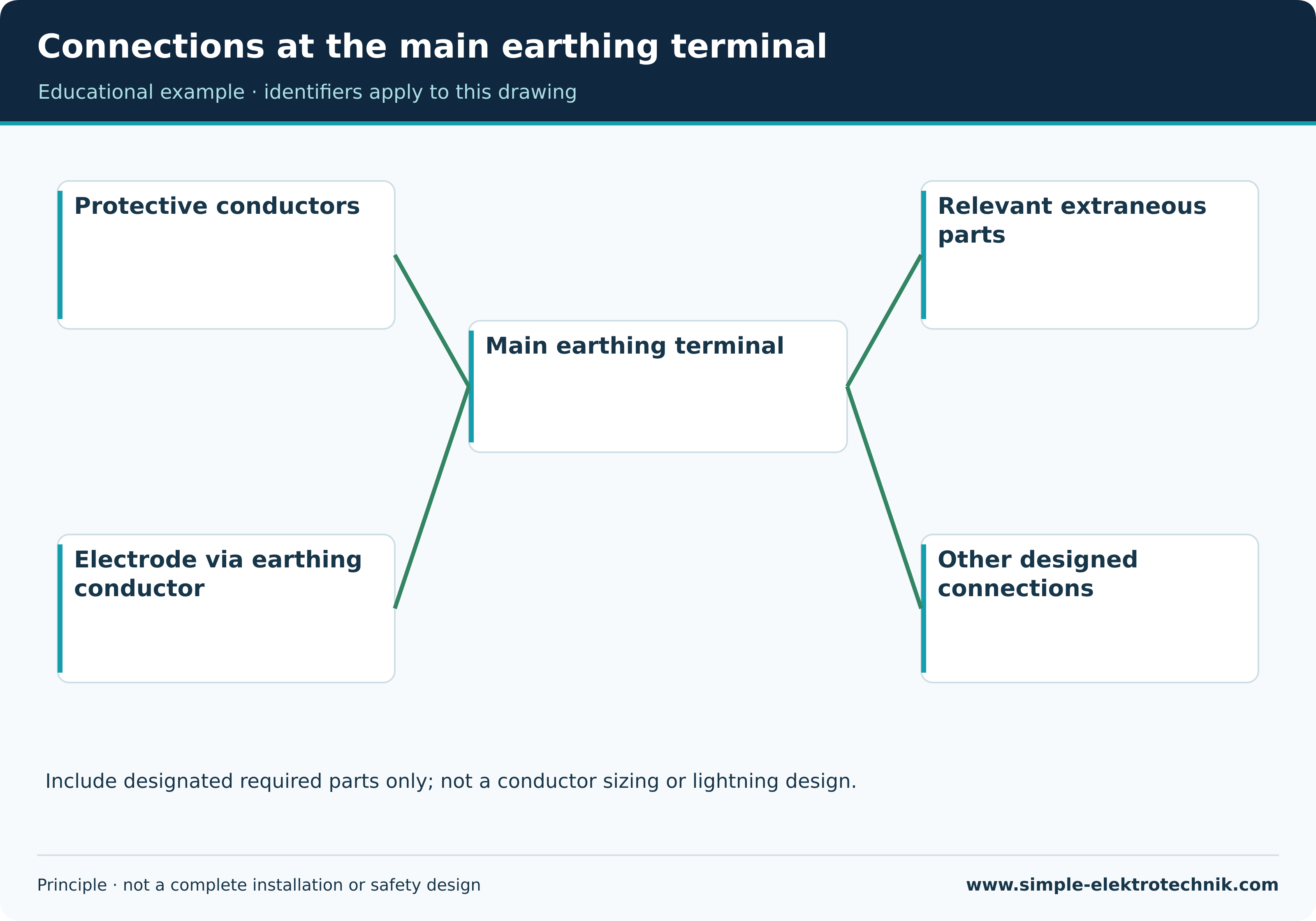
Protective equipotential bondingProtective equipotential bonding connects designated conductive parts to limit hazardous potential differences.
Which parts must be included depends on their actual characteristics and applicable requirements. The main earthing terminal is a designated common connection point within the protective concept.
Example
An actual extraneous conductive part can introduce a potential into an area and may need inclusion accordingly.
Important distinction
Not every metal object needs automatic bonding. Bonding and earthing are related but describe different functions.
Protective relayA protective relay monitors specified quantities or states and initiates a protective response when its criteria are met.
A separate switching device may perform actual power interruption. Sensing, auxiliary supply, output and disconnection device must work together in the full concept.
Example
An overload relay may open an intended control contact and thereby release its associated contactor.
Important distinction
An ordinary relay is not automatically suitable for a validated safety function. A protective relay also does not replace every required protective measure.
Protective switching deviceProtective switching device is a broad expression that can refer to different functions unless the actual device is specified.
An MCB responds to overcurrent; a residual-current-only device responds to residual current. An RCBO combines those functions. Other devices protect motors or perform specialised tasks.
Example
When investigating a trip, first establish which actual device operated.
Important distinction
The everyday statement that a breaker tripped does not identify a definite fault type. Cause and protective function need separate assessment.
PushbuttonA pushbutton generally operates a contact while actuated and returns to its normal state afterwards.
Its normal state may provide an NC, NO or other intended contact function. What the connected control does with the impulse is a separate matter.
Example
A short impulse can toggle an impulse relay while the pushbutton itself returns.
Important distinction
Pushbutton does not imply capacitive touch sensing. Mechanical buttons and electronic touch surfaces should be distinguished.
R
Rated residual operating currentRated residual operating current is a specified RCD characteristic, commonly denoted IΔn.
It differs from rated load current, actual leakage current and the operating current found by a test. Associated conditions are specified by the device and procedure.
Example
An RCD has separate markings for its load-current rating and residual-current protective characteristic.
Important distinction
The marking is not a measured installation value. A suitable rating also does not replace verification of the complete protective measure.
RCBOAn RCBO combines residual-current protection and overcurrent protection in one intended device.
Residual-current type, overcurrent characteristic, ratings and breaking capacity must suit the application. The combined form does not remove conductor or protective-connection requirements.
Example
An individual final circuit may be protected by a suitably selected RCBO.
Important distinction
RCD and RCBO are not interchangeable terms. The first describes a device family, the second a particular combined function.
RCCBAn RCCB is a residual current circuit-breaker without integral overcurrent protection.
Its rated current and rated residual operating current describe different properties. Required overcurrent protection must be coordinated with the complete combination.
Example
A circuit may use an RCCB together with suitable overcurrent protective devices.
Important distinction
A high rated current on its marking does not mean an RCCB trips on overload like an MCB at that value.
RectifierA rectifier converts AC quantities into a rectified output quantity.
Diode or controlled circuits can perform the conversion. Smoothing, regulation and galvanic isolation are additional functions not implied by the term alone.
Example
Bridge rectification can use both half-cycles of a suitable AC supply.
Important distinction
Rectified does not automatically mean smooth, regulated or safe to touch. Output may still contain hazardous voltage and stored energy.
RelayA relay switches a circuit in response to a control signal. Electromechanical relays use an actuator and contacts; other designs operate electronically.
Control and load sides have their own ratings. Whether isolation exists, and of what kind, must follow from actual construction and documentation.
Example
A suitable relay can use a control signal to switch a load with different ratings.
Important distinction
A relay is not automatically a power contactor or safety relay. Solid-state relays may also involve off-state leakage and heat losses.
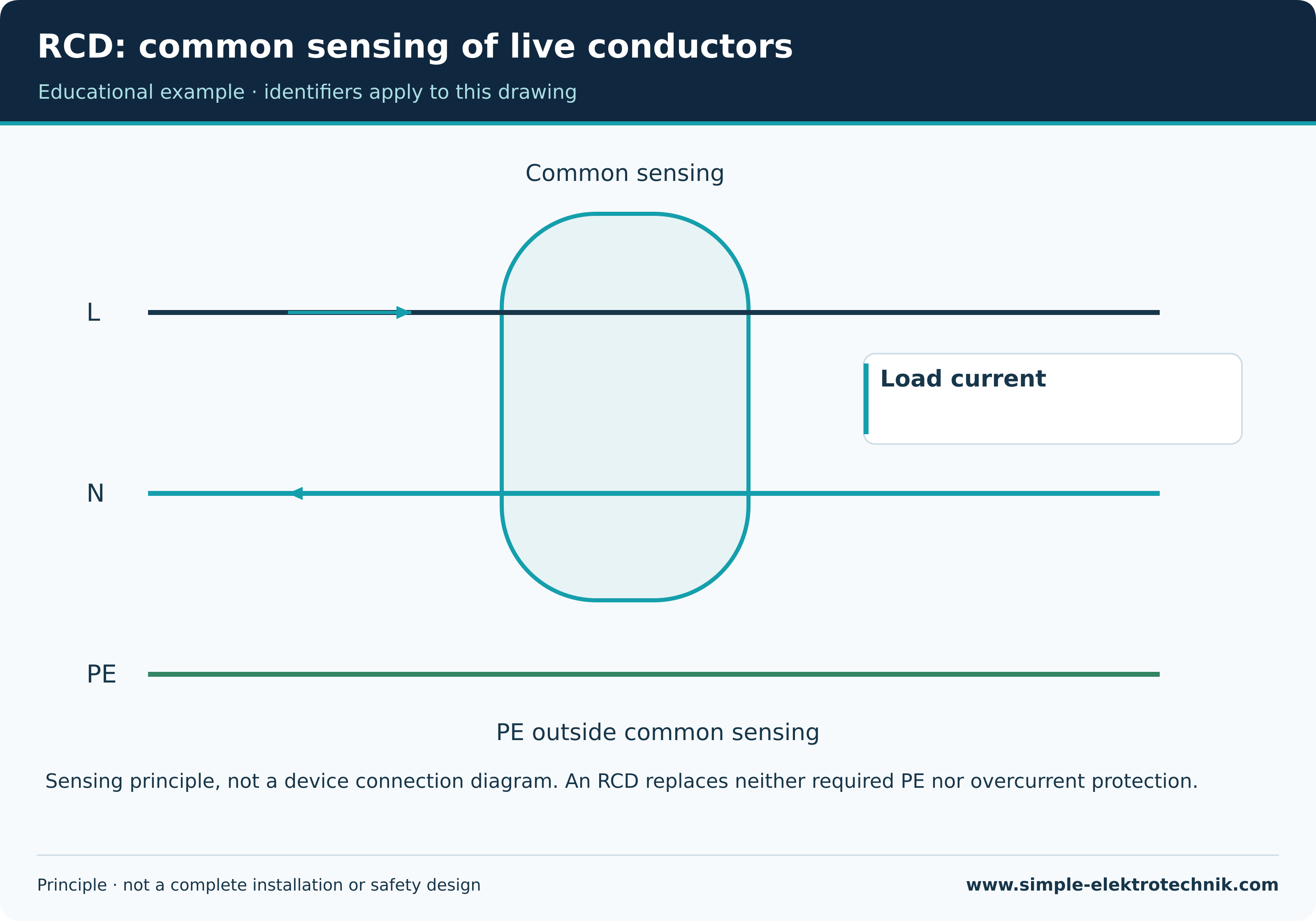
Residual current device (RCD)RCD is the general term for devices responding to a specified residual current.
Live conductors passing through the intended sensing area are considered together. Current returning through another path can create an imbalance. Device design and residual-current waveform must suit the application.
Example
An RCCB provides residual-current protection without integrated overcurrent protection; an RCBO combines both.
Important distinction
A residual-current-only device replaces neither overcurrent protection nor a required PE. It also does not detect every possible hazardous contact.
ResistanceElectrical resistance describes the relationship between voltage and current for a component. It is expressed in ohms.
For an ohmic resistor under unchanged conditions, U = R · I. For other components, the ratio U/I may depend on operating point and temperature.
Example
At 12 V across a constant resistance of 120 Ω, the calculated current is 0.1 A.
Important distinction
A body, LED or regulated power supply is not an arbitrary fixed classroom resistor. Reactive effects may also matter in an AC circuit.
Resistance measurementResistance measurement determines resistance between defined points under the measurement method’s conditions.
Test current, contacts and possible parallel paths influence the value. An ordinary ohmmeter is not intended for arbitrary connection to a supplied circuit.
Example
A defined resistor may be measured across its terminals in a suitable safely isolated teaching setup.
Important distinction
Resistance, insulation and loop-impedance measurements are different methods. One range does not automatically perform the other verification tasks.
Resonant circuitA resonant circuit uses the interaction of inductance and capacitance to produce resonance.
In an idealised model, energy exchanges between magnetic and electric fields. Real losses and loading affect damping and resonance.
Example
A suitably tuned circuit may respond particularly strongly in a certain frequency region.
Important distinction
A real passive circuit does not oscillate indefinitely without losses. High resonant voltages can occur despite a small excitation.
Rotating magnetic fieldA rotating magnetic field is a magnetic field rotating in space. Suitable multiphase windings can produce it through time-displaced currents.
The principle enables many AC motors. Field direction and speed depend on the supply system and machine construction.
Example
The supply phase sequence can influence field direction in a correspondingly connected machine.
Important distinction
A phase-sequence tester indicates electrical order. Actual mechanical rotation needs additional assessment through a suitable procedure.
S
SceneA scene is a stored combination of desired device states.
It can be recalled to set several devices together. Recall may be manual or initiated by an automation.
Example
An evening scene may dim selected lights and switch others off.
Important distinction
A scene alone does not necessarily define the trigger or decision about when to activate it. That belongs to operation or automation.
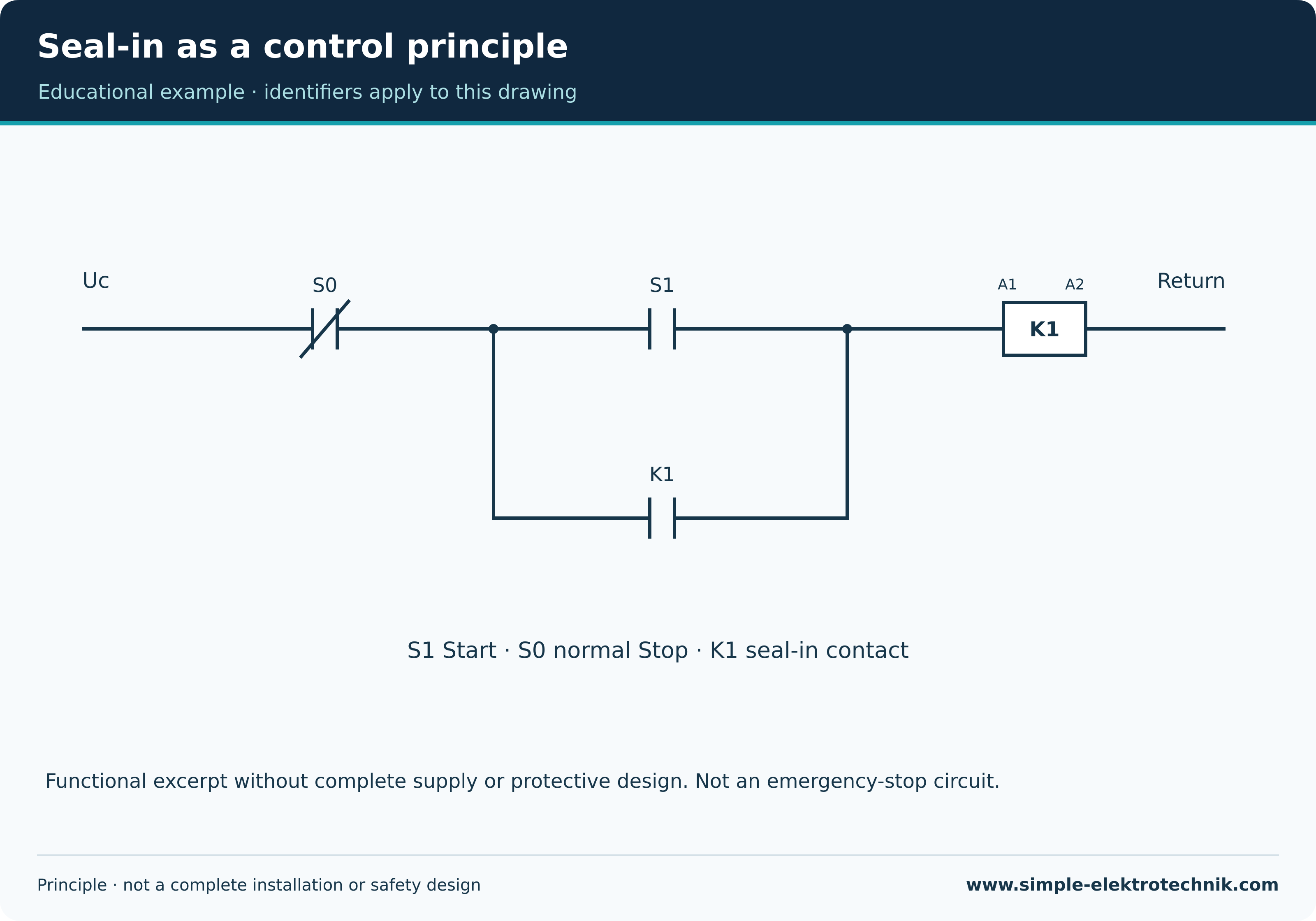
Seal-in circuitA seal-in circuit maintains an intended control state after a start impulse ends, while required conditions remain present.
In classic contactor control, an auxiliary NO contact can bypass the start contact. The stop path and intended protective conditions must still be able to release the circuit.
Example
After Start is released, K1 remains energised if its holding contact and other conditions maintain the coil-current path.
Important distinction
Seal-in is not an uninterruptible power supply. Behaviour after supply loss and restoration depends on the complete control concept.
SemiconductorSemiconductors are materials whose electrical properties can be used and controlled for electronic devices.
Doping, electric fields, temperature and light may influence behaviour. Different devices such as diodes and transistors are built using these properties.
Example
A semiconductor sensor may convert a physical quantity into an electrically usable signal.
Important distinction
A semiconductor is not simply an arbitrary resistor between conductor and insulator. Material behaviour and actual device structure matter.
SensorA sensor detects a physical or other specified quantity and produces a usable signal from it.
Sensing principle, coverage, mounting and processing determine the information actually available. A reported state may also be filtered or delayed.
Example
A temperature sensor provides information on which heating control may act.
Important distinction
A sensor indication does not directly prove every real state. A motion detector, for example, does not automatically detect every stationary person.
Series connectionIn an unbranched series connection, the same current passes through components connected one after another.
The individual signed voltages make up the total voltage. For ideal resistors, resistance values add. Voltage divides according to those resistances.
Example
Two equal resistors across a total of 12 V each have a 6 V voltage drop in the idealised case.
Important distinction
A German Serienschalter does not imply that its lamps are electrically in series. Distinguish the device name from the circuit principle.
Short circuitA short circuit connects points intended to remain separated through a relatively low impedance.
Possible current is limited by the source, conductors and complete fault path. Suitable protective devices must match the installation and prospective fault current.
Example
Damaged insulation can allow an unintended connection between live conductors.
Important distinction
A short circuit is not an ordinary overload. A fault between two live conductors is not detected by every residual-current-only device.
Short-circuit currentShort-circuit current is the current in a considered short circuit. Prospective short-circuit current describes the expected value under defined conditions.
Source impedance, conductor path and fault type influence it. Protective assessment includes disconnection behaviour and suitable breaking capacity.
Example
Different points within one installation can have different prospective short-circuit currents.
Important distinction
A value derived from a measurement is not a deliberately created real short circuit. Method and uncertainty form part of its assessment.
SlipSlip describes the relative speed difference between the synchronous rotating field and an induction-machine rotor.
For the usual motoring case, s = (ns − n)/ns is used. Load and operating state influence its actual value.
Example
A rotor at 1440 rpm with an assumed synchronous speed of 1500 rpm has a calculated slip of 4%.
Important distinction
Slip is not mechanical belt slippage. Formula and sign relate to the considered machine operating mode.
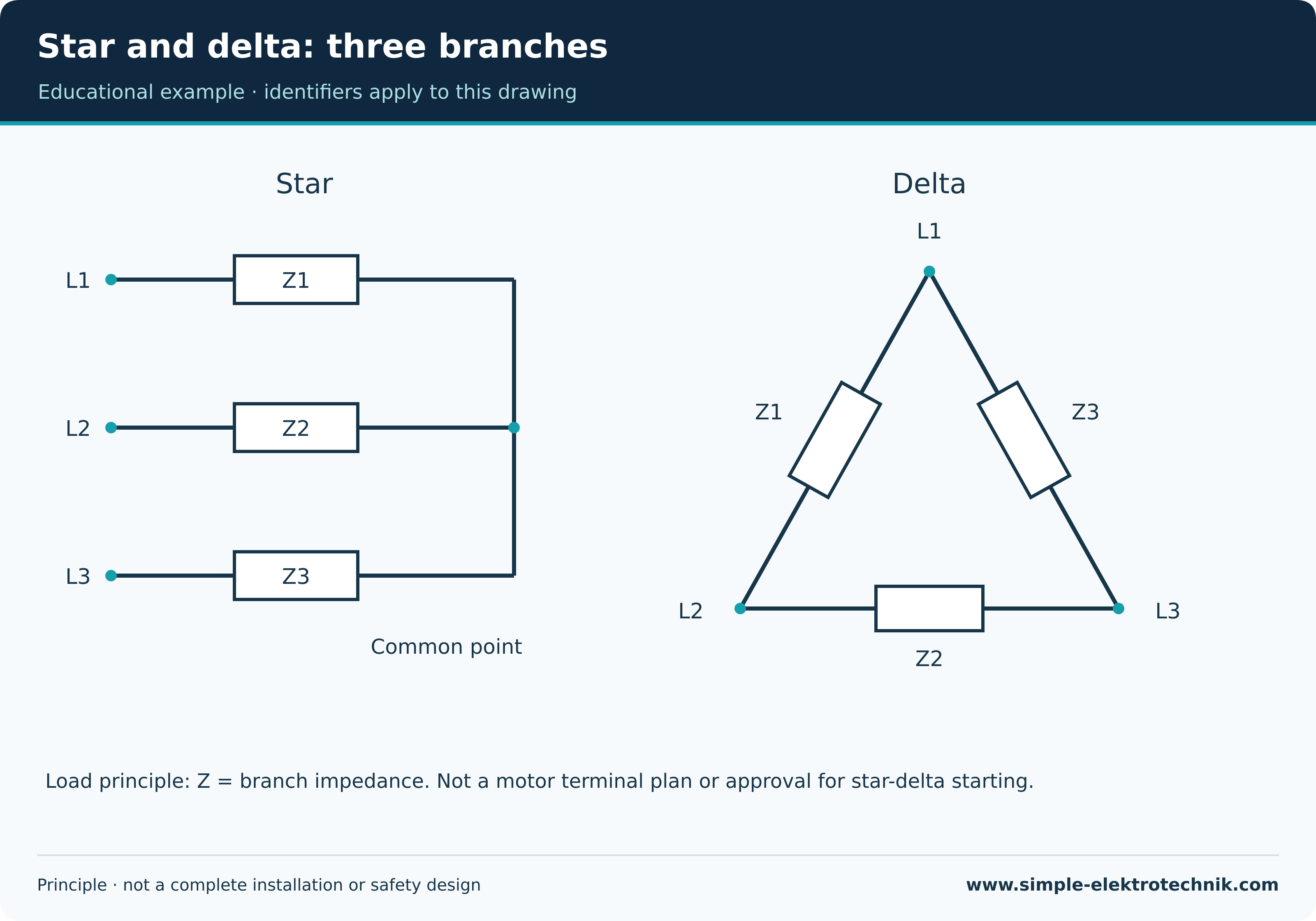
Star and delta connectionStar and delta are different ways of connecting three load branches in a multiphase system.
In star, branches meet at a common point. In delta, they connect between line conductors. Their branch voltages therefore differ at the same line-to-line voltage.
Example
In an ideal balanced case, each star branch receives ULL/√3, whereas each delta branch receives ULL.
Important distinction
The terms do not specify an arbitrary motor terminal plan. Nameplate and manufacturer documents determine permitted connections.
Star-delta startingStar-delta starting starts a suitable motor in star before transferring to its intended delta running connection.
Motor rating, accessible winding ends, load torque and transfer sequence need suitability. Compared with the corresponding direct start, both starting current and available starting torque are reduced.
Example
A suitable starter interlocks against impermissible simultaneous star and delta connection.
Important distinction
It is not suitable for every six-terminal motor. Fixed transfer times or universal overload settings cannot be inferred from the term.
Starting currentStarting current describes current during machine startup. It may differ substantially from normal running current.
Starting method, motor and connected load influence magnitude and duration. Electronic-equipment inrush may arise from different processes and requires separate consideration.
Example
A starter needs to account for load requirements, permitted supply stress and protective coordination.
Important distinction
Brief high current is not automatically a short circuit. Conversely, an excessively long or unsuitable start must not simply be accepted as normal.
Strain reliefStrain relief is intended to keep designated mechanical forces away from the electrical connection.
Its construction must match cable, sheath, diameter and equipment. A sealing function and a mechanical retention function need to be distinguished.
Example
For a suitable flexible supply cord, designated sheath clamping can prevent tension acting directly on conductor terminals.
Important distinction
A tightly fitting cable does not automatically have correct strain relief. Knots and improvised clamps are not general solutions.
Strapping wires in two-way switchingStrapping wires connect the relevant changeover contacts of a two-way lighting circuit. With intermediate switching, they also pass through suitable intermediate switches.
Their association follows from the diagram, device markings and actual routing. A simple two-location circuit has two such interconnecting paths.
Example
Switch positions determine whether the selected path to the lamp is complete.
Important distinction
These wires are not inductively coupled transformer windings. Translating the German term as coupled conductors is misleading here.
Stripping lengthStripping length is the length of core insulation removed at a conductor end for the intended connection.
It depends on the actual terminal and manufacturer instructions. Conducting material and remaining insulation must not be damaged during preparation.
Example
A marked connector may show its required stripping length directly on its housing.
Important distinction
A commonly used millimetre value does not apply to every terminal. Too little or too much exposed conductor can cause different connection problems.
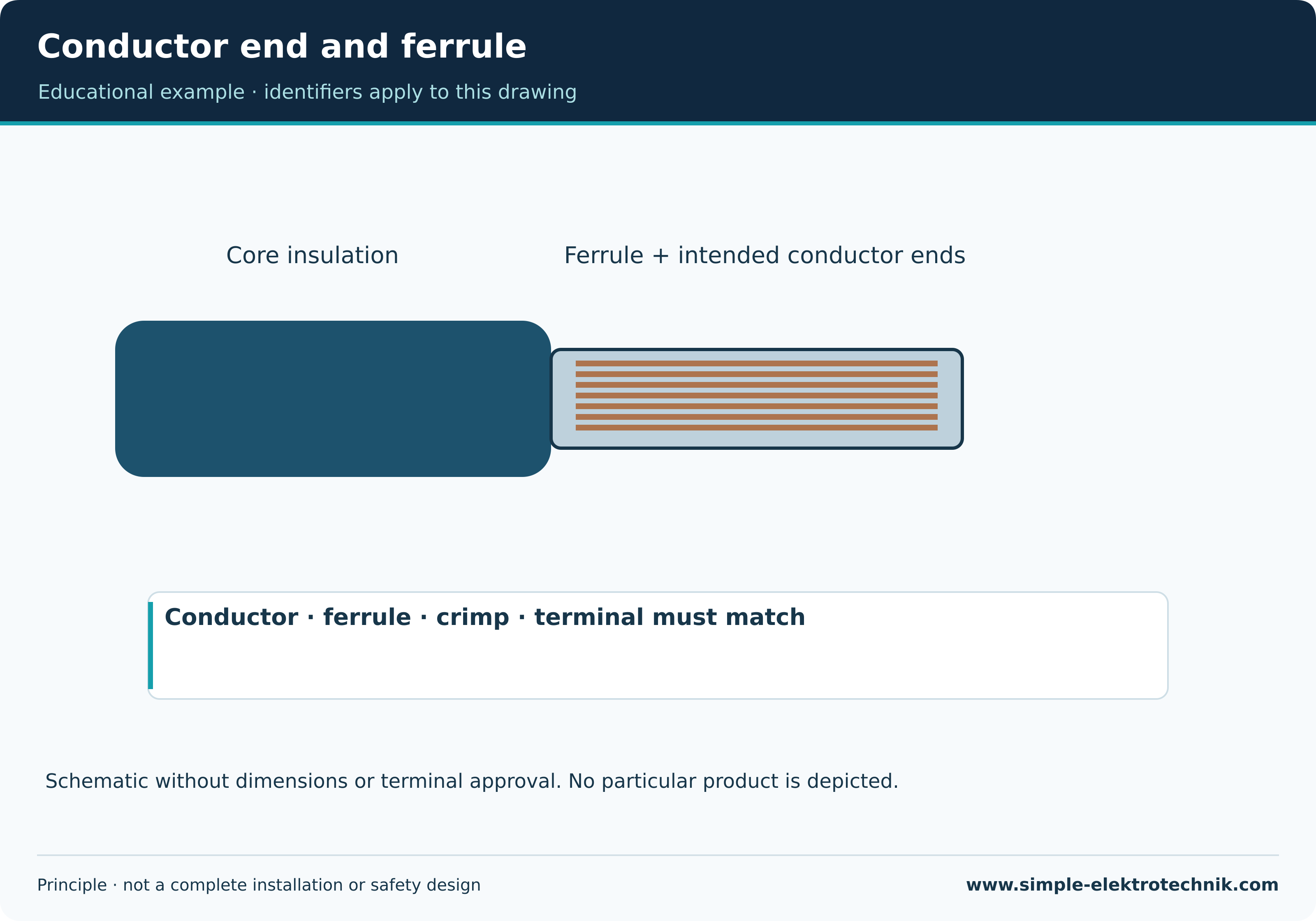
Surge protectionSurge protection limits specified transient overvoltages within its designed protective concept.
SPD selection, coordination, location, connection routing and earthing or bonding work together. Data and power connections may require different measures.
Example
A coordinated concept may include several protective stages within an installation.
Important distinction
A power-strip marking is not complete building lightning protection. An SPD replaces neither overcurrent nor residual-current protection.
SwitchA switch makes, breaks or transfers an electrical connection.
Construction and actuation determine available contacts and whether their state is retained. Switching capacity and suitable load type inform selection.
Example
A maintained light switch retains its position after release.
Important distinction
An ordinary switch is not automatically a suitable isolating device. Its visible position also does not prove a dead work area.
Switching stageSwitching stage is a context-dependent term for a stage converting or amplifying a signal into intended switching states.
Threshold, drive and load side may have separate properties. The specific product term needs interpretation from circuit and documentation.
Example
A sensor output may operate an intended load through a suitable following stage.
Important distinction
Do not equate it with arbitrary linear gain or a safety permissive. Similar status indications do not establish identical electrical output types.
T
Terminal identificationTerminal markings identify intended functions or connections on equipment or a connector system.
The relevant viewing direction and actual product must be known. Contact-side and rear connection views may appear as mirror images.
Example
A drawing of a socket connector’s contact face is not used unchecked as a plug wiring view.
Important distinction
A colour sequence or expected physical position does not replace markings. Machine rotation also cannot be established from a connector picture alone.
Test currentTest current is a current generated or used by an intended test method to examine a particular property.
Its type, magnitude, waveform and duration form part of the method. A continuity-test current serves a different purpose from an RCD test current.
Example
A suitable instrument can generate a defined residual current to test an RCD.
Important distinction
Test current is not automatically load current or rated current. Values from different procedures cannot be compared without context.
ThermocoupleA thermocouple uses thermoelectric voltage from a suitable combination of different conductor materials to determine temperature.
Measured voltage depends on temperature conditions at the measurement and reference junctions. Material pair, connecting leads and reference-junction treatment need to match the system.
Example
A suitable instrument considers required cold-junction compensation as well as measured voltage.
Important distinction
A thermocouple is not a temperature-dependent resistor such as a Pt100. Voltage alone does not provide a reliable temperature without the appropriate reference.
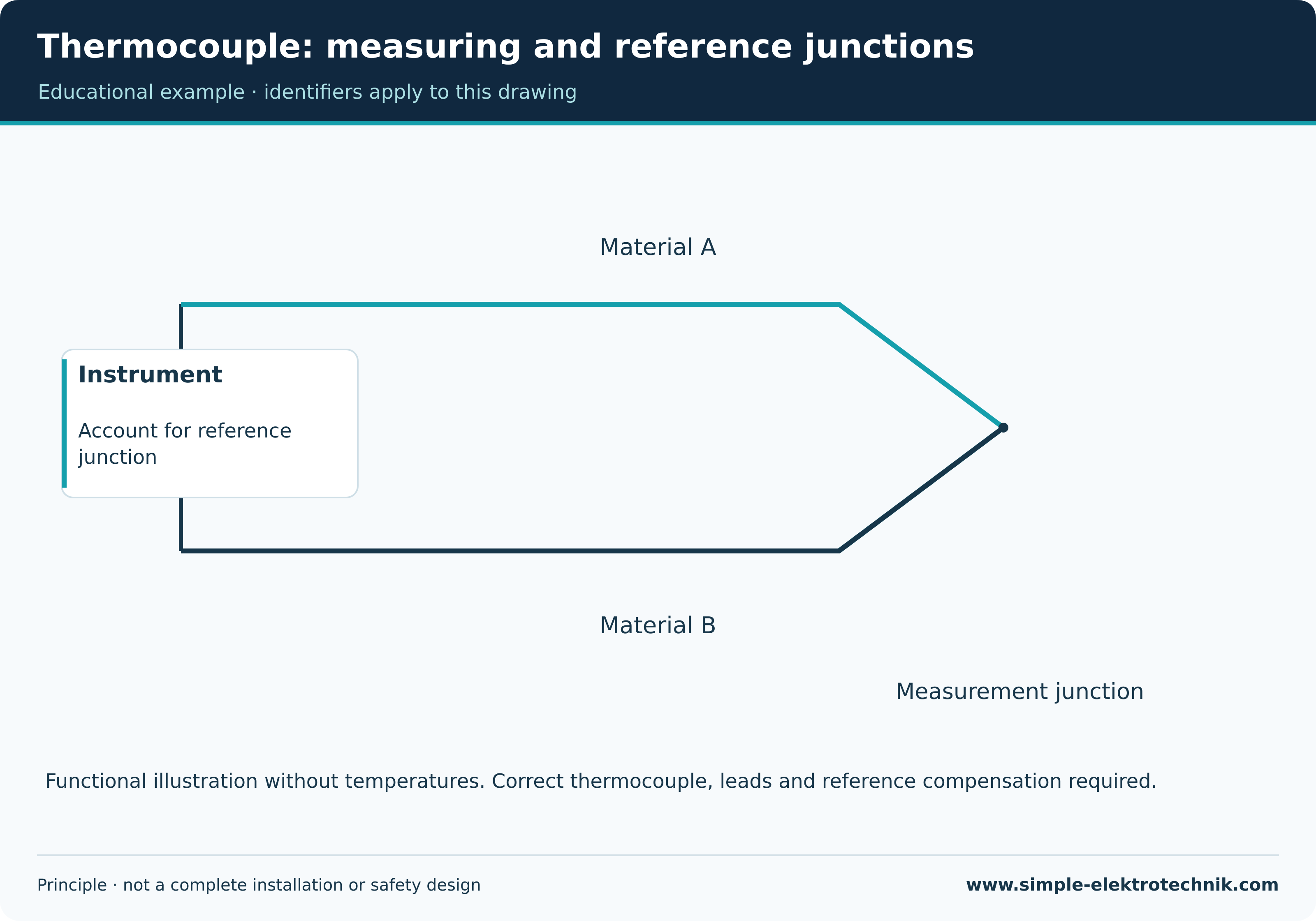
ThreadThread is an IP-based wireless networking protocol for suitable connected devices and uses a mesh structure.
Network transport and application protocol are different. Suitable device roles and a border router support connection to adjacent IP networks.
Example
A Matter device may use Thread as transport while Matter describes the device functions above it.
Important distinction
Not every Thread device is automatically a Matter device. Nor does every battery-powered participant act as a forwarding router.
Thread Border RouterA Thread Border Router connects a Thread network with adjacent IP networks such as a home network.
The role concerns network transport. A device may additionally contain a Matter controller or other functions, but those roles are not identical.
Example
A suitable Thread device may communicate through the border router with compatible participants outside its radio network.
Important distinction
Border router is not a synonym for Matter bridge. Each logo on a device needs consideration of its actual function.
Three-phase ACA balanced three-phase system has three sinusoidal AC quantities at the same frequency, displaced by 120° from each other.
Line-to-line voltage and voltage to the neutral point are different. An ideal balanced star system has the √3 voltage relationship.
Example
In the stated 230/400 V example, about 230 V is present line to N and about 400 V line to line.
Important distinction
Not every load needs N, and not every motor accepts every connection on that supply. Actual equipment ratings matter.
ThyristorA thyristor is a controllable semiconductor device. A common SCR can be triggered and remains conducting under the relevant current conditions.
Returning to blocking requires the conditions specified by the device and circuit. A normal SCR gate is not simply an arbitrary on-off input.
Example
Thyristor-family devices are used in suitable power controllers and controlled rectifiers.
Important distinction
A thyristor is not a general current limiter. SCRs, triacs and other forms must not be treated as identical without considering their differences.
TorqueTorque describes the turning effect of a force about an axis. Its unit is the newton metre.
For rotation, mechanical power, torque and angular speed are related by P = M · ω. A load’s starting requirement may differ greatly from continuous operation.
Example
A drive must provide the required load torque during the intended acceleration.
Important distinction
High electrical input power alone does not prove suitable starting. Gearing, speed range and load behaviour form part of selection.
Touch voltageTouch voltage is the voltage between conductive parts that a person or animal can touch simultaneously under the considered conditions.
Actual exposure and risk also depend on contact, body path, environment and duration. One voltage value therefore does not establish universally safe contact.
Example
An insulation fault may create a hazardous potential difference between an accessible enclosure and another part.
Important distinction
An earth symbol or low reading at unsuitable points does not give general reassurance. Required protection needs professional verification.
TransformerA transformer transfers electrical energy through magnetic coupling between designated windings or winding sections.
Ratio, frequency, loading and construction determine intended operation. An autotransformer has common winding sections and differs from a separate-winding design.
Example
A suitable winding arrangement may transform AC voltage to another rating.
Important distinction
Transformer does not automatically mean protective separation or safe extra-low voltage. An ordinary mains transformer is not an arbitrary DC converter either.
TransistorA transistor is a semiconductor device used to control electrical signals or currents.
Bipolar and field-effect transistors differ in construction and drive. At suitable operating points, they can amplify or operate as switches.
Example
A suitable transistor stage may use a small control signal to switch an intended load.
Important distinction
The name alone does not specify permitted voltage or dissipation. Similar-looking packages can have different pin arrangements.
Two-gang one-way switchA German Serienschalter has two independently operated switching functions for intended circuits or load branches.
The actual internal connection and terminal arrangement follow from the device. Two rockers can for example control two lighting groups separately.
Example
A luminaire with two separately supplied groups may be controlled according to its appropriate circuit.
Important distinction
This device name does not establish a series connection of lamps. A literal English translation as series switch is often misleading.
V
Variable-frequency driveA variable-frequency drive produces a controlled electrical output supply for its intended drive, with variable frequency and other regulated properties.
It can influence motor speed and operation. Motor suitability, EMC, protective measures, cable routing and manufacturer requirements must be considered.
Example
A suitable drive can adjust speed to the process instead of merely switching fixed steps.
Important distinction
Output waveforms are not simply unchanged mains sine waves. Stored energy may remain relevant after switching off.
Verifying absence of voltageVerifying absence of voltage checks the actual electrical condition at the intended point of work using a suitable procedure.
Instrument, test points and instrument function checks must suit the task. Verification belongs within the complete safe working procedure and covers all relevant conductors.
Example
An unlit lamp or app status is not accepted as proof of absence of voltage.
Important distinction
Non-contact indicators or single-pole indications are not general substitutes for the required procedure. Absence-of-voltage verification is also distinct from complete initial verification.
VoltageVoltage is the electrical potential difference between two points. Its unit is the volt, and U is commonly used as the quantity symbol.
A voltage always refers to two points. A battery can have voltage across its terminals even when no load is connected and no steady load current flows.
Example
Across an idealised 120 Ω resistor, 12 V DC produces a current of 0.1 A.
Important distinction
Voltage and current are different quantities. An off load or an interrupted circuit does not prove absence of voltage.
Voltage measurementVoltage measurement determines the electrical potential difference between defined points.
Mode, range, input properties and safe instrument selection must suit the task. A reading always relates to the actual measurement points.
Example
In a simple extra-low-voltage teaching diagram, voltage is measured across the considered resistor.
Important distinction
An arbitrary measurement is not complete verification of absence of voltage. A wrongly selected current input connected across a source can create a dangerous fault.
W
Wi-FiA wireless LAN is a local wireless network. Wi-Fi is commonly used in connection with compatible wireless networking products.
Coverage, supported bands, security and configuration affect operation. A connected device may communicate locally or additionally require an internet service.
Example
A Wi-Fi socket may be connected to the home network while its app function depends on a particular platform.
Important distinction
Wi-Fi connection and internet access are different. A strong radio signal also does not prove working cloud connectivity.
Wire-end ferruleA wire-end ferrule gathers the fine strands of a suitable conductor at its end.
Ferrule, conductor area, length, crimp tool and terminal must match. Whether a ferrule is required, permitted or unsuitable follows from the connection design and product instructions.
Example
A terminal may accept flexible conductors only in particular prepared conditions.
Important distinction
A ferrule does not make every terminal suitable for every conductor. Tinning is not a general alternative to the specified conductor-end treatment.
Z
ZigbeeZigbee is a family of standardised communication solutions for compatible connected devices, often using wireless mesh networking.
Device roles, profiles and actual supported functions determine interaction. A coordinator or suitable system connection may be needed for the intended use.
Example
A compatible sensor may report events to a suitable hub that initiates a lighting action.
Important distinction
Zigbee and Thread are different communication systems even if some radio foundations are similar. A radio logo alone does not guarantee complete feature compatibility.
No matching term. Try another spelling or select all topics.